What you'll learn
Key ideas from Do Pause
These ideas compress the book's argument without treating the author's view as settled fact. Use them as an orientation before reading the full work or listening in Wiseley.
A pause is an active opening that shifts attention and creates choices within ongoing activity.
Creative insight can depend on incubation: a gap gives fragile ideas time to develop indirectly.
Brief bodily cues can interrupt habitual reactions and redirect attention during ordinary routines.
Longer pauses rarely arise without protection because constant demands make time away easy to postpone.
Choosing a pause begins with identifying the need and what it should enable, then considering a practice or anchor that fits.
Personal pace layers connect daily pauses with weekly, monthly, yearly, or longer rhythms.
Pauses can enrich time, yet excessive or badly timed breaks can stall progress.
Inside Do Pause
Read the first chapter in full here. The other 6 continue in the Wiseley app.
Chapter 1 of 7 · 6 min · Audio & text
Reclaiming the Meaning of Pause
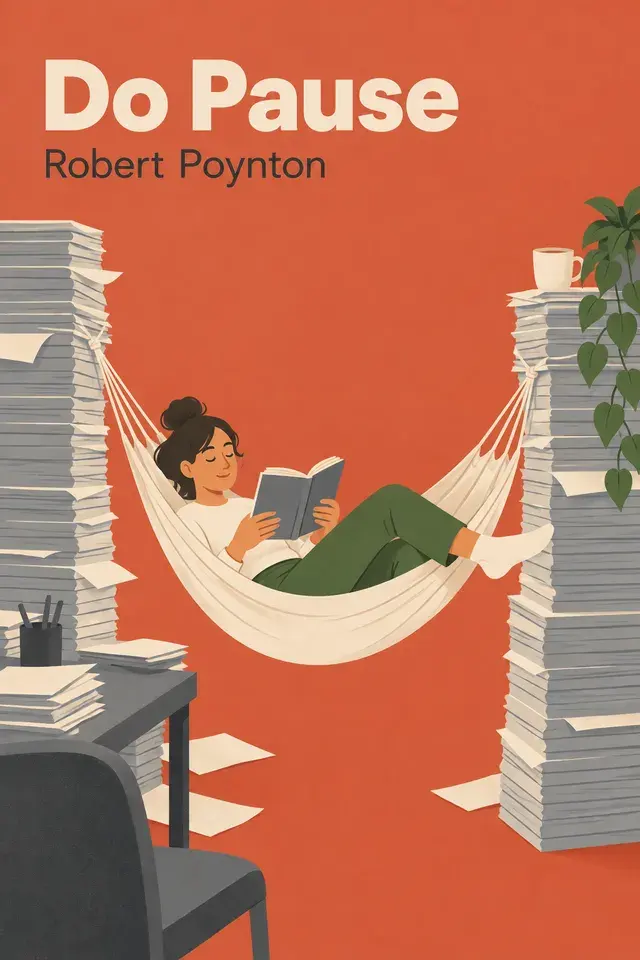
Do Pause, by Robert Poynton.
A pause can look like a halt: work stops, movement slows, silence arrives. But Robert Poynton is interested in what the interval makes possible. He describes a pause as an opening in the flow of activity, one that shifts attention and gives a person room to choose what happens next. Its value does not depend on reaching a certain speed or lasting a prescribed number of minutes. A pause may affect what follows, and sometimes change how we understand what came before. It is usually conscious or chosen; an interruption imposed from outside is not necessarily a pause in this sense.
Chris Riley’s recurring reading weekend shows what an extended pause can offer. Riley makes room to read, but the weekend’s value reaches beyond the books. It affects him physically, mentally, and emotionally. He notices himself, reconnects with other people, reconsiders what matters, and encounters ideas and perspectives that can carry into ordinary life. At first, stopping can feel uneasy: he feels anxious because he is not working. That discomfort helps explain why an open interval can be hard to enter, even when it is wanted.
The weekend also accumulates across the year. Its annual return gives the year a shape: Riley can anticipate it beforehand and gather or synthesize what he has read afterward. The pause can steady him during busy stretches before it begins, then continue to nourish him once it is over. It is therefore more than a break with a sharp boundary. The time around it matters too. Its value comes from how it changes his relation to the rest of the year.
This example does not establish a required length or a formula. A pause might last seconds, hours, days, or much longer. It may be planned, like Riley’s weekend, or arise spontaneously. Those forms have no universal scale or purpose. What they share is a change in attention and in the way a person relates to activity. Context, timing, what gets interrupted, and what becomes possible afterward all matter. The pause is defined by its role, not by its place on a clock.
That distinction separates pause from rest and slowness. Rest may be one reason to stop, while slowness describes a pace. Neither, by itself, tells us whether attention has shifted or a new choice has opened. Slower is not always better, and trying to make slowness the answer to every problem can add pressure when life does not cooperate. A pause can belong within fast activity as well as slow activity. It is less a command to reduce speed than a way to change the rhythm between actions.
Nor does pausing mean becoming inactive or emptying the mind. The body continues to breathe and make small adjustments. Thoughts and feelings continue, too. Poynton’s point is that a pause changes the quality of attention rather than erasing experience. What had been overlooked can become noticeable. Even apparent stillness contains activity; the interval offers a different relationship to it.
The difficulty is that people are often trained to fill every gap. A spare moment can quickly become a call, an email, or another task. This habit treats unoccupied time as wasted time and leaves less room for noticing, appreciation, or reflection. Stopping can also feel unsettling when work has become a way to avoid the questions that might surface in its absence. The pressure is not only personal. Expectations at work and in society can make constant availability seem normal and busyness seem valuable.
Technology reinforces that pressure. Machines are designed for repetitive speed, and people may begin to adapt themselves to that tempo. They can be judged by how quickly they respond rather than by the quality of their response. Alongside this, urban and work cultures often celebrate being always on. Poynton does not argue that people can simply reverse technological acceleration or that a slower life is always available. His concern is that machine speed and social expectations can narrow the space in which people notice what they need.
That narrowing has personal, relational, and moral costs. Relentless activity can lead to burnout, but the loss may also be less visible: a person can become absorbed in a list of tasks and lose contact with other possibilities. Time with children, for instance, can become a chain of logistics and achievements, leaving less room simply to be with them or for them to enjoy childhood. And efficient action is not automatically good action. Without a pause to examine broader implications, people can keep moving toward outcomes that deserve reconsideration.
Pause also challenges the idea that work and life are opposing sides in a contest for time. Meaningful work can contain energy and purpose; life outside work also involves effort. A pause can belong within both, and at any pace. This makes it different from a fixed policy of working less or moving more slowly. The question is what the opening allows a person to notice, reconsider, or reconnect with.
Riley’s reading weekend gives that question an annual scale. Its effects are not guaranteed by the calendar, nor do they depend on a universal duration. They arise through what the interval makes room for and what he can carry into the time around it. A pause is not valuable because it stops life for a set amount of time. It matters because it can change how life is attended to, and what choices become visible within it.
Chapter 2 of 7 · 5 min · Audio & textIn the app
Gaps for Ideas and Conversation
Creative work often depends on a gap in which nothing obvious seems to be happening. Poynton describes pauses, delays, and fallow periods as part of how ideas develop.
Chapter 3 of 7 · 7 min · Audio & textIn the app
Small Pauses in Everyday Life
Pausing does not have to begin with a special setting or a long stretch of free time. Poynton offers small practices that can fit into ordinary days: a breath, a walk, a moment at a doorway, or a few lines on paper.
Chapter 4 of 7 · 6 min · Audio & textIn the app
Designing Longer Pauses
A brief pause can fit inside an ordinary routine. A longer one faces a different obstacle: ordinary demands quickly fill any space left unclaimed.
Chapter 5 of 7 · 7 min · Audio & textIn the app
Places, Rituals, and Choosing a Pause
A pause is easier to enter when it has a place in life. That place might be a landscape, a temporary community, a weekly custom, or a longer break that people recognize as legitimate.
Chapter 6 of 7 · 5 min · Audio & textIn the app
Mapping a Personal Rhythm
The earlier chapters explore practices through habits, design, and culture, but these are not steps in a sequence. You may already have an idea of what you want to work on.
Chapter 7 of 7 · 6 min · Audio & textIn the app
The Payoff and Limits of Pausing
Do Pause asks what follows if time is treated as something to spend efficiently, and doing more is assumed to be better. The efficiency mindset can make activity look like the measure of a good use of time.
Chapter 1 of 7 · 6 min · Audio & text: Reclaiming the Meaning of Pause
Wiseley supports reading and listening to summaries in the app.
Continue in WiseleyWhat Do Pause is about
Do Pause asks how brief interruptions and longer breaks can change attention and experience of time. It distinguishes pausing from simple rest or slowness, then explores its roles in creativity, conversation, judgment, daily habits, retreats, and shared rituals. The book offers adaptable ways to make pauses part of work and life without turning them into another rigid target.
About Robert Poynton

Robert Poynton is the author of “Do Pause”. The book explores how brief interruptions and longer breaks can change attention and the experience of time.
Explore more books by Robert Poynton