What you'll learn
Key ideas from Designing Your Life
These ideas compress the book's argument without treating the author's view as settled fact. Use them as an orientation before reading the full work or listening in Wiseley.
For most people, passion develops through experience, enjoyment, and growing mastery rather than prior certainty.
Coherence connects identity, beliefs, and actions while allowing conscious trade-offs among competing values.
The Good Time Journal pairs activity logs and separate engagement and energy ratings with weekly reflection over at least three weeks.
Reframing separates the desired outcome from the first route proposed for reaching it.
Three distinct five-year sketches loosen the pressure to identify one perfect future.
Prototypes turn imagined futures into questions that can be explored through real-world encounters.
Commitment directs attention into a chosen path, while new information can still justify a correction.
A useful growth lesson identifies what went wrong and a specific change to try next time.
Inside Designing Your Life
Read the first chapter in full here. The other 11 continue in the Wiseley app.
Chapter 1 of 12 · 5 min · Audio & text
Life as a Design Practice
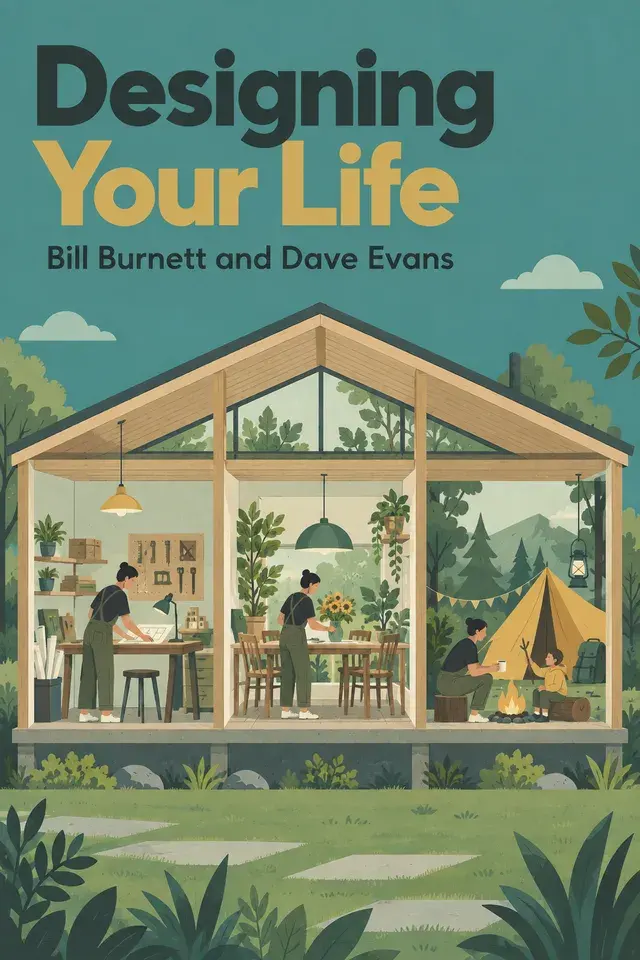
Designing Your Life, by Bill Burnett and Dave Evans.
Many people approach a life decision as if the task were to discover the one answer already waiting for them: the right major, occupation, or calling. Bill Burnett and Dave Evans propose a different starting point. A person may know the kind of outcome that matters—a meaningful, joyful life—without knowing the route that could produce it. That uncertainty is not proof of failure. It is the kind of uncertainty design addresses.
Some problems have a defined goal and a way to test whether a solution works. Life direction is less settled. There may be no established model to copy and no single measure that identifies the best answer. More than one path can lead to a life that feels worthwhile. So the task is not to wait until the perfect route becomes clear. It is to form possibilities, try them, and use what happens to shape what comes next.
The authors challenge the belief that a college major determines a person’s career. Ellen chose geology because she liked rocks, but the work involved in her major and the careers it suggested did not fit her. After graduation, she felt unsure about where to go. Her experience shows how an early interest or credential can be mistaken for a complete plan. A major may offer a starting point, but it cannot guarantee that its daily work will suit the person who chose it.
Conventional success does not guarantee fulfillment either. Janine has an education, a marriage, and an influential legal career, yet she feels deeply unhappy. Donald has a stable career, a paid-down home, educated children, and retirement savings. Even with those signs of responsibility and security, he wonders why he continues doing his work. Their stories do not make achievement or stability meaningless. They show that external markers cannot answer on their own whether someone’s life feels right to live.
The same question applies to the advice to find a passion first. The authors cite William Damon’s research that one in five people ages twelve to twenty-six had a clear vision of where they wanted to go, what they wanted to accomplish, and why. They also say their own experience suggests that about eighty percent of people, across ages, do not know their passion. These are different kinds of claims: one is attributed to research, while the other is the authors’ experience-based estimate. Neither means that deep, singular devotion never occurs. Their point is that it is a poor universal requirement for choosing a life.
For most people, the authors argue, passion is more likely to grow after they try something, find that they like it, and develop mastery. Interest and skill tests, or simply asking someone what they feel passionate about, may not yield a clear, actionable answer. Trying possible directions gives a person experience to respond to. Enjoyment and growing competence can then deepen interest. A person does not need to identify one passion in advance to begin designing a life they love.
Burnett and Evans describe five mindsets that support this work. Curiosity makes ordinary situations worth exploring and helps a person notice possibilities that routine might hide. The authors connect this openness with seeming luckier, because opportunities become easier to recognize. A bias to action means moving beyond extended speculation and testing a possibility. Reframing means examining whether the problem has been posed too narrowly or rests on an assumption that should be questioned. A different framing can make different routes visible.
Awareness of process prepares a person for design to be untidy. Ideas may be discarded, initial plans may need to be released, and surprises or mistakes may change what seems worth pursuing. Those changes are part of learning, not evidence that the effort has failed. The authors also call design radical collaboration. They treat it as a team activity: people with different experiences and backgrounds can build empathy and develop possibilities that one person might not reach alone.
The authors report that their Stanford course grew from work with design students into a popular elective and was later taught to people in varied settings. They also cite doctoral research reporting that participants became better able to imagine and pursue desired careers, held fewer dysfunctional beliefs, and generated more life-design ideas. This is the authors’ account of evidence for the course, not a promise of identical results for everyone. They emphasize that tools cannot produce personal answers automatically. The participant has to do the work and learn from it.
The governing idea is to treat life as an evolving experience rather than a fixed object with one final answer. A good direction can become clearer through inquiry, action, reflection, and revision. The five mindsets keep that process moving when certainty is unavailable. Later exercises give this broad design practice more concrete forms, but its starting point is simple: build forward from what matters, and let experience help reveal the way.
Chapter 2 of 12 · 5 min · Audio & textIn the app
Start with Your Actual Life
Before deciding what a life should become, start with the life that is here. The authors call this the “You Are Here” moment: describe your current conditions and identify a problem you might be able to change.
Chapter 3 of 12 · 4 min · Audio & textIn the app
Build a Personal Compass
A dashboard describes how parts of life are going now. A personal compass adds a different kind of information: what matters to you and how you want your choices to relate to it.
Chapter 4 of 12 · 7 min · Audio & textIn the app
Read Your Engagement and Energy
When you do not yet know where you are going, ordinary days can offer clues about where to move next. The authors call this wayfinding: paying attention to what happens as you go, instead of expecting a complete map in advance.
Chapter 5 of 12 · 5 min · Audio & textIn the app
Reframe Before You Solve
After noticing which parts of life engage or energize us, the next move is to generate directions. A common obstacle is treating the first solution that comes to mind as if it were the goal itself.
Chapter 6 of 12 · 6 min · Audio & textIn the app
Imagine Several Possible Lives
When one possible future fills the whole horizon, choosing can feel like a permanent decision. The authors suggest making room for several futures before settling on one.
Chapter 7 of 12 · 8 min · Audio & textIn the app
Test the Future in Practice
An imagined future can feel persuasive while leaving its most important questions unanswered. A person may research a path and picture its rewards, yet still not know what the daily work feels like or how it fits in practice.
Chapter 8 of 12 · 8 min · Audio & textIn the app
Find Work Through People
The familiar job search begins with a listing. You decide whether the job looks perfect, send a résumé and cover letter, then wait.
Chapter 9 of 12 · 7 min · Audio & textIn the app
Choose, Commit, and Move
After exploration has produced possible directions, choosing becomes a different task. The aim is to turn those possibilities into a path you can inhabit.
Chapter 10 of 12 · 6 min · Audio & textIn the app
Turn Failure Into Learning
A failed attempt can hurt, but it does not establish that you are a failed person. Burnett and Evans call this failure immunity: not the ability to avoid setbacks, or an end to grief and disappointment, but a refusal to let failure misinform you about your worth or what remains possible.
Chapter 11 of 12 · 7 min · Audio & textIn the app
Design with a Supportive Community
Life design can look like a private task: decide what you want, work hard, and solve the rest alone. Burnett and Evans challenge that picture.
Chapter 12 of 12 · 6 min · Audio & textIn the app
Keep Designing as You Live
Life design continues as life changes. The dashboard, compass, journal, prototypes, and community are tools to revisit as you check your direction, notice what is working, and decide what to try next.
Chapter 1 of 12 · 5 min · Audio & text: Life as a Design Practice
Wiseley supports reading and listening to summaries in the app.
Continue in WiseleyAbout Bill Burnett & Dave Evans

Bill Burnett
Bill Burnett is a designer, educator, and cofounder of the Stanford Life Design Lab. “Designing Your Life” explores how design thinking can help people build meaningful work and a satisfying life without waiting for one perfect calling.
Explore more books by Bill Burnett
Dave Evans
Dave Evans is an American entrepreneur. “Designing Your Life” explores how design thinking can help people build meaningful work and a satisfying life without waiting for one perfect calling.
Explore more books by Dave Evans