What you'll learn
Key ideas from Crime and Punishment
These ideas compress the book's argument without treating the author's view as settled fact. Use them as an orientation before reading the full work or listening in Wiseley.
Dunya’s proposed marriage and Sonya’s prostitution expose how family need can turn women’s freedom into a claimed social necessity.
The horse dream makes Raskolnikov’s abstract justification collide with compassion, bodily horror, and the concrete reality of violence.
Punishment begins as fever, fractured memory, and bodily weakness before any formal accusation or sentence.
Raskolnikov’s hierarchy grants extraordinary people a conditional, conscience-based permission to cross law for a higher idea, not an unlimited right to act.
Sonya’s care and Lazarus reading recast ruin as faith-shaped endurance, without proving that Raskolnikov has begun to believe.
Svidrigailov’s provisions and witnessed suicide show freedom without repentance ending in controlled self-destruction.
Raskolnikov’s exact confession earns a legal sentence, but punishment does not itself establish remorse or moral conversion.
The unopened Gospel and seven remaining years keep rebirth a future process rather than a completed transformation.
Inside Crime and Punishment
Read the first chapter in full here. The other 8 continue in the Wiseley app.
Chapter 1 of 9 · 6 min · Audio & text
Poverty, Pride, and the Idea
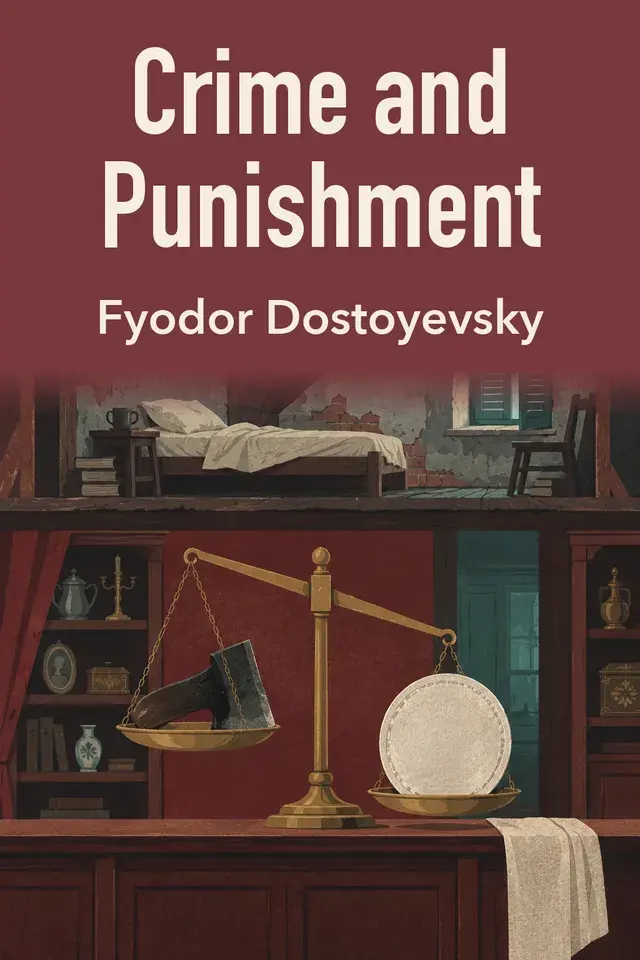
Crime and Punishment, by Fyodor Dostoyevsky.
Poverty is not a single cause in Crime and Punishment. It is the atmosphere in which Raskolnikov’s pride, isolation, family obligations, and dangerous idea reinforce one another. The novel places this pressure in Russia’s reform-era upheaval. Reforms promised change after the Crimean defeat and emancipation of the serfs, while urban life remained marked by unemployment, drunkenness, prostitution, disease, broken families, and abandoned children. Arguments about nihilism, rational egoism, and utilitarianism also asked whether human conduct could be organized by calculation. The novel enters that conflict without reducing the crime to social conditions alone.
Raskolnikov’s own life makes abstraction feel urgent. He lives in a cramped room, owes rent, lacks food, and has withdrawn from people. He has stopped ordinary work, dismissing poorly paid teaching while imagining that he needs complete capital at once. His thoughts move between a bold act and calling it absurd or impossible. Pawning his father’s watch exposes the gap between what he needs and what the world will pay. Poverty, shame, and isolation do not mechanically produce violence. They leave him trying to make a moral problem solvable by thought.
In a tavern, Marmeladov gives this crisis a human voice. He distinguishes poverty from destitution. Poverty may leave a person with noble feelings; destitution destroys dignity and drives a person out of human company. His speech is drunken, ornate, and self-dramatizing, so it is not a neutral report. Yet it contains admissions that make him responsible: he has pawned Katerina’s belongings, lost work through drink, stolen money he brought home, and spent Sonya’s last coins on alcohol. He is culpable and pitiable at once.
His household makes that contradiction visible. Katerina is educated, proud, ill, and working constantly while the children go hungry. Sonya’s honest shirtmaking brings no dependable income, and pressure pushes her into prostitution. When Sonya returns with thirty silver rubles, she places the money before Katerina and hides under a shawl. Katerina kneels, kisses Sonya’s feet, and sleeps beside her. The scene does not make the household just. It shows care surviving inside coercion, while the tavern crowd turns suffering into entertainment.
The letter from Raskolnikov’s mother turns family love into moral pressure. Her small pension, borrowed money, and careful travel plans reveal how little room the family has. Dunya now agrees to marry Luzhin, a financially secure man whose plans may offer housing, work, reunion, and perhaps a route back into Raskolnikov’s education or career. Yet Luzhin’s wish that a wife regard her husband as a benefactor suggests dependence. The family hopes for rescue, but the arrangement remains uncertain.
Raskolnikov interprets Dunya’s decision as self-sacrifice. He believes she is surrendering freedom for her mother and brother, while he becomes the chief beneficiary. He imagines the family inventing moral arguments to call that loss necessary for a good cause. His comparison between Dunya and Sonya is deliberately unsettling. He asks whether a respectable marriage without love, even with contempt, is cleaner than Sonya’s coerced sexual labor. Their situations are not identical, but both can be described as costs imposed on women by family need. The comparison turns suffering into a calculation of whose freedom may be spent.
That calculation reappears when Raskolnikov sees a very young, intoxicated girl followed by a well-dressed man. He suspects she has been deliberately made vulnerable, though the details remain his inference; the policeman only agrees she was probably tricked. Raskolnikov intervenes, recruits the policeman, and pays for a cab. Then he abruptly withdraws support, tells the officer to let the man amuse himself, and resents the money. His compassion is real, but unstable.
He imagines the girl’s future as a chain of exploitation and decline. He mocks the claim that a certain percentage must disappear each year. An abstract phrase can make catastrophe feel inevitable and intellectually comfortable. He even wonders whether Dunya might become part of that discarded percentage. In his mind, the same world that normalizes one woman’s sacrifice can make another’s suffering appear an acceptable remainder.
Afterward, Raskolnikov thinks of visiting Razumikhin. The impulse is unexplained, but the contrast matters. Raskolnikov’s diligent study earns respect, yet poverty, pride, silence, and superiority keep him isolated. Razumikhin is sociable, intelligent, strong, adaptable, and able to survive hardship through practical work. Raskolnikov has avoided him for months, and the text does not yet call them close friends. Still, Razumikhin represents durable human connection rather than one decisive theory.
The pre-crime field is morally crowded. Humiliation can produce resentment or calculation, but it can also provoke a gift, protection, or patient relationship. Raskolnikov can imagine suffering as a ledger because isolation makes people seem interchangeable. The lived examples around him resist that ledger. His idea remains unstable: not yet a completed act, but an attempt to make necessity sound like permission.
Chapter 2 of 9 · 5 min · Audio & textIn the app
The Crime Tests the Theory
The theory becomes a test only when it passes through a body. Raskolnikov has imagined Alyona Ivanovna’s death as an exchange: one harmful life for money that might benefit many others.
Chapter 3 of 9 · 5 min · Audio & textIn the app
Punishment Before Judgment
Punishment begins before the law names it. After the crime, Raskolnikov’s first sentence is a body he can no longer command.
Chapter 4 of 9 · 6 min · Audio & textIn the app
Evidence, Family, and Exposure
As Raskolnikov emerges from illness, the murder acquires a public life. People discuss suspects, objects, witness behavior, and motive, yet no fact arrives with meaning attached.
Chapter 5 of 9 · 7 min · Audio & textIn the app
The Exceptional Man Unravels
Raskolnikov’s theory becomes clearest when Porfiry makes him explain it, and most revealing when fear makes him test it. He divides humanity into ordinary and extraordinary people.
Chapter 6 of 9 · 6 min · Audio & textIn the app
Rival Visions of Freedom
Raskolnikov’s imagined freedom becomes clearer beside the freedoms around him. He wants to stand outside ordinary limits.
Chapter 7 of 9 · 7 min · Audio & textIn the app
Interrogation and Public Ruin
By this stage, truth in Crime and Punishment is no longer merely a hidden fact waiting to be found. It becomes a contest over fear, appearances, evidence, and who can force another person to reveal himself.
Chapter 8 of 9 · 5 min · Audio & textIn the app
The Last Tests of Power
Once Raskolnikov’s secret has moved beyond Sonya’s private knowledge, the final pressure becomes a contest over what guilt means. Porfiry and Svidrigailov possess information that can destroy his remaining freedom, but they use it oppositely.
Chapter 9 of 9 · 6 min · Audio & textIn the app
Punishment and Unfinished Rebirth
After Raskolnikov returns to the police station and names the two women he killed, the novel separates legal closure from moral change. Before surrender, he had walked beside the Neva considering suicide.
Chapter 1 of 9 · 6 min · Audio & text: Poverty, Pride, and the Idea
Wiseley supports reading and listening to summaries in the app.
Continue in WiseleyAbout Fyodor Dostoyevsky
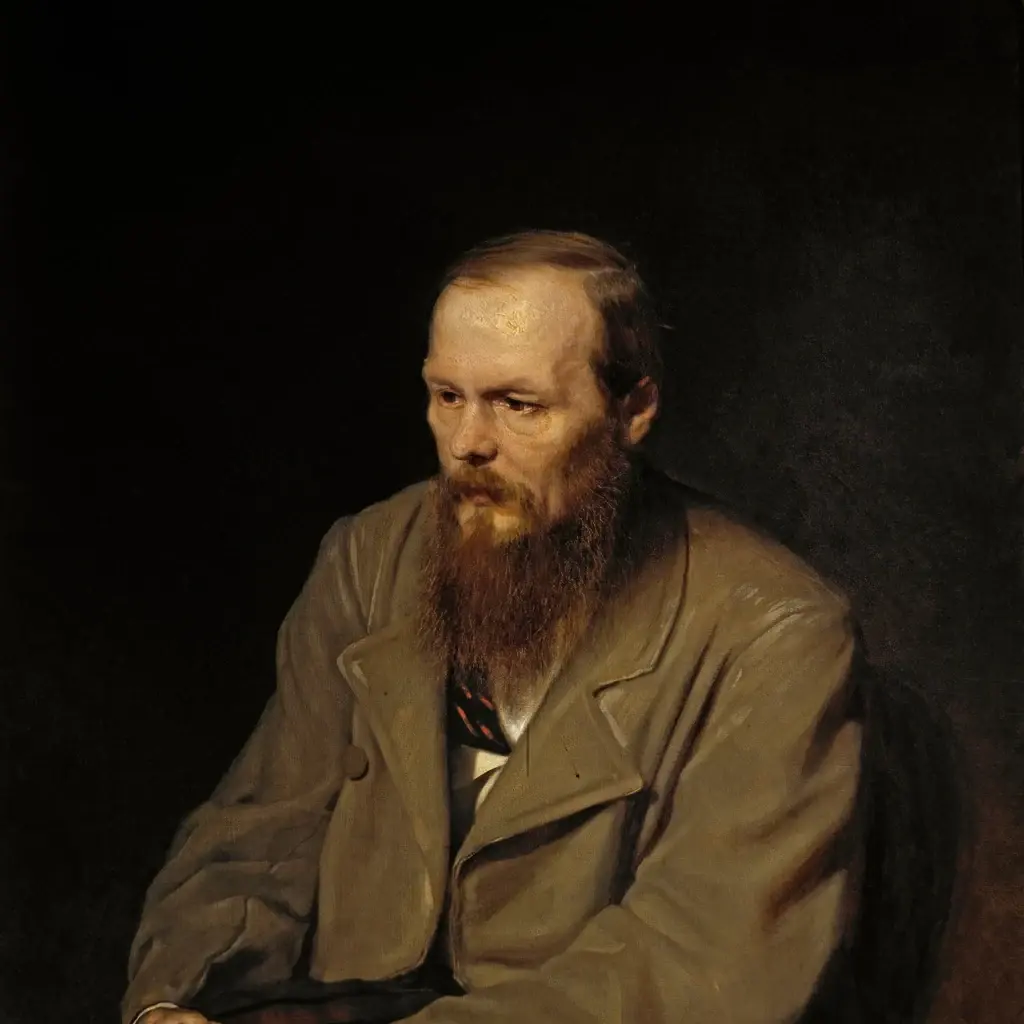
Fyodor Dostoyevsky was a Russian novelist and philosopher. “The Brothers Karamazov” explores what can justify belief, responsibility, and forgiveness through a fractured family and a murder trial.
Explore more books by Fyodor Dostoyevsky