What you'll learn
Key ideas from Creative Acts for Curious People
These ideas compress the book's argument without treating the author's view as settled fact. Use them as an orientation before reading the full work or listening in Wiseley.
Creative ability grows through practice that combines action, reflection, and adaptation under uncertainty.
A chosen sensory focus and repeated close-looking questions can reveal details that habitual attention filters out.
Open-ended interviews build insight by following a person’s details and cues, allowing pauses, and checking interpretations.
A tentative need is an interpretation to check through conversation or a prototype, not a fact about another person’s motives.
Journey and stakeholder maps show how routines, interruptions, relationships, and institutional positions shape an experience and the prospects for change.
A prototype is a learning tool; reactions can reveal whether the need, solution, or test needs reconsideration.
Design ethics stays active because choices can create intended and unintended effects for people with unequal power.
Inside Creative Acts for Curious People
Read the first chapter in full here. The other 11 continue in the Wiseley app.
Chapter 1 of 12 · 4 min · Audio & text
Design Begins With Learning
Creative Acts for Curious People, by Sarah Stein Greenberg.
In this book, design means more than giving an object a finished look. It is a way to shape products, experiences, and systems, and a creative capacity the author believes people can learn. The work starts with attention to the people affected by a design and responsibility for the world it helps shape. It does not require arriving with the right answer already in hand.
The book treats creative practice as learning through action. An assignment is a prompt to try something, notice what happens, and reflect on what that experience reveals. The process can matter as much as the finished result: a flexible way of learning may help someone approach future challenges, even when the original exercise or technique is no longer useful. This is why the book emphasizes experience over mastery of a fixed toolkit.
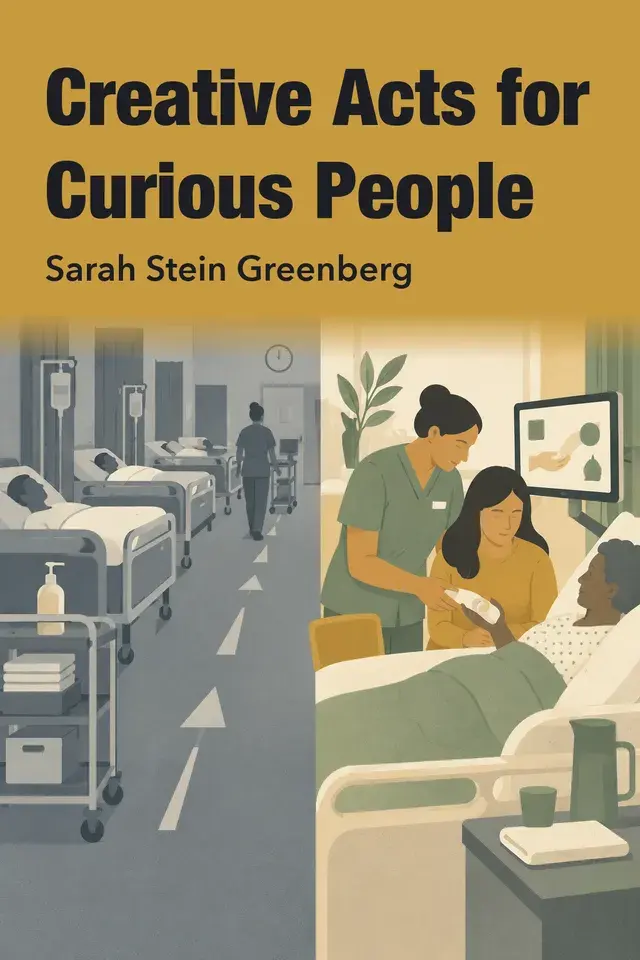
The Noora Health story shows how this stance can change a project. Four graduate students from international policy, engineering, and medicine worked with Narayana Health hospitals in Bangalore. Their broad project concerned patient flow and affordable, high-quality care. The team had a partner and some experience, but its important advantage was that it had not settled on an exact problem before learning more.
As the students listened to families, they heard that hospital care could be expensive, emotionally difficult, and frightening. Those experiences shifted the question. Edith later reflected that a narrow focus on readmissions would not have led to the same solution; what the team heard from families was a need to reduce fear and suffering. Taking that concern seriously did not mean abandoning medical outcomes. In Edith’s account, addressing the human problem helped them move toward the medical one.
The resulting service trained existing hospital staff, usually nurses, with interactive videos and printed materials. Nurses then taught family members practical care skills in hospital wards, around visiting hours. The project’s direction grew from seeing families’ experiences as evidence about what mattered. A patient-flow question had opened onto a need to support family caregivers, who could be included in care rather than treated only as visitors.
The story does not present creative work as a smooth path from insight to success. The team faced uncertainty and tension, and its supportive collaboration was not free of conflict. More broadly, open-ended projects can make people feel like beginners, even when they bring relevant skills. The author’s point is that people can practice how they respond: act while some things remain unknown, pay attention to what follows, and adapt their understanding as they learn.
That practice also involves other people. The book’s account of design brings human concerns into technical work and invites people across disciplines and hierarchies to contribute. This can create productive questions, but it does not guarantee agreement or make collaboration effortless. Noora’s story gives a concrete reason to keep listening: people living with a situation may describe burdens that a project’s first framing leaves out.
The assignments are meant to support this kind of learning, not prescribe one required route. They loosely follow the arc of a course, but readers can choose exercises for the skills they want to develop, then remix, skip, pause, or revisit them. The book ranges across aims such as noticing, collaborating, making sense of ideas, and reflecting on learning. Its invitation is to practice in ways that fit the challenge, rather than complete every exercise in order.
The introduction also leaves large questions open. How can people sustain collaboration without gathering physically? How can design contribute to confronting systemic racism when its toolkit is insufficient? How should people work amid polarization and respond to environmental crisis? The book presents no recipe that resolves these challenges. It offers a way to prepare: keep learning, remain open to what people’s experiences reveal, and be ready to change the problem you thought you were solving.
Chapter 2 of 12 · 7 min · Audio & textIn the app
Observe Before You Decide
People take in far more than they consciously notice. The mind filters information to keep the world from becoming overwhelming, but that filtering can hide details that matter.
Chapter 3 of 12 · 8 min · Audio & textIn the app
Conversations That Build Insight
Conversation becomes a source of insight when its structure builds trust and lets another person’s meaning emerge. The interviewer brings a topic, but the conversation can reveal connections neither person anticipated.
Chapter 4 of 12 · 7 min · Audio & textIn the app
Learn Through Uncertainty
Learning is often described as collecting knowledge: What facts or procedures did you acquire? That matters, but it leaves out another question: How did you learn?
Chapter 5 of 12 · 9 min · Audio & textIn the app
Reframe Needs and Generate Possibilities
A person’s first description of a problem often includes a proposed solution. That answer is useful, but it can also narrow the work too soon.
Chapter 6 of 12 · 11 min · Audio & textIn the app
Widen the Circle of Attention
Once you have heard one person’s account, a wider question follows: what else shapes that experience? Routines, rules, coworkers, institutions, and other people can all change what happens.
Chapter 7 of 12 · 5 min · Audio & textIn the app
Make Learning Visible
At the d.school, people often ask, “How did that feel?” after a challenging assignment.
Chapter 8 of 12 · 10 min · Audio & textIn the app
Prototype, Test, and Revise
A promising idea is not yet a useful solution. It becomes more useful when people can encounter it, respond to it, and help reveal what should change.
Chapter 9 of 12 · 5 min · Audio & textIn the app
Work Through Creative Struggle
Creative work can include a stretch when the flaws in an idea become easier to see than its promise. Nicole Kahn calls this the “trough of despair.”
Chapter 10 of 12 · 7 min · Audio & textIn the app
Anticipate Consequences and Ethics
A design choice can change people’s experiences in ways its makers intend and in ways they do not. It can open possibilities for some people while creating costs or barriers for others.
Chapter 11 of 12 · 7 min · Audio & textIn the app
Design Teams and Your Own Learning
A design practice can shape the way people lead, not only what they make. Creative skill in one person does not automatically produce effective group work.
Chapter 12 of 12 · 12 min · Audio & textIn the app
Scope Projects and Integrate Practice
A design assignment can teach one ability at a time, but design practice depends on fitting abilities together. Greenberg describes a progression from short, supported exercises toward open-ended projects where learners decide whom to serve, what to investigate, and how to proceed.
Chapter 1 of 12 · 4 min · Audio & text: Design Begins With Learning
Wiseley supports reading and listening to summaries in the app.
Continue in WiseleyWhat Creative Acts for Curious People is about
How can people become more creative when problems are uncertain and other people’s needs are unfamiliar? Sarah Stein Greenberg presents design as a learnable practice of observation, conversation, experimentation, reflection, and ethical choice. The book offers adaptable exercises for developing ideas, testing them with people, and considering the systems their work affects.