What you'll learn
Key ideas from Co-Intelligence
These ideas compress the book's argument without treating the author's view as settled fact. Use them as an orientation before reading the full work or listening in Wiseley.
Broad output does not establish humanlike understanding, and models can reproduce errors and biases in their training data.
Small, ordinary experiments reveal an AI system’s task-specific strengths and limits.
Creative prompting expands the options; human judgment selects, combines, and develops the promising ideas.
Good task allocation weighs observed AI strengths, human priorities, checking ability, and the cost of error.
AI can remove tedious duties or expand managerial monitoring; organizational choices shape which outcome workers experience.
Foundational knowledge supports reasoning through unfamiliar problems and evaluating AI output.
AI reflects human culture, goals, biases, and labor, so present choices shape who benefits and who bears the costs.
Inside Co-Intelligence
Read the first chapter in full here. The other 9 continue in the Wiseley app.
Chapter 1 of 10 · 7 min · Audio & text
How Generative AI Became Different
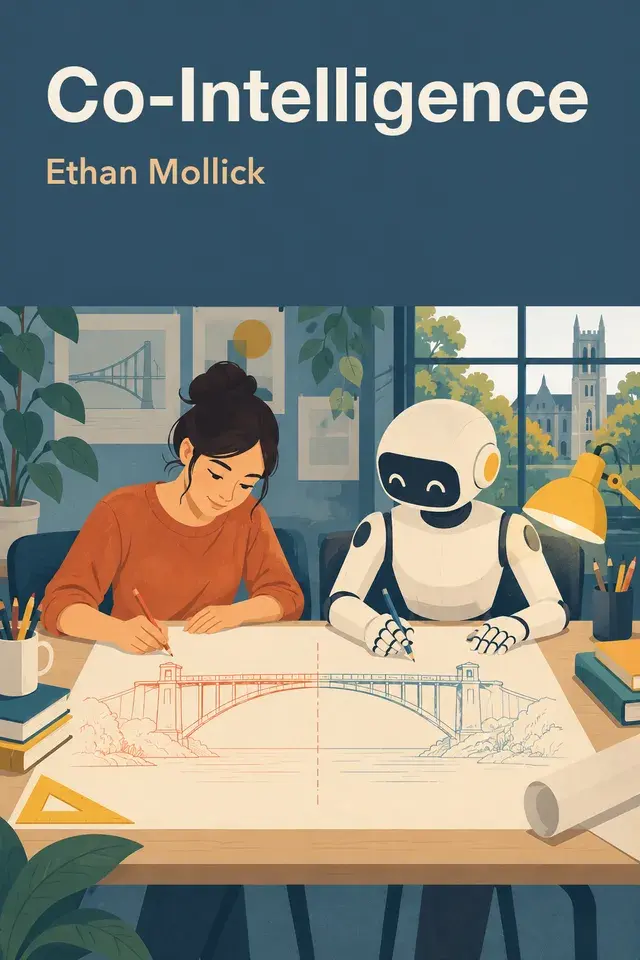
Co-Intelligence, by Ethan Mollick.
Mollick calls the new relationship with AI co-intelligence: a system can take part in work and extend what a person can do without being human or necessarily sentient. An early example makes that practical. In front of his entrepreneurship class, student Kirill Naumov created a working demo for his project: a Harry Potter-inspired moving picture frame that reacted to people walking near it. He used a code library he had never used before, finishing in less than half the time it otherwise would have taken. Separately, Mollick says he used AI to code in Python, a language he had never learned. These examples show how the tool could help people attempt unfamiliar work. They do not establish that AI will perform every task reliably.
The change also arrived quickly in ordinary life. Mollick’s students soon used ChatGPT to explain difficult ideas and help with schoolwork; some began asking fewer questions in class because they could ask the system later. He contrasts this fast uptake with the slower spread of earlier general-purpose technologies. He argues that AI may reach deeply into work because it can assist with thinking and writing, as well as tasks that computers have handled before. The pace and reach help explain why the technology feels different, even while its longer-term effects remain uncertain.
Earlier predictive AI offers a useful contrast. These systems were often trained on labeled examples to answer a defined question, such as recognizing whose face appears in an image when images are labeled with the names or identities of the people shown, or forecasting demand. A hotel, for example, could use weather, local events, and competitors’ prices to forecast demand and adjust its resources. The system is useful within that task because it learns patterns linked to a particular outcome. It is not thereby equipped to respond flexibly to any question a person might ask.
Generative language models work across a wider range of prompts. A key step was the Transformer architecture, which uses attention to weigh how words and phrases relate across a context. Rather than treating each word as an isolated item or relying only on nearby word order, the model can give different parts of the text different importance as it processes them. This helped make language output more coherent than earlier methods. It also supported models that could be trained on large collections of text and used for many kinds of language tasks.
At the technical level, a large language model predicts a likely next token. A token may be a whole word or a piece of one. Given a prompt, the model predicts a continuation, adds it to the text, and predicts again. Mollick compares ChatGPT to an elaborate autocomplete: a useful way to picture the mechanism, provided we remember that the learned patterns are broad. Ordinary phrases often have predictable continuations, while an open-ended prompt can have many plausible ones. The model’s probabilistic generation means that responses to the same unusual prompt can vary.
The model first acquires much of its language ability through pretraining. It repeatedly encounters text and adjusts its many internal weights to improve its next-token predictions. The training does not require a person to label every passage with a correct answer. Over time, the weights encode statistical relationships among words, phrases, and contexts. The model can then use those relationships to produce a continuation that fits the prompt. This process helps account for the range of outputs: the system has learned patterns across a great deal of language, rather than being built for one forecast like the hotel example.
Pretraining alone does not determine how a model will behave in conversation. Further tuning can use human judgments about answers, including which responses people prefer. In Reinforcement Learning from Human Feedback, those ratings help reinforce preferred outputs and discourage others. Models can also be adapted for a particular task with examples of the desired responses, such as customer-support exchanges. These stages shape how the model responds, but they do not replace the underlying pattern-learning process. The result is a system guided by data and feedback, not a person applying human judgment.
Generative AI is not limited to language. Image-generation systems such as diffusion models learn associations between pictures and captions. They begin with random noise and gradually refine it into an image guided by a text prompt. Multimodal models combine language and image capabilities. For example, a model may interpret a rough drawing, infer what it might represent, and produce a more developed image. That interpretation can be uncertain. These systems extend the same broad idea of learning patterns across different kinds of material, though their mechanics are not identical to predicting text tokens.
The breadth of learned patterns comes with qualifications. Pretraining data can contain errors and biases, which a model may reproduce. The models’ training collections may also include copyrighted works; whether using those works to train a model is permitted remains disputed in the account. More generally, both the technology and its consequences are changing quickly, and no one has a complete picture of what follows. A fluent answer or a striking output is evidence of learned capability, but it does not by itself explain what the model understands.
That is the starting model for the book: generative AI learns patterns at scale, then produces likely continuations shaped by additional training and human feedback. Because these patterns span many kinds of material, the system can be useful in a surprising range of work. Because it generates probabilistically from data rather than through human understanding, its abilities remain variable and difficult to characterize. The term co-intelligence names that consequential, still uncertain partnership.
Chapter 2 of 10 · 10 min · Audio & textIn the app
Capability Without Reliable Judgment
A system can produce useful work without reliably judging what that work means. Mollick turns from how generative AI is made to the harder question of what its growing capabilities imply.
Chapter 3 of 10 · 7 min · Audio & textIn the app
Four Rules for Working Together
Once AI can be excellent at one task and clumsy at a neighboring one, working with it becomes a question of method. Mollick offers principles intended to outlast particular products.
Chapter 4 of 10 · 10 min · Audio & textIn the app
Personlike Conversation, Real Risks
Ordinary conversation encourages us to imagine a mind on the other side. A voice that follows our meaning, answers in complete sentences, and seems to respond to our feelings can feel like a person.
Chapter 5 of 10 · 8 min · Audio & textIn the app
Creativity Needs Human Direction
Creativity can sound like making something from nothing. Yet many ideas begin when someone connects things that were already familiar.
Chapter 6 of 10 · 9 min · Audio & textIn the app
Divide Work at the Jagged Frontier
A job contains different kinds of work, and AI can be helpful in one task while getting another badly wrong. Mollick calls the uneven boundary between those strengths and weaknesses the Jagged Frontier.
Chapter 7 of 10 · 9 min · Audio & textIn the app
From Hidden Use to Job Change
An employee who discovers that AI can speed up part of a job may not tell a manager. Whether people share that discovery depends on the workplace around them: its rules, its attitude toward AI, and what workers expect will happen to them if they become more productive.
Chapter 8 of 10 · 8 min · Audio & textIn the app
Teaching and Learning With AI
School assignments have often served two purposes: giving students practice and showing teachers what they can do. Generative AI unsettles that arrangement.
Chapter 9 of 10 · 7 min · Audio & textIn the app
Expertise in the Age of AI
Professional expertise often develops after formal education, through work itself. Beginners take on basic tasks, learn from mistakes, and watch experienced colleagues make decisions.
Chapter 10 of 10 · 9 min · Audio & textIn the app
Possible Futures, Human Choices
The book closes with four possible futures for AI: As Good as It Gets, Slow Growth, Exponential Growth, and The Machine God. They are conditional scenarios, not predictions.
Chapter 1 of 10 · 7 min · Audio & text: How Generative AI Became Different
Wiseley supports reading and listening to summaries in the app.
Continue in WiseleyAbout Ethan Mollick

Ethan Mollick is a professor at the Wharton School who studies artificial intelligence and education. “Co-Intelligence” explores how people can work with generative AI when it is capable, uneven, and not fully understood.
Explore more books by Ethan Mollick