What you'll learn
Key ideas from Buy This, Not That
These ideas compress the book's argument without treating the author's view as settled fact. Use them as an orientation before reading the full work or listening in Wiseley.
The author’s decision method weighs probabilities, stakes, risks, and rewards without requiring certainty.
Financial independence is a personal freedom target shaped by the work, relationships, activities, and location someone wants.
A deliberate savings rate turns a portion of current earnings into invested assets and shapes how quickly expenses can be accumulated.
Risk tolerance includes both the financial capacity to recover from losses and the ability to stay invested through them.
The 30/30/3 framework caps monthly payment, reserves cash for the purchase and emergencies, and ties home price to annual gross income.
Career choices combine pay, personal fit, learning, and future opportunities; the highest immediate offer does not decide the question by itself.
Partners’ money habits and goals become part of shared life, making early and candid discussion central to a financial partnership.
Outsourcing weighs enjoyment against time, stress, safety, and the opportunity cost of doing a task oneself.
Inside Buy This, Not That
Read the first chapter in full here. The other 16 continue in the Wiseley app.
Chapter 1 of 17 · 4 min · Audio & text
Choose With Incomplete Information
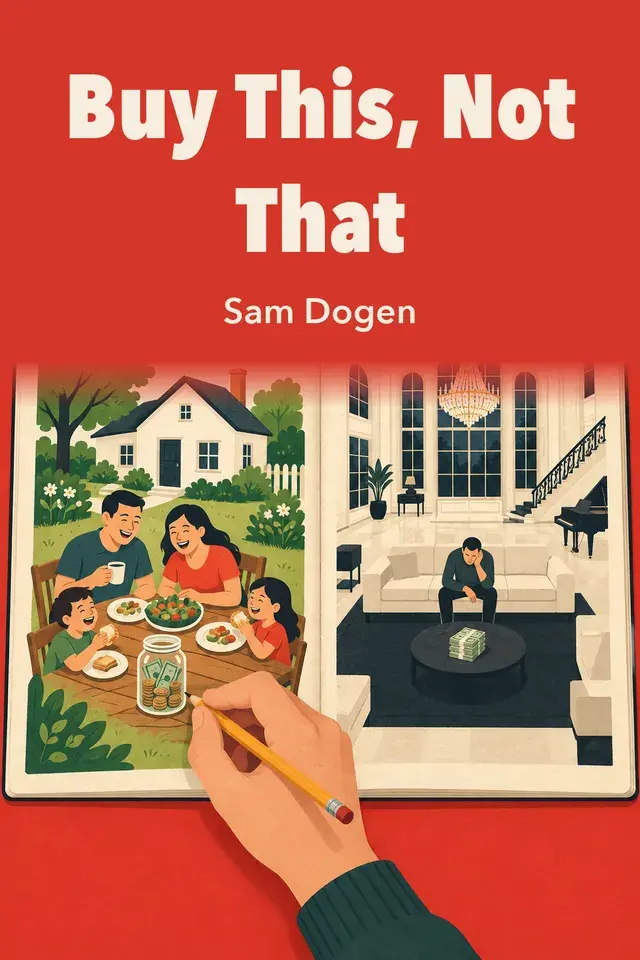
Buy This, Not That, by Sam Dogen.
Financial independence matters because it can give a person more control over time. It can provide a buffer when life goes wrong and room to pursue work or projects that would otherwise feel too risky. The author’s starting question is practical: how can money create more choice, sooner? Reaching that goal calls for decisions made under uncertainty, since important choices rarely come with complete information or guaranteed results.
The author suggests comparing likely outcomes rather than waiting for certainty. A choice has possible rewards, costs, and risks, and its quality depends on the person’s circumstances. Due diligence can improve the odds, but it cannot remove uncertainty. The stakes matter too: a small possible gain may not justify a serious downside, while a larger decision calls for more careful analysis and a stronger reason to expect a favorable result. The aim is not to find a perfect option, but to make a considered choice with a reasonable edge.
His 70/30 framework gives that approach a memorable shape. He recommends acting when a decision seems at least 70 percent likely to be the better choice, while accepting that it may still prove suboptimal. The remaining 30 percent represents the possibility of being wrong, not a promise that every decision can be measured precisely. Over time, sound reasoning across many choices may improve the odds of good results, but one favorable outcome can reflect luck, and confidence alone is no protection from risk. A disappointing result does not, by itself, prove the decision was foolish; what matters is whether the reasoning took the available evidence and tradeoffs seriously.
To improve that reasoning, the author advocates forecasting. Before an uncertain event, write down what you expect and how likely you think it is. Later, compare the forecast with what happened. That record makes it easier to see where judgment was well calibrated and where it needs adjustment. Without it, people can remember their successful predictions and overlook the misses. The same habit helps question persuasive claims: compare what a purchase or investment was supposed to deliver with its actual results, then revise your view when the evidence warrants it.
The author’s story of pursuing an opportunity at a career fair illustrates persistence. He recalls difficult circumstances, including moving between countries, modest means, and experiencing bullying and racism. His account credits showing up and continuing to pursue an opening with helping him reach a career opportunity. The lesson is that sustained effort can improve a person’s prospects, not that effort controls every outcome. Strong competition and events outside one’s control can still prevent success.
He also describes leaving banking at age 34, in 2012. A punishing schedule and worsening health had led him to plan an exit. He planned to save and invest aggressively, aiming to build a passive-income portfolio that could cover his living expenses. A severance package covered about six years of expenses, which he describes as buying time. That financial runway made a change possible; it is one person’s account, not a promise that the same path will be available to everyone.
Effort and careful choices matter, but they do not guarantee wealth. People begin with unequal resources and opportunities, and discrimination can shape which chances are available to them. The author acknowledges these limits alongside his emphasis on persistence. His decision method asks for humility in both directions: take worthwhile opportunities without demanding certainty, and judge choices by their reasoning as well as their outcomes. Recording forecasts and learning from the gap between expectation and result helps make later decisions more informed.
Chapter 2 of 17 · 5 min · Audio & textIn the app
Define the Life Money Serves
Financial independence is easier to plan when you first decide what you want it to make possible. Money is a means to freedom over your time, work, relationships, and location.
Chapter 3 of 17 · 7 min · Audio & textIn the app
Set Targets and Test Risk
Once you have a sense of what you want money to support, the next question is how to measure progress toward it. Net worth offers one kind of target; income from investments offers another.
Chapter 4 of 17 · 7 min · Audio & textIn the app
Turn Earnings Into Income
Once you have a financial target, the next step is to turn current earnings into assets that may produce income. Dogen calls those investments a “money army” working alongside a person’s main earnings.
Chapter 5 of 17 · 6 min · Audio & textIn the app
Borrow With Deliberate Limits
Debt is not one uniform obstacle to building wealth. Sam Dogen asks what the borrowing costs, what it financed, and whether the borrower can carry its risks.
Chapter 6 of 17 · 7 min · Audio & textIn the app
Diversify for Resilience
Before choosing particular funds or securities, the author says to decide how your overall wealth should be spread. His three net-worth models offer different starting structures.
Chapter 7 of 17 · 8 min · Audio & textIn the app
Optimize Accounts and Investments
Once a broad allocation is set, the next decisions are which accounts should hold investments and which holdings belong within them. Dogen starts with access to money, then tax treatment, then investment choice.
Chapter 8 of 17 · 9 min · Audio & textIn the app
Buy a Home Without Overreaching
A home can meet an important personal need and still put too much strain on a household’s finances. The author’s 30/30/3 rules turn affordability into three separate checks: the monthly payment, the cash kept available, and the price in relation to income.
Chapter 9 of 17 · 6 min · Audio & textIn the app
Make Housing Fit Changing Lives
After a home fits the affordability limits discussed in the previous chapter, its location and form still need to fit a person’s life. Housing affects access to work, daily comfort, and the ability to adapt when plans change.
Chapter 10 of 17 · 9 min · Audio & textIn the app
Invest in Property With Evidence
Once a home provides basic exposure to real estate, the next question is whether another property belongs in the plan. Sam Dogen presents real estate as a possible complement to stocks.
Chapter 11 of 17 · 5 min · Audio & textIn the app
Build a Career With Options
A career is part of a financial plan: earnings can become savings and investments, building more choices later. But salary alone does not determine a job’s value.
Chapter 12 of 17 · 6 min · Audio & textIn the app
Negotiate Exits and Care Choices
Career advancement, in the author's account, depends on more than doing good work. He argues that employees should understand their value to the company, perform well, and make their contributions visible because many promotion decisions depend on consensus.
Chapter 13 of 17 · 7 min · Audio & textIn the app
Grow a Side Business Carefully
A side business can add income and give someone a project that might outlast a particular job. The author recommends starting while still employed, so salary and benefits support the experiment while the idea develops.
Chapter 14 of 17 · 7 min · Audio & textIn the app
Pay for Learning With Purpose
Education is an investment in a person’s ability to make choices. The author treats learning as broader than a degree: reading, online courses, conversations, and exposure to different views can all build knowledge and confidence.
Chapter 15 of 17 · 4 min · Audio & textIn the app
Build a Financial Partnership
Money is part of intimate life because partners share routines, choices, and the effects of one another’s habits. Dogen argues that love and financial stability both matter: a good financial teammate can make shared life easier, while mismatched habits can make it harder.
Chapter 16 of 17 · 6 min · Audio & textIn the app
Prepare Family for Change
Having children changes household costs, work, time, and relationships. Financial planning should make room for family life, not turn a particular salary or net worth into permission to begin.
Chapter 17 of 17 · 5 min · Audio & textIn the app
Spend for Freedom and Meaning
The closing argument is that wealth should be judged by the life it makes possible. Money can create options, but those options matter when they offer more control over time, privacy, health, and meaningful work.
Chapter 1 of 17 · 4 min · Audio & text: Choose With Incomplete Information
Wiseley supports reading and listening to summaries in the app.
Continue in WiseleyAbout Sam Dogen

Sam Dogen is the founder of the personal finance site Financial Samurai. “Buy This, Not That” explores how money can support a personally defined good life through choices about saving, investing, housing, and work.
Explore more books by Sam Dogen