What you'll learn
Key ideas from Burn Rate
These ideas compress the book's argument without treating the author's view as settled fact. Use them as an orientation before reading the full work or listening in Wiseley.
Bonobos became credible when Spaly tested a specific fit problem and customers paid for a better alternative.
The account makes reciprocal scrutiny, disconfirming evidence, and direct conversation safeguards against turning distress into an external enemy.
Replacing a founder revealed separate merchandising, production, design, planning, and creative-direction capabilities that growth required.
Repeat purchases and stronger owned-brand margins turned customer economics into evidence investors could evaluate.
Closing or spinning out side ventures restored strategic focus and demonstrated the value of disciplined stopping.
Dunn’s account treats work as fuel and the brain as the engine, without making employment a cure or mania an advantage.
Dunn’s recovery required medical treatment, legal safeguards, honest disclosure, and organizational support rather than explanation alone.
Stability remained a shared practice of psychiatric care, therapy, medication, sleep reporting, transparent conversation, and responsible fatherhood.
Inside Burn Rate
Read the first chapter in full here. The other 9 continue in the Wiseley app.
Chapter 1 of 10 · 10 min · Audio & text
How Silence Becomes Denial
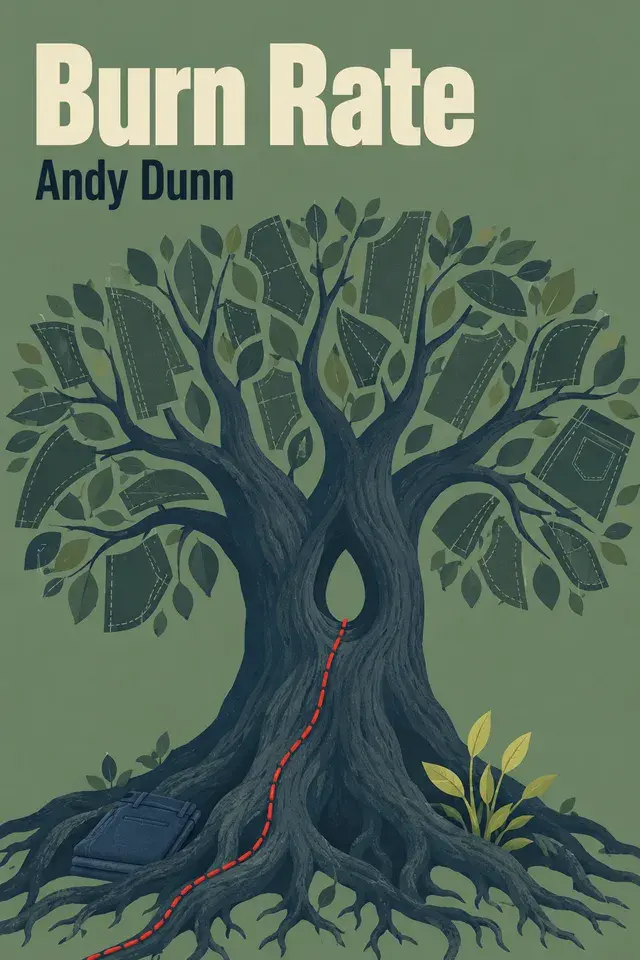
Burn Rate, by Andy Dunn.
Burn Rate opens with a question: what happens when a person can pass as ambitious, gifted, or merely eccentric while mental illness remains unspeakable? Dunn calls bipolar disorder the Ghost. He says it first appeared in 2000 and stayed hidden for sixteen years, known only to a small circle of loved ones. His purpose is not to turn illness into a founder myth, but to show how silence can let denial imitate safety. He also warns that this is a retrospective memoir: some names and identifying details changed, and fallible memories were checked against family and friends.
Silence has a family precedent in Dunn’s story. His maternal grandparents were displaced by the partition of Punjab, and his mother’s life joined educational ambition to sacrifice. She trained as an X-ray technician, sent her income home, and gave up possible medical training when family needs came first. Dunn remembers her as demanding but attentive to people. Yet medical knowledge did not prevent psychiatric secrecy. His paternal grandmother, Nana, had been a wartime trauma nurse before developing mood swings. Her psychiatrist husband medicated her, she was institutionalized, and the family moved while treating embarrassment and good periods as reasons not to expect the illness back. Dunn’s retrospective conclusion is that this pattern taught concealment, not preparation.
That inheritance met a childhood identity built from both otherness and specialness. Dunn was a brown-skinned, half-Indian child in a mostly white setting, so difference could feel like uniqueness until it became a target. When he learned he might skip a grade, he treated unusual ability as evidence that he was an outlier. He links that feeling of being exceptional to later self-importance and entrepreneurial hubris, while acknowledging that family history, racial difference, and giftedness did not cause bipolar disorder by themselves. He also wonders whether idealizing his affectionate, noncompetitive father left him trying to prove superiority over other men.
The nickname Windu, meaning “White Hindu,” gave this lesson a sharper form. The insult exposed his difference, but Dunn did not show that it hurt. He learned to hide vulnerability behind indifference, while his older sister recognized what he concealed and mobilized friends to stop the harassment. Later, after a prom-related humiliation and a peer’s mockery, Dunn secretly moved mud onto the other boy’s car. No one confronted him the next day. He did not apologize, and the group’s silence became his only judgment. Dunn reads these memories as early evidence of a pattern: absorb the injury, retaliate privately, then avoid the conversation that might bring repair or accountability.
College supplied a setting where that pattern could blend into ordinary excitement. Sigma Chi offered genuine friendship, mentoring, and career access, but its ambitious “study hard and play hard” culture also normalized status anxiety, intoxication, and behavior that sacrificed sleep. When another friend’s drug use and psychological episodes were handled through silence, the situation felt less real to the group. Dunn believed he was protected from a breakdown because he had no prior mental-health history and avoided hard drugs. His own episode therefore began gradually, disguised as enthusiasm and goal-directed energy. Obsessively collecting and stacking guests’ coats, talking more, and pursuing intense experiences did not immediately look abnormal to him or his peers.
The breakdown cannot be reduced to one trigger. A fake-ID incident produced legal fear, shame, guilt, and conflict with his father. A new relationship brought romantic intensity. A ski trip combined psychedelics, alcohol, and marijuana. He also names ecstasy, daily drinking, Accutane, the symbolic pressure of Y2K, and the abandonment of sleep, food, and water. Dunn and Dr. Z later treat these forces as interacting pressures rather than a clean chain of cause and effect. The uncertainty matters because it left him several explanations to reach for after the crisis: a drug, a medication, exhaustion, or an unusually intense romance.
Dunn’s retrospective distinction between hypomania and mania explains what changed. He describes hypomania as heightened engagement with reality, an intensified version of the world that can feel vivid, meaningful, and unusually connected. Mania goes further. It constructs a private reality and treats unconscious material, wishes, and associations as facts. These labels were applied later, not recognized during the episode. At first, an ordinary film seemed to reveal the deepest truth about his relationship with his father. He invented a story to comfort a friend, felt he had performed a good deed, and later argued that his altered state lacked the ordinary intention to deceive. As the private reality hardened, casual encounters became signs, strangers’ agreement became confirmation, and he came to believe he would become president and was the returning Messiah.
The crisis then crossed from grandiosity into physical danger. Dunn stopped eating and drinking, believed he would not need sleep, wandered through the night, and interpreted his own ideas as inevitable truths. Friends searched for him. A psychologist privately considered drug use, mania, or schizophrenia, but told Nick only to get Dunn to the hospital; Dunn initially resisted hospitalization. He eventually trusted his family enough to let them take him to the hospital. Staff addressed dehydration and sleeplessness rather than debating his beliefs. He slept for sixteen hours, received acute psychiatric medication, and gradually became recognizable to others again. The account presents recovery of shared reality as a slow descent from an intoxicating state, not as a moment when someone simply won an argument.
The discharge psychiatrist diagnosed bipolar disorder type I. That was the initial diagnosis, but it did not settle the differential. Dunn’s family asked whether Accutane or psychedelic mushrooms had played a role, and the doctor allowed that a one-off psychotic event remained possible if no recurrence occurred for five years. The family treated “one-off” as a life raft. Dunn later corrects that timeline: five years is not the right timeline; mania can return twenty years later, out of nowhere. Dunn, entering the depression that followed mania, could not absorb what a lifelong and unpredictable condition might mean. The diagnosis therefore coexisted with uncertainty: it named a serious possibility while leaving him an escape route from it.
Stigma made that escape route emotionally attractive. Dunn experienced “bipolar” as an imposed identity, preferring to say that someone has an illness rather than that the illness defines who they are. He had already associated psychiatric care with secrecy, euphemism, and jokes about the mental ward. In his view, business culture intensified the problem by treating stability as a requirement for leaders. After discharge, he lectured the psychiatrist, rejected follow-up, avoided his family’s questions, and returned to school as if nothing had happened. Depakote made him feel dulled and creatively diminished. That was his response to one medication experience, not a universal claim about treatment, but without an ongoing clinical relationship he had no trusted setting in which to separate dosage, side effects, diagnosis, and identity.
Two years later, Dunn tried to discuss the episode with a college friend. The conversation stalled, and the friend later asked never to discuss the episode again. Whatever the friend’s reasons, Dunn experienced the refusal as confirmation that the subject was taboo. He began explaining the crisis as a glitch caused by mushrooms, ecstasy, sleep loss, alcohol, Accutane, or romantic rapture. The later crisis is only a frame here, not a retelling. Its place in the memoir matters because it shows that the first episode was not safely sealed by calling it a one-off or a mistake. Dunn’s central insight is that shame and exceptionalism worked together: one made illness humiliating, the other made it feel incompatible with the person he believed himself to be. Silence then became more than the absence of discussion. It became a way to preserve that identity, even when uncertainty and warning signs should have made denial harder to sustain.
Chapter 2 of 10 · 7 min · Audio & textIn the app
Turning Ambition Into Customer Evidence
Dunn came to Stanford wanting an entrepreneurial identity before he had shown that he could build a company. Private equity had taught him how ownership worked, but not how to create a product or earn a customer.
Chapter 3 of 10 · 10 min · Audio & textIn the app
The Enemy Outside and Within
Bonobos’s crisis was not created by a disagreement with no business substance. Dunn and Spaly agreed that pants should be sold online, but they differed about hiring speed, decision-making, product strategy, and the company’s larger purpose.
Chapter 4 of 10 · 9 min · Audio & textIn the app
Financing Growth Beyond Founder Energy
While Spaly was still on Bonobos’s board, the company was already confronting the limits of founder energy. In 2009, Bonobos doubled sales.
Chapter 5 of 10 · 7 min · Audio & textIn the app
Making Culture Less Founder Dependent
After Bonobos closed its Series A, money did not make the company calmer. It missed its new budget and lost more than planned, while professional investors joined the board.
Chapter 6 of 10 · 6 min · Audio & textIn the app
When Expansion Outruns Its Evidence
Bonobos learned two lessons from growth. One came from customers; the other came from Dunn’s image of what the company might become.
Chapter 7 of 10 · 7 min · Audio & textIn the app
Work Is Fuel and Structure
The Las Vegas recurrence exposed the limits of Dunn’s earlier explanation of his mood cycles, but it did not by itself settle them. He had been tempted to see Bonobos as the cause, because depression seemed to arrive around its demands.
Chapter 8 of 10 · 7 min · Audio & textIn the app
Crisis Makes Consequences Inescapable
When Dunn returned to Bonobos, his energy still looked useful. He was focused, decisive, and able to treat renewed activity as evidence that he was finally functioning well.
Chapter 9 of 10 · 8 min · Audio & textIn the app
Recovery Requires Treatment and Repair
Recovery in Dunn’s account begins after the emergency, not at hospital discharge. The 2016 manic spiral led to Bellevue, violence against Manuela and her mother, arrest, and felony and misdemeanor assault charges.
Chapter 10 of 10 · 9 min · Audio & textIn the app
Stability Is a Continuing Responsibility
Six months after Dunn’s major episode, his criminal case was dismissed and the records were sealed. He felt relief from the fear that the episode would destroy his career or company.
Chapter 1 of 10 · 10 min · Audio & text: How Silence Becomes Denial
Wiseley supports reading and listening to summaries in the app.
Continue in WiseleyAbout Andy Dunn

Andy Dunn is an American entrepreneur and cofounder of Bonobos. “Burn Rate” explores how entrepreneurial ambition coexisted with concealed bipolar disorder during the building of Bonobos.
Explore more books by Andy Dunn