What you'll learn
Key ideas from Buddha’s Brain
These ideas compress the book's argument without treating the author's view as settled fact. Use them as an orientation before reading the full work or listening in Wiseley.
Attention helps determine which experiences are learned, while repetition can strengthen lasting neural patterns.
Threats usually carry more weight than missed rewards, biasing attention and memory toward negative information.
The first dart is unavoidable discomfort; the second is suffering added by reactive interpretation, even around neutral or positive conditions.
Negative experiences can outweigh more numerous positive ones in implicit memory, so positive experiences often need deliberate attention to become durable resources.
Equanimity creates space between pleasant, unpleasant, or neutral feeling tones and automatic craving, aversion, or neglect.
Empathy recognizes another person’s inner experience without requiring agreement, approval, or surrendering rights.
Goodwill is compatible with truth-telling, protective action, and boundaries while letting go of revenge.
Inside Buddha’s Brain
Read the first chapter in full here. The other 11 continue in the Wiseley app.
Chapter 1 of 12 · 7 min · Audio & text
The Brain Can Be Trained
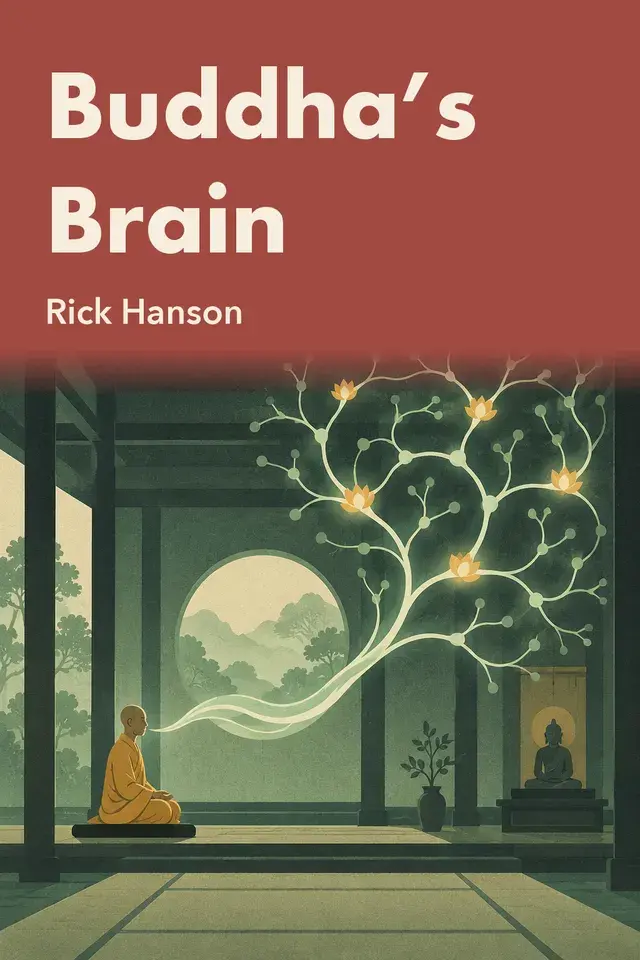
Buddha’s Brain, by Rick Hanson.
Can mental habits change the person who has them? Buddha’s Brain begins with a practical yes. Rick Hanson and Richard Mendius bring neuroscience, psychology, and contemplative practice together to ask how people might cultivate more happiness, love, and wisdom. Their starting point is that experience does not simply pass through us. Mental activity can change the brain, and the brain’s changing patterns influence what we think and feel next.
The authors use “mind” broadly. It includes conscious and unconscious information flow: bodily regulation, skills, personality, hopes, meanings, and other mental activity. The brain is a central physical basis for this activity, but mind and brain are not treated as separate, self-contained machines. The body, relationships, natural world, and culture also shape mental life. The system is reciprocal: the brain affects the mind, while what a person experiences and does can affect the brain.
At the neural level, signals pass between neurons at connections called synapses. A simplified account is that repeated activity can strengthen the circuits involved. Some mental events are brief patterns of activity; others can leave more lasting changes. The familiar shorthand that neurons firing together wire together conveys the book’s point, but it is not a complete explanation of how the brain works. Attention, feeling, behavior, and other functions emerge through interactions across systems, not from one isolated brain part.
This capacity for change is called neuroplasticity. The authors argue that repeated mental activity can reinforce patterns associated with well-being. They use London taxi drivers as an example: drivers who repeatedly navigate complex streets are described as having larger hippocampi, a brain structure associated in the account with visual-spatial memory. The example suggests a link between sustained experience and brain structure. It does not mean that every practice produces the same change, or that one example explains the full process.
Experienced meditators offer a second illustration. During deep meditation, Tibetan practitioners are described as showing unusually strong, synchronized gamma activity across broad areas of the brain. The authors interpret this as a sign of integration across wide neural territories. It is an intriguing association, not a settled account of meditation or consciousness. Together, these examples make the book’s case that brains are shaped by experience, while leaving open exactly how particular experiences produce particular changes.
Attention matters because the brain learns especially from what receives attention. A passing experience may have little lasting effect, while an experience held in awareness can become more influential. This gives deliberate attention a role in change: it helps determine which parts of experience are registered and repeated. It does not provide instant control over the brain. The claim is that small, repeated influences can gradually shift what becomes familiar and easier to do.
The authors make this gradual process concrete through present actions. The past cannot be changed, but a person can influence the conditions of what comes next. A longer breath during a tense moment, recalling a sense of being loved while upset, or allowing a happy moment to register can each be a small cause. Repeated over time, such actions may contribute to larger changes in mental and neural patterns. These examples introduce the logic of practice; later chapters develop particular methods in more depth.
The book connects this possibility to three broad functions: regulation, learning, and selection. Regulation includes the nervous system’s balancing of activity, with processes that can excite or inhibit. Learning changes patterns in response to experience. Selection reflects how an organism comes to value some possibilities over others, in part through what it has learned. These functions provide a bridge to the Buddhist framework the authors use. Virtue regulates thoughts, words, and actions toward benefit rather than harm. Mindfulness directs attention skillfully toward inner and outer experience. Wisdom recognizes what tends to cause harm or help, then supports letting go of harmful patterns and strengthening helpful ones. The book links these ideas without claiming that a neural description exhausts their ethical or spiritual meaning.
The scientific frame has limits. Psychology and neurology are still developing, and the authors simplify complex processes to make their account accessible. The relationship between brain and mind, especially conscious experience, remains unresolved. They work with the hypothesis that ordinary mental activity depends on the brain, while acknowledging that science cannot settle every proposed transcendental explanation. Contemplative traditions offer another kind of accumulated expertise about mental training, but the methods presented here do not replace traditional spiritual training. Nor are they substitutes for professional care. Practices also differ in suitability; if an exercise brings up distress, it can be changed or stopped, with support sought when needed.
The book’s working claim is therefore modest but consequential: mind and brain influence one another within an embodied, relational life. Attention and repeated practice can help shape that relationship over time. By understanding change through regulation, learning, and selection, the authors set the stage for exploring how virtue, mindfulness, and wisdom may become more than ideals: they can also be qualities supported by patterns we strengthen in everyday life.
Chapter 2 of 12 · 7 min · Audio & textIn the app
The Survival Brain’s Three Strategies
In Buddha’s Brain, Rick Hanson asks why a brain organized to protect life so often leaves people uneasy, dissatisfied, or afraid. He treats this as an evolutionary diagnosis: systems that aided survival still shape experience.
Chapter 3 of 12 · 7 min · Audio & textIn the app
Pain, Reaction, and the Stress System
Pain and suffering overlap, but they are not the same. The book calls unavoidable physical or mental discomfort a first dart.
Chapter 4 of 12 · 6 min · Audio & textIn the app
Taking In the Good
An experience does more than pass through the mind. It leaves traces that shape expectations, emotional habits, and the felt sense of who we are.
Chapter 5 of 12 · 7 min · Audio & textIn the app
Regulation, Safety, and Refuge
Settling does not mean proving that nothing bad can happen or keeping yourself calm all the time. Hanson points to the parasympathetic branch of the autonomic nervous system as a bodily route toward easing activation.
Chapter 6 of 12 · 8 min · Audio & textIn the app
Motivation Without Reactivity
Being alive means continually leaning toward what comes next, from meeting immediate needs to pursuing happiness, love, and wisdom. The question is not whether to have motivation, but how to let its energy serve aims we have considered, rather than letting every impulse set our course.
Chapter 7 of 12 · 9 min · Audio & textIn the app
The Evolutionary Social Brain
Human beings carry capacities for care and hostility at the same time. The chapter pictures them as two wolves: repeated actions strengthen either love or hate.
Chapter 8 of 12 · 8 min · Audio & textIn the app
Empathy with Boundaries
Meaningful relationships depend on more than solving practical problems. People also need to feel that their inner lives—their feelings, needs, and intentions—are recognized.
Chapter 9 of 12 · 9 min · Audio & textIn the app
Goodwill Without Passivity
Kindness is the wish that others be happy; compassion is the wish that they not suffer. Because happiness is possible even when no crisis is underway, kindness can be offered in ordinary life, not only in response to pain.
Chapter 10 of 12 · 7 min · Audio & textIn the app
Training Attention for Daily Life
Attention is the ability to place awareness where one intends, keep it there, and shift it when needed. In daily life, it determines which sights, thoughts, memories, and sensations occupy the foreground.
Chapter 11 of 12 · 7 min · Audio & textIn the app
From Mindfulness to Concentration
Meditation begins with a simple difficulty: the mind wanders. It scans for what is striking, seeks stimulation, and responds to thoughts, feelings, and sensations.
Chapter 12 of 12 · 8 min · Audio & textIn the app
Seeing Through the Self
The sense of being a self is real, but it does not prove that one permanent, independent owner stands behind experience. The book describes selfhood as a shifting pattern assembled from bodily feeling, emotion, memory, thought, and relationships.
Chapter 1 of 12 · 7 min · Audio & text: The Brain Can Be Trained
Wiseley supports reading and listening to summaries in the app.
Continue in WiseleyAbout Rick Hanson

Rick Hanson is an American psychologist and author. “Buddha’s Brain” explores how neuroscience, psychology, and contemplative practice can help the mind reduce avoidable suffering.
Explore more books by Rick Hanson