What you'll learn
Key ideas from Boundaries
These ideas compress the book's argument without treating the author's view as settled fact. Use them as an orientation before reading the full work or listening in Wiseley.
A boundary is a personal property line that clarifies what belongs to one person and where that person’s responsibility ends.
The book maps four boundary failures: compliance cannot say no, avoidance rejects good care, control ignores another person's no, and nonresponsiveness withholds responsible love.
A sustainable boundary names the speaker’s action openly and relies on a consequence the speaker can control.
A truthful yes requires the freedom to say no; compelled agreement can conceal resentment, rebellion, and an unowned motive.
Self-boundary growth follows repeated cycles of ownership, support, practice, consequences, and restoration, with counseling needed when abuse-related injury blocks the work.
Forgiveness releases a debt inwardly; reconciliation and renewed access require ownership, changed conduct, and trustworthy evidence.
Jane’s story shows that a lasting boundary may require grieving the relationship a person hoped to receive, not merely confronting its harm.
Purposeful boundaries protect resources so time, relationships, and commitments can serve chosen values.
Inside Boundaries
Read the first chapter in full here. The other 11 continue in the Wiseley app.
Chapter 1 of 12 · 9 min · Audio & text
Where Your Responsibility Begins
Boundaries, by Dr. Henry Cloud.
Sherrie’s day is full of useful work, yet nothing feels under her control. Her mother uses loneliness and martyrdom to draw her into an unwanted visit. Sherrie abandons a project, hides what she wants, and later wonders whether the visit helped. A friend then brings another crisis, receiving Sherrie’s attention without asking about her struggles. At work, Jeff praises her dependability while assigning a large last-minute editing task, and she agrees despite resentment.
During family dinner, she answers a call because someone may need her. Phyllis, the church women’s ministries leader, asks her to take over the retreat activities coordinator role after Margie cancels. Sherrie had hoped the retreat would provide solitude, but a familiar internal thought pattern, whose source she cannot identify, frames giving it up as a privilege and as letting go of selfishness, so she agrees. In her marriage, Walt’s anger has taught her to monitor his moods, apologize, retract her views, and perform extra acts of service. These tactics bring temporary peace but deepen fear, resentment, and isolation. The book’s framework does not portray Sherrie as lazy or uncaring. She is trying hard. Her central difficulty is not knowing what belongs to her and what belongs to someone else.
The answer begins with a property-line image. A boundary is a limit that shows where one person begins and ends. Physical skin makes separateness visible; emotional, mental, and spiritual boundaries are less visible but still mark personal property. Inside that property are aspects of life a person must own and care for: feelings, choices, behavior, time, and resources, along with the inner life from which they act. Ownership is not a claim to control other people. It is recognition of what belongs to me, which creates room for responsibility and choice.
The book then distinguishes responsibility to others from responsibility for them. People can be responsible to someone by helping carry an overwhelming burden, what the chapter pictures as a boulder too heavy because of limited strength, resources, or knowledge. But each person also has ordinary daily loads, the manageable cargo of work, decisions, feelings, and obligations that person is expected to carry. Confusing the two creates opposite harms: treating a boulder as a normal load leaves someone crushed and alone, while treating a daily load as a boulder invites dependence and avoids responsibility. Healthy care asks where one person’s responsibility ends and the other’s begins.
Bill’s parents show how rescue can erase that line. They give him money, arrange new schools, and remove obstacles, hoping to make him responsible, yet his drug use and avoidance continue. A counselor points out that Bill has no practical problem while his parents pay, worry, plan, and spend their energy. Their help has transferred the consequences to them. The lawn analogy makes the point concrete: if parents keep watering an adult child’s lawn, his neglected property appears comfortable while their own lives deteriorate. Defining the property lines and stopping the watering allows his choices to become his problem. The question is not whether help sounds loving, but whether this help has actually helped.
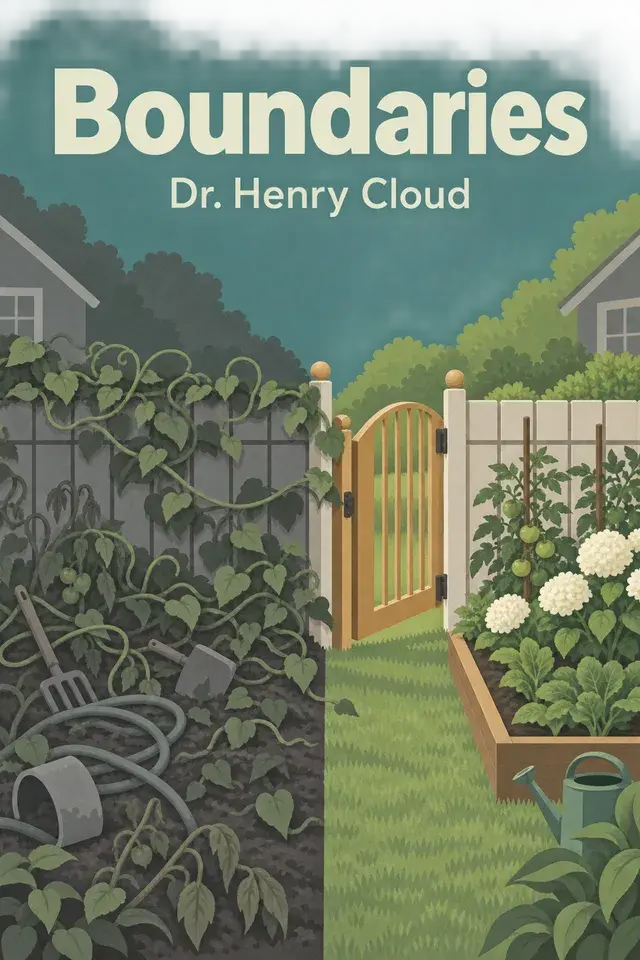
Boundaries are not only fences that exclude. They are fences with gates. They keep danger out while allowing truth, love, healing, and appropriate support in. Mary’s abuse history illustrates an inverted pattern: pain remained inside, support stayed outside, and further harm kept entering. A healthier boundary would reverse those directions by excluding new harm and admitting safe help. The image prevents two errors at once. A person need not remain exposed in order to love, but protection should not become isolation.
The authors place this model inside an explicitly Christian account of God, creation, and human responsibility. God is described as distinct from creation, clear about who he is, relational without losing distinction, protective against evil, and open to love. Within the book’s framework, human boundaries reflect that combination of separateness and connection. This opening establishes the book’s spiritual setting; it does not yet settle every objection that limits might be selfish, unloving, or disobedient.
An ownership test follows. First, identify the feeling. Feelings are information about what is happening in a relationship or within oneself, not commands that must automatically be obeyed. Resentment may signal an unwanted obligation; fear may signal danger or the need for careful examination. Owning a feeling means naming it and deciding how to respond, not blaming another person for it or letting it rule behavior. Next, identify the choice. Pressure can be real, but the choice to agree, refuse, delay, or ask for help still belongs to the person making it. Other people own their choices in the same way.
Then look at time, behavior, and resources. Time is finite personal property; spending it on one demand may take it from work, rest, family, or another commitment. Behavior belongs to the person acting, along with the consequences that behavior produces. Money, attention, abilities, and emotional capacity are resources to steward, not automatic supplies for every request. This does not mean refusing all dependence. It means asking whether the situation calls for help with a boulder or rescue from a load that someone can carry.
Finally, choose a boundary that stays within personal control. Words can mark the line through a clear yes, no, or truthful statement of what one will and will not do. Time can be set aside or withheld. Physical, geographical, or temporary emotional distance can reduce exposure to danger and restore ownership; it does not make the other person change. Consequences let behavior meet its results, or let the boundary-setter withdraw money, access, participation, or other resources that belong to the setter. A consequence is effective only when it is real and within the boundary-setter’s control, not a threat aimed at controlling someone else.
The result is a definition broad enough for every later application. A boundary identifies what a person owns and must care for. It protects the inner life, allows safe connection, and returns ordinary responsibility to its proper owner. That is how the book’s central promise works: people can help one another with genuine burdens without taking over one another’s daily lives.
Chapter 2 of 12 · 8 min · Audio & textIn the app
How Boundary Patterns Take Shape
Boundary problems are not all about failing to say no. The book's map asks whether a person can give and receive care, refuse harm, and respect another person's limit.
Chapter 3 of 12 · 11 min · Audio & textIn the app
Making Limits Work in Practice
Making limits work requires more than knowing that each person has a separate property line. The authors turn the ten laws into a reasoning process.
Chapter 4 of 12 · 8 min · Audio & textIn the app
Love Without Compulsory Compliance
Boundaries can seem selfish, disobedient, angry, ungrateful, or incompatible with Christian love when love is confused with constant availability. Christians are called to care about other people’s welfare, so the authors take the objection seriously.
Chapter 5 of 12 · 10 min · Audio & textIn the app
Changing Inherited and Chosen Relationships
Family relationships can keep adult life organized around childhood roles long after a person has moved away. Susie’s visits to her parents end in deep depression.
Chapter 6 of 12 · 10 min · Audio & textIn the app
Separateness Within a Shared Marriage
Marriage creates a special boundary problem. Spouses become one flesh, share a home and future, and make decisions that affect each other.
Chapter 7 of 12 · 10 min · Audio & textIn the app
Teaching Children to Own Their Choices
Children do not begin life with an inner sense of responsibility. An infant depends on caregivers for protection, comfort, and a secure place from which to experience the world.
Chapter 8 of 12 · 8 min · Audio & textIn the app
Protecting Work, Time, and Calling
Applying boundaries to work begins with a practical question: what belongs to whom? A job includes duties, time, energy, authority, and agreed expectations.
Chapter 9 of 12 · 9 min · Audio & textIn the app
Building Boundaries Within Yourself
Setting limits on other people is only half of boundary work. The next question is whether a person can govern what belongs to them: money, time, unfinished work, words, appetite, sexuality, and substance use.
Chapter 10 of 12 · 9 min · Audio & textIn the app
When Other People Resist
A boundary becomes real when it changes what you will do, not when another person approves. That change can disturb an arrangement that benefited the other person, so resistance is predictable.
Chapter 11 of 12 · 8 min · Audio & textIn the app
Grieving What Compliance Cannot Obtain
Understanding boundaries does not automatically make them possible. A person may recognize an exploitative pattern and still feel unable to act.
Chapter 12 of 12 · 7 min · Audio & textIn the app
From Practiced Limits to Purposeful Living
Boundary growth is not measured by how often a person says no, or by how forcefully a limit is defended. It is measured by whether life becomes more honest, reciprocal, responsible, and free.
Chapter 1 of 12 · 9 min · Audio & text: Where Your Responsibility Begins
Wiseley supports reading and listening to summaries in the app.
Continue in WiseleyWhat Boundaries is about
How can you care for others without taking over their lives or neglecting your own? Boundaries presents a Christian framework for personal responsibility, loving limits, and freely chosen commitment. Its practical methods address family, friendship, marriage, parenting, work, and the inner obstacles that make saying no difficult.