What you'll learn
Key ideas from Big Mistakes
These ideas compress the book's argument without treating the author's view as settled fact. Use them as an orientation before reading the full work or listening in Wiseley.
Graham separates a business’s possible worth from the market’s daily offer, which may reflect fear or enthusiasm more than changing prospects.
A preset loss budget makes the acceptable loss explicit before fear, uncertainty, or attachment changes the decision.
Indexing can reduce reliance on manager selection, but it still requires patience through drawdowns and long stretches without gains.
Buffett’s 20-investment punch-card is a thought experiment; advance criteria can help make a mistaken thesis recognizable.
Prices reflect expectations as well as fundamentals, and patience needs both a revisable thesis and a portfolio its owner can endure.
Concentration can magnify gains and company-specific losses; diversification reduces how much one holding determines the portfolio’s result.
Paulson’s housing windfall did not establish that another large wager would work; his later gold losses show the risk of treating exceptional success as repeatable.
Hindsight can make uncertain outcomes seem obvious, and misleading similarities to the past can distort present choices.
Inside Big Mistakes
Read the first chapter in full here. The other 9 continue in the Wiseley app.
Chapter 1 of 10 · 6 min · Audio & text
Value Without Iron-Clad Laws
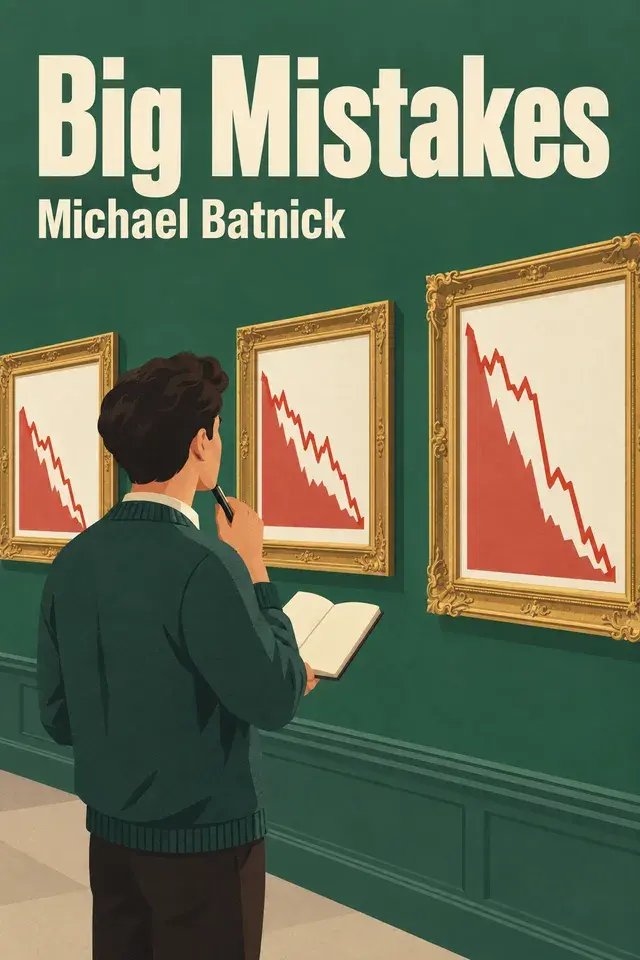
Big Mistakes, by Michael Batnick.
Big Mistakes starts from a simple difficulty: when investing goes badly, the setback can feel personal and isolating. Michael Batnick turns attention to the mistakes of accomplished investors. He argues that studying their failures is the next-best way to learn after investing oneself. The aim is perspective, not a formula that makes errors disappear. Reading can help, but it cannot replace experience.
Benjamin Graham provides the book’s foundation for thinking about what an investment is worth. Batnick presents Graham’s distinction between a security’s price and the value of the business behind it as an enduring idea. Graham helped make financial analysis accessible: Security Analysis addressed professionals, while The Intelligent Investor was written for general readers. But he treated analysis as an inexact discipline, not a branch of physics with laws that always produce precise answers.
A market price is the amount someone is willing to pay now. It does not necessarily measure what a business is worth over time. Graham’s example of Wright Aeronautical makes the point without requiring an exact valuation: he thought the shares were attractive at eight dollars and unattractive at two hundred eighty. For some decisions, recognizing that a price is clearly appealing or excessive matters more than pinning down a single correct value.
General Electric offers a sharper example of how much sentiment can move a price. Its market value fell from 1.87 billion dollars in 1937 to 784 million dollars in 1938. Graham argued that investors’ optimism and pessimism shifted more dramatically than the underlying business’s prospects. The example does not show that business conditions never change. It shows that a large move in price need not mean the business itself changed by as much.
Graham’s Mr. Market story gives this gap a memorable shape. Imagine a business partner who offers to buy your share or sell you another share every day. Some days the offer may be reasonable. On others, enthusiasm or fear can push it far from a useful estimate of the business’s worth. The investor can listen to the offer without accepting it. A market quotation is an option to act, not a command.
That distinction guides Graham’s margin-of-safety approach. Instead of paying the full amount one estimates a security might be worth, an investor seeks a substantial discount to a conservative estimate of its intrinsic value. The discount is meant to leave room for mistakes in the estimate. Graham favored assets that could be measured, such as property, equipment, inventory, and raw materials. Some of his rules looked for shares priced below net working capital or selected low-multiple stocks. These shortcuts made valuation more practical, but they still depended on judgments about what assets were worth and whether a business could use them as expected.
A margin of safety is therefore a guide, not a shield against severe losses. Graham’s own experience makes that limit difficult to miss. Before the 1929 downturn, his investment account had done exceptionally well: in 1926 it gained 32 percent while the Dow gained 0.34 percent. Near the downturn, Graham covered short positions and held convertible preferred securities because he believed prices were already too low. In 1929 he lost 20 percent while the Dow fell 17 percent.
Believing the worst had passed, Graham went heavily into the market in 1930 and used borrowed money. Prices kept falling. He lost 50 percent that year and was personally wiped out. From 1929 through the 1932 market bottom, he lost 70 percent. The Dow fell 89 percent from its peak to its trough. A conviction that assets were cheap did not stop them becoming cheaper, and borrowed exposure made a mistaken judgment especially costly.
Those losses did not make Graham abandon security analysis. During the Depression, he pointed to companies trading below their cash or liquidating value and urged shareholders to consider the businesses they owned, not just daily quotations. The book also reports that Graham-Newman outperformed the market by nearly three percent annually over twenty years. That record supports value investing as a potentially effective long-term approach, while Graham’s personal losses show why long-term effectiveness cannot be confused with short-term protection.
There is no guarantee that a price gap will close on an investor’s preferred schedule. Valuation differences can persist for long periods, and waiting for a return to past norms can be difficult and costly. Graham himself recognized that methods could lose reliability as conditions changed. As more investors searched for undervalued companies, those opportunities became harder to find, and he questioned whether elaborate analysis still justified its cost. He was also skeptical of expert market forecasts, reasoning that known information was already reflected in prices while unknown events could still move them.
That is the balance this opening chapter establishes. Value analysis can help separate a business’s possible worth from the market’s current offer. A margin of safety can discipline the price an investor is willing to pay. Neither can make uncertain estimates exact, prevent every large loss, or guarantee that past relationships will continue. The book begins with Graham’s framework because it is useful, and with its limits because no financial principle is an iron-clad law.
Chapter 2 of 10 · 8 min · Audio & textIn the app
Keep Errors From Becoming Ruin
Investors often reach for a familiar rule to explain why they bought, sold, or held something. A rule can be helpful, but it can also make a complex decision seem settled before the relevant facts have been weighed.
Chapter 3 of 10 · 8 min · Audio & textIn the app
Choose a Method You Can Keep
An investment method is useful only if it fits what an investor understands and what that investor can keep doing through discomfort. Michael Batnick makes this point through two very different careers.
Chapter 4 of 10 · 8 min · Audio & textIn the app
Confidence Meets a Changed Market
A rising market can make investing feel easier than it is. In the United States, stocks have risen in most years, and the Dow posted double-digit gains in 47 percent of years since 1900.
Chapter 5 of 10 · 7 min · Audio & textIn the app
When Conviction Becomes Identity
People do not hold ideas as detached claims. A view can become part of how someone sees themselves, especially after they have defended it publicly.
Chapter 6 of 10 · 10 min · Audio & textIn the app
Patience, Expectations, and Skill
A losing investment does not, by itself, prove that the decision was foolish. A thesis can be reasonable and still be wrong, or the market may already have priced in what the investor expects.
Chapter 7 of 10 · 7 min · Audio & textIn the app
The Double Edge of Concentration
Concentration has an obvious attraction: a few exceptional companies can account for a large share of the wealth created in the stock market. One historical analysis cited in the book found that fewer than four percent of public companies—the top thousand—accounted for all the market’s net gains.
Chapter 8 of 10 · 7 min · Audio & textIn the app
Windfalls, Drawdowns, and Staying Power
Investing tests an investor after a gain as surely as during a loss. A spectacular result can reset expectations: ordinary returns begin to feel small, and another large wager can seem like the obvious next step.
Chapter 9 of 10 · 6 min · Audio & textIn the app
Regret Without Hindsight’s Trap
Investors cannot avoid regret. They will sometimes buy something they later wish they had avoided, or sell something they wish they had kept.
Chapter 10 of 10 · 6 min · Audio & textIn the app
Turn the Mirror Into a Process
The closing lesson turns behavioral finance back toward the investor. Jason Zweig’s image of it as a mirror captures Batnick’s approach: the ideas used to explain other people’s mistakes can also help reveal our own.
Chapter 1 of 10 · 6 min · Audio & text: Value Without Iron-Clad Laws
Wiseley supports reading and listening to summaries in the app.
Continue in WiseleyAbout Michael Batnick

Michael Batnick is an American writer and blogger. “Big Mistakes” explores why capable investors make costly mistakes and what those failures can teach.
Explore more books by Michael Batnick