What you'll learn
Key ideas from Become What You Are
These ideas compress the book's argument without treating the author's view as settled fact. Use them as an orientation before reading the full work or listening in Wiseley.
The ego can turn self-renunciation or self-acceptance into another project of self-interest.
Renunciation is credible only when desire has been honestly examined, including whether satisfaction would still be welcomed if it became available.
Religious teachings function as pointers when they return attention to lived experience rather than become objects of attachment.
Wu-wei is unforced participation in changing conditions, not passivity, deliberate relaxation, or imitation of natural behavior.
Realization recognizes ordinary perception as already within reality rather than producing a new object or universal sensory consciousness.
Ultimate nonduality does not erase human morality; Watts treats moral discipline as protection against abusing spiritual freedom.
Past and future appear as present thoughts, so postponing fulfillment continually replaces one present with another and keeps satisfaction out of reach.
Inside Become What You Are
Read the first chapter in full here. The other 8 continue in the Wiseley app.
Chapter 1 of 9 · 7 min · Audio & text
The Trap of Self Surrender
Become What You Are, by Alan Watts.
Watts begins with a command that sounds spiritually admirable: surrender the self, accept the self, or lose the ego. The difficulty is hidden in the grammar. Who is supposed to obey? The same self that wants to disappear must make the decision, supervise the effort, and perhaps take credit for its success. If it says, I have finally surrendered, it has turned surrender into a new possession. Self-acceptance can repeat the same pattern. The self can try to approve itself, gain self-respect, and become different by declaring that it now accepts what it is. In either case, the attempt to escape self-interest remains another movement of self-interest.
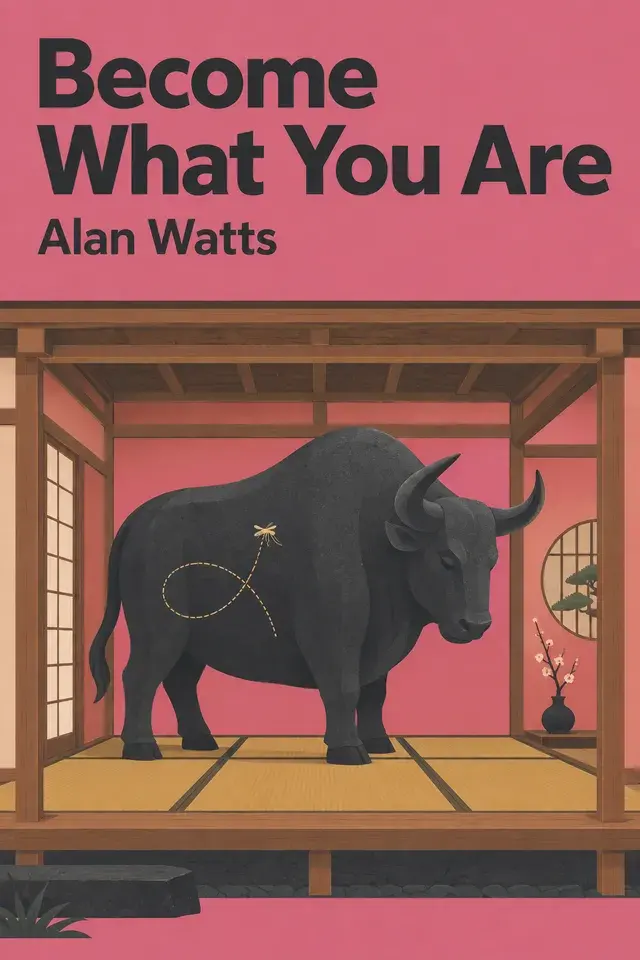
Watts illustrates this futility with the Zen image of a mosquito trying to bite an iron bull. The insect may keep trying, but its effort cannot pierce the bull. The image is not merely about weakness. It exposes a mismatch between the instrument and the task. The ego tries to break through its own structure by using more will, more scrutiny, or more endurance. Nothing essential changes. Yet even failure can be appropriated. The mosquito can make a heroic identity out of its wounds and persistence, treating the impossible bite as proof that it has earned spiritual importance. The attempt survives by turning defeat into a badge.
This is why Watts questions spiritual stories that make suffering, discipline, endurance, or willpower prerequisites for transformation. Such claims can become another way for the ego to feel deserving. They may support preaching based on shame, fear, and guilt, or encourage people to display hardship as evidence of progress. Watts is not simply praising comfort or condemning every form of effort. His target is the belief that liberation becomes secure when the self has accumulated enough proof of its seriousness. If the self can say, I achieved surrender through heroic exertion, then the supposed surrender remains an achievement.
Watts gives the impossible command an indirect function, calling it upaya, or skillful means. It cannot be obeyed like an ordinary instruction, because no separate inner agent can stand outside the self and force the self to disappear. Yet the command may expose that impossibility. A serious attempt at self-renunciation or self-acceptance reaches the discovery that the attempt cannot accomplish what it demands. Watts describes this as the ego’s metaphorical death: not the destruction of a person, but the collapse of the claim to complete self-mastery. The important event is not a successful performance of surrender. It is recognition that the performer cannot manufacture it.
The same paradox becomes clearer in emotional conflict. Suppose fear and love arise together. Fear may block love, while love remains present despite the fear. If a person commands themselves to accept love, they may simply turn against the fear with renewed force. The conflict then has not been understood; it has been divided into an approved feeling and a rejected one. The same can happen with sorrow and pride. Sorrow may call for tears, while pride prevents them. Ordering oneself to feel sorrow does not dissolve pride. It adds another demand, and the demand can become a new form of resistance.
Watts therefore warns against resolving conflict by choosing one feeling and declaring it correct. Conflicting feelings cannot always be settled by an act of preference. His psychological point is more specific: inward feeling may be allowed to unfold without being treated as an enemy. He portrays spontaneous reactions as intelligent adaptations to life, rather than as mere obstacles. Fear, for example, can provide flexibility. A mind that refuses to melt with sorrow or love may become brittle. Like water following the shape of the ground, feeling can respond to circumstances in ways that deliberate control cannot reproduce.
This account concerns inward experience, not a command to act on every impulse. Watts says that one should not pretend to feel love when one feels hatred, but acknowledging hatred does not make harmful conduct necessary or justified. Allowing a feeling to complete its inward movement is different from discharging it through premature action. Suppression can prevent the feeling from unfolding, but so can an impulsive attempt to escape the tension it creates. The distinction matters because acceptance is not a license, and emotional honesty is not the same as behavioral surrender.
The deepest examples involve feelings that no argument can finally remove: death, helplessness, and conflicts that cannot be solved by choosing a side. Philosophy can become an attempt to talk oneself out of these experiences, replacing direct recognition with explanations. Watts suggests that attention to such limits does not produce surrender as a technique. Instead, it can reveal the point at which control has reached its boundary. When resistance to an ultimate feeling ends, he says, its meaning may change. Terror may open into joy, and the horror of mortality may become freedom from the demand to preserve a separate individuality.
These claims are presented as Watts’s interpretation, not as a guaranteed psychological procedure. The chapter’s central lesson is that self-surrender becomes possible as recognition, not manufacture. The ego cannot command itself to stop commanding. It can only discover the limits of that project. In the mosquito’s futile bite, in the struggle between fear and love, and in the helplessness surrounding mortality, the same mechanism appears: attempts to control the controller sustain the division they promise to overcome. Surrender is not another victory for the self. It is what becomes visible when the claim to victory falls away.
Chapter 2 of 9 · 6 min · Audio & textIn the app
Knowing What You Actually Want
Spiritual honesty begins with a question that sounds less noble than many ideals: What do I actually want? Watts places this question before talk of renunciation, purity, or right motives.
Chapter 3 of 9 · 7 min · Audio & textIn the app
Attention Beyond the Pointing Finger
Watts begins with a warning about how religious teaching can become its own obstacle. He compares religion with medicine: it can be therapeutically useful, but need not be consumed continuously as an unquestioned way of life.
Chapter 4 of 9 · 9 min · Audio & textIn the app
Moving With Change Without Forcing
Watts uses wu-wei, often translated as nondoing or nonstriving, to name action without forcing. It is not passive withdrawal, literal inaction, or abandonment of practical aims: one can still eat dinner or take a bus.
Chapter 5 of 9 · 7 min · Audio & textIn the app
Where Explanation Reaches Its Limit
Watts begins by granting the force of logical criticism. Modern logical philosophy says statements about God, the Absolute, or ultimate reality fail to convey determinate knowledge because their key terms cannot survive logical analysis.
Chapter 6 of 9 · 7 min · Audio & textIn the app
Nonduality in an Ordinary Life
After showing why ultimate reality cannot be captured as a final concept, Watts turns to the positive claim those failed definitions were protecting. The point is not to replace one theory with a better one.
Chapter 7 of 9 · 11 min · Audio & textIn the app
Faith and Works Meet
Watts’s Buddhist essay starts with a puzzle. Philosophic Buddhism can look like salvation through self-help, while popular Mahayana devotion can look like trust in a saving power.
Chapter 8 of 9 · 6 min · Audio & textIn the app
Freedom That Includes Other People
The moral challenge appears precisely where spiritual freedom sounds most dangerous. If ultimate reality is beyond good and evil, and if Amida’s compassion accepts people regardless of moral condition, why should anyone resist cruelty?
Chapter 9 of 9 · 8 min · Audio & textIn the app
The Present as Reciprocal Life
The final question is not how to escape the present, but how to recognize what it already contains. Memory and anticipation seem to take us elsewhere, yet both are events occurring now.
Chapter 1 of 9 · 7 min · Audio & text: The Trap of Self Surrender
Wiseley supports reading and listening to summaries in the app.
Continue in WiseleyWhat Become What You Are is about
What changes when the effort to improve or transcend yourself becomes part of the problem? Alan Watts explores selfhood, nonstriving, and ordinary experience through Taoist, Buddhist, and Christian perspectives. These essays examine how attention, honest self-knowledge, and participation in life can coexist with uncertainty, individuality, and responsibility.
About Alan Watts
Alan Watts was a British and American writer and lecturer. “The Book” explores whether a person is an isolated ego or an expression of the whole universe.
Explore more books by Alan Watts