What you'll learn
Key ideas from Awaken Your Genius
These ideas compress the book's argument without treating the author's view as settled fact. Use them as an orientation before reading the full work or listening in Wiseley.
Genius is defined as becoming most like oneself, not as superiority, intelligence, or status.
Beliefs remain clearer when held as provisional understandings, with revision treated as learning rather than personal cancellation.
Finite attention makes single-tasking, risk-aware triage, and outcome-based priorities more valuable than visible busyness.
Personal definitions of success and enough keep vanity metrics, borrowed shoulds, and inherited prestige from governing a life.
Diverse, like-hearted collaborators and good-faith dissent expose blind spots, counter confirmation bias, and improve decisions.
Creation begins with repeated action before certainty, while imperfect work develops through practice and useful feedback.
Persuasive stories can outrun evidence, so skepticism works best when paired with curiosity, source-checking, and willingness to revise conclusions.
Flexible direction preserves agency, while rigid plans turn imagined outcomes into traps that block evidence and adaptation.
Inside Awaken Your Genius
Read the first chapter in full here. The other 7 continue in the Wiseley app.
Chapter 1 of 8 · 7 min · Audio & text
Wake from Inherited Scripts
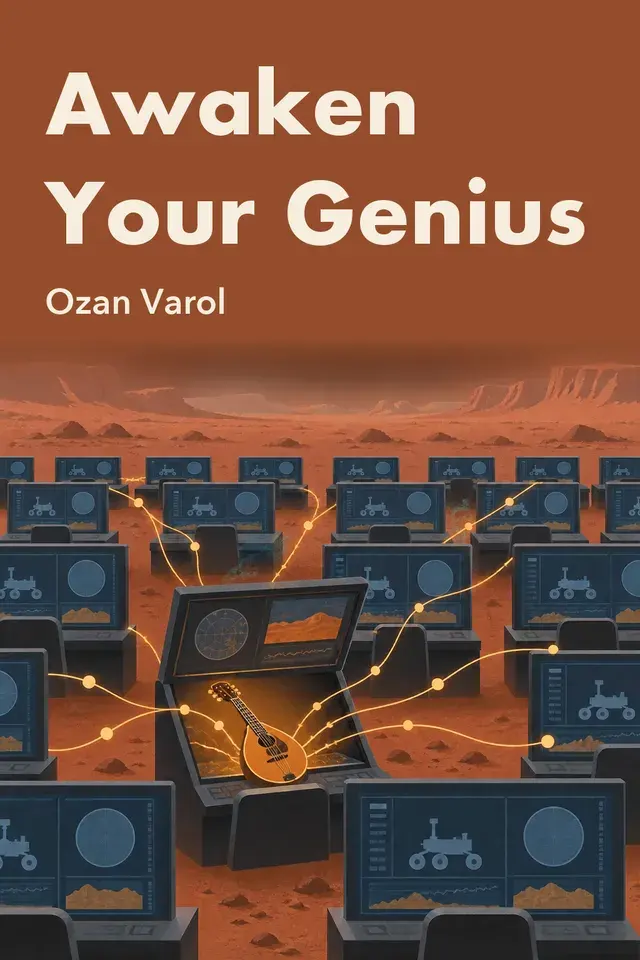
Awaken Your Genius, by Ozan Varol.
Genius, in Ozan Varol’s definition, is not a measure of intelligence, talent, status, or superiority. It means becoming most like oneself: bringing a particular perspective into the world instead of performing a borrowed life. Genius is therefore less a rare trait than a capacity that can be obscured. Each person carries an unrepeatable mixture of experiences, relationships, mistakes, and ways of seeing. The task is not to rank that mixture, but to stop letting outside expectations write its expression.
The book begins by treating ordinary life as sleepwalking. People repeat routines, beliefs, identities, and choices without knowing how they acquired them or whether they want them. Habits create a loop: familiar thoughts produce familiar actions, making the past look like the only future. Families, schools, communities, tribes, and institutions can supply scripts. Approval rewards repetition, while dissatisfaction is redirected toward external fixes. A person may become a supporting actor in a life authored elsewhere, sensing that something important remains unused.
Varol is careful not to replace one authority with another. He presents the book as a mirror and a tool for excavation, not as the reader’s truth or a complete life prescription. Readers are invited to keep what helps, skip what does not, disagree, and ask questions of their own. Independent thinking, in this account, is not reflexive opposition, solitary certainty, or a new tribal identity built around conspiracy. It can include collaboration with people who see differently. The aim is to act rather than merely react, while remaining open to correction.
The education critique shows how early these scripts can become. The story of Gillian Lynne illustrates the danger of confusing a mismatch with a defect: movement that looked like misbehavior became evidence of a way of thinking that flourished through dance when the environment changed. It shows why behavior should be understood in context before it is disciplined. Schools, the book argues, often deliver a common curriculum and common formulas to students with different perceptions and curiosities. This may be efficient, but it can fail to engage learners in subjects whose purpose they cannot see.
Purpose matters because instructions alone rarely create deep engagement. The text argues that people participate more fully when they understand why an activity matters and can connect it with an outcome they value. Its alternative to answer-centered schooling begins with the child’s original posture: curiosity, experimentation, awe, and questions. A bounded choice can preserve agency; in the author’s kindergarten example, adults set suitable limits while the child explored options, asked questions, and chose among them.
Against that ideal, the author contrasts education that stuffs facts into passive students and rewards them for regurgitating information. Memorizing the name of a process is not the same as understanding the process, just as repeating a definition of osmosis did not give the author a working grasp of it. Teacher-centered systems can encourage students to outsource thinking, while teachers themselves may be constrained by required outcomes, standardization, and teaching to the test. Rules that require permission for ordinary movement or bodily needs add another lesson: compliance can matter more than judgment. Even when schools claim to value creativity, the text says highly creative or unconventional students can be less desirable to teachers. The critique is aimed at patterns in many schools, not every teacher; well-meaning educators can be operating inside those constraints.
Exams intensify the pattern when they imply that every important question has one permanent answer already held by an authority. The question of who discovered America becomes, in the book’s example, a prompt for a narrow answer unless we first ask what discovery means, who lived there, how migration occurred, and what evidence supports each account. Real problems are often ambiguous, so a student trained only for predetermined answers may feel unprepared when no answer key appears. The author’s own law-school experience makes a related distinction: success in an evaluation system can produce a strong record without guaranteeing durable understanding.
Awakening starts earlier than creativity or a grand plan. It begins by noticing which routines, rules, and answers are accepted automatically; asking what makes us curious; understanding why a goal matters; and taking initiative to investigate rather than wait for permission. Adults, teachers, and managers can support this by responding with more inquiry and allowing people to propose solutions instead of supplying every answer. The point is not to reject all structure or become contrarian. It is to question inherited systems before they quietly become our future. Awakening genius means returning authorship to the person who must live the life.
Chapter 2 of 8 · 8 min · Audio & textIn the app
Shed Identities, Loosen Certainty
Growth can require an act that looks like failure: letting go of something that once helped. Varol uses a snake’s shedding as a metaphor.
Chapter 3 of 8 · 7 min · Audio & textIn the app
Reclaim Attention and Silence
After loosening inherited certainty, a practical question remains: what is allowed to occupy the mind? Ozan Varol argues that independent thought needs protected mental space.
Chapter 4 of 8 · 8 min · Audio & textIn the app
Build a Distinctive Life
Building a distinctive life begins with a distinction: belonging means being accepted as oneself, while fitting in means being accepted because one resembles everyone else. The author argues that pursuing the second can make the first harder.
Chapter 5 of 8 · 7 min · Audio & textIn the app
Generate Insight from Within
Insight begins before research. Varol argues that independent thinking starts by forming a provisional view before consulting Google, books, authorities, or algorithms.
Chapter 6 of 8 · 8 min · Audio & textIn the app
Play, Create, and Share
Curiosity becomes useful when it leaves the private world of possibilities and becomes something made, revised, and shared. Varol connects stages that are often treated separately: play expands the field, deliberate practice strengthens execution, and public creation turns exploration into contribution.
Chapter 7 of 8 · 10 min · Audio & textIn the app
Test Reality for Yourself
Reality testing begins with a pause. A claim can feel true because it has been repeated, endorsed by a credentialed person, or wrapped in a story.
Chapter 8 of 8 · 6 min · Audio & textIn the app
Release the Map
By the end of the book, the central challenge is no longer finding the right answer. It is living responsibly when no answer can map the route ahead.
Chapter 1 of 8 · 7 min · Audio & text: Wake from Inherited Scripts
Wiseley supports reading and listening to summaries in the app.
Continue in WiseleyWhat Awaken Your Genius is about
Awaken Your Genius examines how inherited identities, social conditioning, distracted attention, and borrowed certainty narrow a person’s choices. It asks how to recover independent judgment and distinctive creativity, then turn curiosity into purposeful action while adapting to uncertainty. The result is a practical framework for thinking, experimenting, creating, and changing course.
About Ozan Varol

Ozan Varol is a Turkish-born author and former law professor. “Awaken Your Genius” explores how inherited identities, social conditioning, and borrowed certainty narrow a person’s choices.
Explore more books by Ozan Varol