What you'll learn
Key ideas from Anxiety at Work
These ideas compress the book's argument without treating the author's view as settled fact. Use them as an orientation before reading the full work or listening in Wiseley.
Credible workplace support protects privacy, addresses workable conditions, and connects employees with professional care without turning managers into therapists.
Clarity works with autonomy when employees understand the situation, decision boundaries, and freedom they retain.
Chronic overload is a work-design problem when exceptional effort becomes the normal operating model.
Individual development links motivations and skills to supported practice, useful work, coaching, recognition, and repeated decisions about direction.
Explicit good-enough criteria preserve iteration where feedback is useful without relaxing safety-critical standards.
Issue-Value-Solution turns a tense concern into a factual, values-based conversation with a jointly developed next step.
Effective allyship protects confidentiality, investigates concerns, accepts correction, and keeps responsibility for change with people who hold power.
Validation affirms a person’s worth, while recognition names an achievement and its impact; both are needed.
Inside Anxiety at Work
Read the first chapter in full here. The other 7 continue in the Wiseley app.
Chapter 1 of 8 · 9 min · Audio & text
Recognizing Anxiety Behind Competence
Anxiety at Work, by Adrian Gostick and Chester Elton with Anthony Gostick.
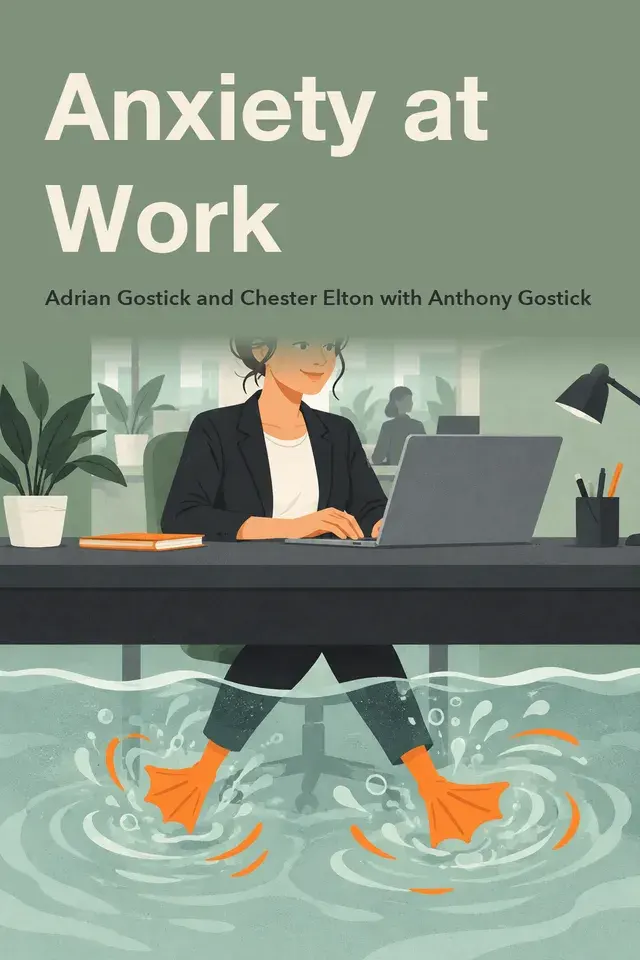
Outward competence can be misleading evidence. An employee may meet deadlines, sound confident, and solve difficult problems while privately losing sleep, second-guessing decisions, or spending unsustainable energy appearing calm. The authors use “duck syndrome” for this split between a composed surface and frantic effort underneath. Steady output and silence about mental health cannot prove that someone is well or that a workplace feels safe. People may fear lost opportunities, marginalization, or judgment, while warning signs such as irritability, declining productivity, and more sick days remain subtle and nonspecific. Anxiety is not proof of weakness. The authors note that anxious employees can be highly productive and that worry may motivate harder work, but those possible contributions do not establish anxiety as a universal or proven cause of superior performance.
In the authors’ terms, worry, stress, and anxiety overlap but are not interchangeable. Worry is repetitive thought. Stress is the body’s response to change. Anxiety is a mind-and-body experience that can interfere with life and, in some cases, be a diagnosable disorder. It may attach to a recognizable threat, such as job security or excessive workload, or appear as generalized unease without an obvious reason. This distinction separates ordinary workload complaints from anxiety overload: too much work is not automatically a disclosure that work is producing anxiety. The book names uncertainty, overload, unclear growth or expectations, perfectionism, fear of speaking, marginalization, exclusion, and low confidence as sources. Their specific interventions come later; this chapter establishes why leaders must understand the difficulty before choosing a response.
Disclosure is not equally safe for everyone. The authors use Lenny Mendonca’s openness about depression and anxiety to show the value of public conversation, but Mendonca also recognized that executive seniority protected him from risks most employees face. A junior employee may reasonably wonder whether honesty will affect assignments, advancement, or belonging. That is the practical meaning of psychological safety here: a credible expectation that speaking about difficulty will not automatically bring shame or career harm. This makes a manager’s first response consequential.
Chloe’s story shows why. She had academic success and appeared confident, yet experienced self-doubt and growing isolation. She eventually told her manager that she felt overwhelmed. The manager treated it as normal workplace pressure and advised her not to stress. Only after that response did Chloe begin to feel a looming dread each night and show the signs of a full-blown panic attack on Sunday evenings. Before long she could hardly get out of bed. The authors read her tentative disclosure as a test: was it safe to discuss what was happening? The minimizing reply closed the route to further conversation. Chloe withdrew, then disappeared from work and communication. The point is not that a manager caused a disorder, or that one conversation explains every later event. It is that dismissal can turn a possible support conversation into concealment, withdrawal, and organizational loss. A capable employee can be struggling long before performance makes the problem undeniable.
That is why resilience cannot be reduced to toughness. The authors define it as the ability to respond to change and recover from challenges, and they argue that it can be developed. Mastery is the sense that one retains some control and influence over circumstances; it is different from optimism or simply enduring hardship. Supportive relationships give people places where difficulty can be acknowledged. They are associated with better recovery from trauma, while critical reactions can encourage suppression, avoidance, withdrawal, and self-blame. People also differ in how anxiety appears and what support they need. One person’s deadline fear may reflect perfectionism; another may be secure about performance but frightened by the organization’s direction. Managers should investigate the difficulty, not assign a label.
Southgate’s England example offers a contrasting pattern. The team had been affected by anxiety and fear of media criticism. Southgate acknowledged vulnerability, involved a culture psychologist, and made room for compassionate conversations about players’ experiences. The authors connect that shift toward cohesion, positivity, and enjoyment with England’s reported top-four finish at the 2018 World Cup. The example is not proof that support alone produced the result. Its lesson is about conditions: a leader’s openness can lower the cost of speaking, while practical and relational support can help people use their abilities without hiding distress. Vulnerability here is an invitation, not a demand for disclosure.
A useful first response starts with observable difficulty rather than a diagnosis. A manager can name a change in participation, output, or attendance and ask how the person is doing. The manager should state the purpose of the conversation, listen before offering advice, and acknowledge that the experience may be difficult. Then ask what would make the immediate work more manageable. The answer may point to a workplace strain, such as an unclear expectation, an overloaded assignment, or the need for a short-term adjustment. Address what lies within managerial control and follow through. Do not respond with calm down, treat a disclosure as ordinary pressure, or send everyone straight to an assistance program. An employee may need an advocate and a manager who examines the work, not only a referral away from it.
At the same time, managers are not therapists. They should not pry into medical history, demand a diagnosis, or press for details the employee does not want to share. They can explain available options, including an employee assistance program, licensed counselor, or other qualified specialist, and help the employee reach them when professional care is appropriate. Referral should be offered with empathy, not used to imply that the person or the workplace is the whole problem. Privacy and choice make support safer. If the manager has contributed to the strain, responsibility includes examining and changing that contribution where possible.
Leaders cannot eliminate anxiety, control economic shocks, or solve every personal cause. They can reduce the anxiety their practices add. That means making support credible through repeated behavior: explaining difficult conversations, listening without minimizing, responding with practical help, and connecting people to care without abandoning them to it. The aim is not to identify anxious employees or turn the workplace into a clinic. It is to make competence and distress both speakable, so people are less likely to disappear before anyone understands what they need.
Chapter 2 of 8 · 10 min · Audio & textIn the app
Making Uncertainty Discussable and Actionable
Uncertainty becomes exhausting when people must supply missing information themselves. A gap in facts, an ambiguous request, or silence after work is submitted invites threat anticipation: What does my manager expect?
Chapter 3 of 8 · 9 min · Audio & textIn the app
Designing Work People Can Sustain
Chronic overload is not simply a test of character. A genuine crunch can briefly mobilize energy, but trouble begins when exceptional effort becomes the normal operating model.
Chapter 4 of 8 · 10 min · Audio & textIn the app
Building Growth Around the Individual
Career anxiety often starts with the future, not with a single difficult task. A person may wonder whether staying means missing more interesting, secure, or better-paid work.
Chapter 5 of 8 · 9 min · Audio & textIn the app
Replacing Perfectionism With Reliable Learning
High standards are not the problem. The authors distinguish responsible exactness from perfectionism.
Chapter 6 of 8 · 8 min · Audio & textIn the app
Turning Silence Into Constructive Disagreement
Silence can look like peace, but at work it can conceal an accumulating argument. Employees who fear consequences may flee tense conversations, change the subject, sugarcoat bad news, or withhold a view.
Chapter 7 of 8 · 9 min · Audio & textIn the app
Addressing Unequal Burdens Through Allyship
Anxiety at work can affect anyone, but the authors argue that exposure to it is not equal. Prejudice, exclusion, economic insecurity, and pressure to assess whether it is safe to be authentic can add stress before a task even begins.
Chapter 8 of 8 · 12 min · Audio & textIn the app
Making Belonging and Appreciation Credible
At work, anxiety can be shaped by two doubts: Do I belong with these people? Does what I do matter to them?
Chapter 1 of 8 · 9 min · Audio & text: Recognizing Anxiety Behind Competence
Wiseley supports reading and listening to summaries in the app.
Continue in WiseleyWhat Anxiety at Work is about
How can leaders reduce the anxiety that everyday work creates? Anxiety at Work examines uncertainty, overload, stalled growth, perfectionism, silence, and exclusion. It offers practical ways to clarify expectations, shape manageable work, support development, encourage constructive disagreement, and build belonging and confidence while respecting the limits of a manager’s role.
About Adrian Gostick, Chester Elton & Anthony Gostick

Adrian Gostick
Adrian Gostick is a British writer. “Anxiety at Work” explores how leaders can reduce the anxiety that uncertainty, overload, and perfectionism create at work.
Explore more books by Adrian Gostick
Chester Elton
Chester Elton is a Canadian writer. “Anxiety at Work” explores how leaders can reduce the anxiety that uncertainty, overload, and perfectionism create at work.
Explore more books by Chester Elton
Anthony Gostick
Anthony Gostick is a coauthor of “Anxiety at Work”. The book explores how leaders can reduce the anxiety that uncertainty, overload, and perfectionism create at work.
Explore more books by Anthony Gostick