What you'll learn
Key ideas from And There Was Light
These ideas compress the book's argument without treating the author's view as settled fact. Use them as an orientation before reading the full work or listening in Wiseley.
Lincoln viewed democratic reform as a contest in which reason might gradually shape public opinion and institutions.
Lincoln and Dan Stone condemned slavery in 1837 while accepting constitutional limits on federal action.
Lincoln treated the Declaration’s equality principle as a standard for judging slavery, not as proof that equality had already been achieved.
The war began as a struggle to preserve the Union; emancipation entered policy through a series of contested steps.
The final Proclamation targeted enslaved people in areas still in rebellion; it was a consequential wartime measure, not universal abolition or equality.
The Gettysburg Address asked the living to finish the dead’s unfinished work and made equality and popular government stakes of the war.
Lincoln’s suffrage hesitation exposed the gap between ending slavery and accepting Black political power.
Lincoln advanced freedom and helped preserve democracy, but his achievements did not secure lasting racial justice.
Inside And There Was Light
Read the first chapter in full here. The other 14 continue in the Wiseley app.
Chapter 1 of 15 · 7 min · Audio & text
The Making of an Unfinished Man
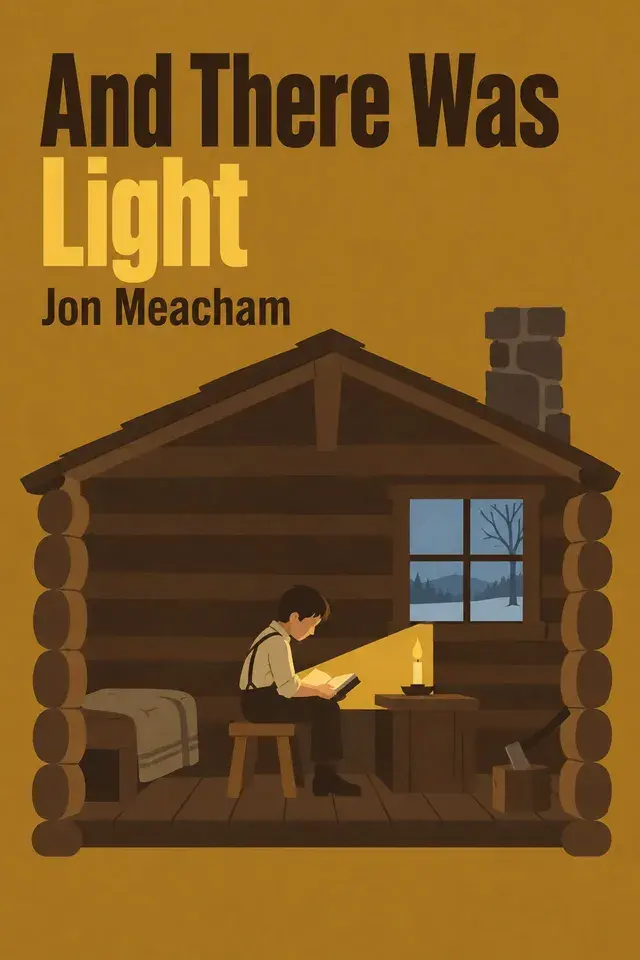
And There Was Light, by Jon Meacham.
Meacham opens on the young republic’s frontier, where Abraham Lincoln’s childhood combined poverty, family memory, religious teaching, and a growing appetite for books. Lincoln was born in Kentucky in 1809 and lived there until his family moved to Indiana in 1816. The dates place his childhood first in a state where slavery was entrenched, then in Indiana, where slavery was prohibited. They also locate his formation in a hard, sparsely settled world.
Family memory offered Lincoln a way to imagine where he came from. Around 1850, he told his law partner that Nancy Hanks was believed to be the illegitimate daughter of an unknown, well-bred Virginia farmer or planter. Lincoln thought this possible grandfather might explain his own ambition and intellectual gifts, while crediting his mother for all he was or hoped to be. The story mattered to his self-understanding, but it does not establish his parentage. Other claims about his origins circulated as rumor. A separate family legend told that his grandfather was killed while opening a Kentucky farm, and that his uncle Mordecai killed the attacker while saving Thomas, Lincoln’s father. Lincoln said this account stayed strongly in his memory. The stories carried both a search for ancestry and a memory of vulnerability; neither turns uncertain family history into verified biography.
Vulnerability was also material. Lincoln was born in a small, dirt-floored cabin and remembered cold winters, tattered clothes, and his toes sticking out of his boots. In Indiana, Thomas Lincoln put his son to work clearing forest and farming. Abraham later recalled spending much of his youth at an axe. His classroom schooling amounted to less than a year. Yet he practiced writing wherever he could find a surface, tracing letters in dust, sand, snow, or charcoal. Education was not a normal track laid out for him; it became a habit he made for himself amid labor and limited schooling.
The move to Indiana carried more than one motive. Land was cheaper there, and slavery was prohibited. Accounts differ about what mattered most to Thomas. Lincoln later recalled difficulty with land titles as the chief reason and slavery as a partial reason; Dennis Hanks emphasized better land and denied that opposition to slavery explained the move by itself. Meacham reads the evidence as economic and moral at once. Thomas did not own enslaved people, and he joined Baptist congregations in Kentucky and Indiana where opposition to slavery could be heard. That setting gives substance to Lincoln’s later description of himself as naturally antislavery, without making his childhood a single dramatic conversion.
The family lived near a route used by slave traders, and one writer inferred that Lincoln might have seen enslaved people driven along it. Lincoln later reportedly said he had seen slavery as a boy and remembered horrifying images. But that recollection does not confirm that he witnessed a particular chained group on the road; the specific scene remains an inference.
The Baptist world around the Lincolns did not speak with one voice. Some ministers described slavery as oppression and a sin against God, drawing on the belief that all people could be redeemed; other Christian settings tolerated or practiced slavery. Lincoln heard sermons and reportedly repeated them nearly word for word. Sarah Bush Lincoln later remembered him repeating sermons on a stump and making other speeches. His stepsister Matilda Johnston Moore recalled that when the children were left at home, Lincoln would take down the Bible, read a verse, give out a hymn, and preach while they sang. These recollections show religion as an active part of household life, not merely formal Sunday attendance.
He did not join his family’s church or openly profess the faith around him. The sources offer several possible explanations, including his relationship with his father and discomfort with Baptist predestination, but settle on none. Scripture itself could be difficult: creation and goodness stood beside the Flood, deliverance from Egypt beside Israel’s enslavement, and Job’s suffering. Meacham presents Lincoln’s religious formation as exposure to moral claims, conflicting teachings, and questions he did not resolve, rather than a neat conversion story.
His first education also came through family. Nancy read the Bible to Abraham and taught him reading, spelling, and kindness. She died in 1818, two years after the move to Indiana. Meacham treats her loss as a formative rupture, while describing the surviving recollections of her as sparse and mixed. Thomas later married Sarah Bush Johnston, a widow whose arrival changed the household. She cleaned and mended the children’s clothes, brought order, and encouraged Abraham’s appetite for learning. Thomas expected his son to work and was initially reluctant to grant him time for study. Sarah persuaded him to allow reading at home as well as at school. The family then let Abraham read undisturbed until he stopped on his own. Her support did not remove the labor or poverty around him, but it gave his self-education room to continue.
Lincoln read whatever was available, including Aesop’s Fables, Pilgrim’s Progress, a life of Washington, Robinson Crusoe, and the Bible. He especially valued the King James Psalms and Isaac Watts’s hymns. He later singled out Lindley Murray’s English Reader, besides the Bible, as perhaps the most important book of his life. The Reader joined lessons in language with lessons in conduct. Its selections counseled self-possession instead of anger, charity toward others, severe judgment of oneself, and perseverance through distress. Those maxims offered more than instruction in fluent reading; they gave him a vocabulary for discipline and moral self-scrutiny.
Lincoln did not simply absorb a finished creed from books. He puzzled at night over expressions spoken by older people until he could restate them plainly to himself. Readings by Addison and Blair linked education with discovering hidden capacity, and influence with careful speech and amiable character. Grimshaw’s popular history presented antislavery as part of the nation’s gradual movement toward the Declaration’s ideals. These books could help a poor farm boy imagine distinction and a larger life, though they could not settle what he would do with that ambition. The influences were real, but they left his character and future course open.
Chapter 2 of 15 · 5 min · Audio & textIn the app
Learning to Lead in Public
In March 1832, Lincoln announced his candidacy for the Illinois legislature. He presented himself as young and poor, promised diligent service, and supported education and internal improvements.
Chapter 3 of 15 · 5 min · Audio & textIn the app
A Republic Against Its Own Laws
By 1837, antislavery speech had become a source of alarm across the country. In Illinois, lawmakers sought to reassure slaveholding states by condemning abolitionists, supporting colonization, and defending slavery in the District of Columbia.
Chapter 4 of 15 · 6 min · Audio & textIn the app
Marriage, Ambition, and Political Character
Lincoln’s public ambition developed alongside a private life marked by uncertainty and strain. His marriage to Mary Todd brought affection, shared hopes for public distinction, and the demands of family life.
Chapter 5 of 15 · 6 min · Audio & textIn the app
Slavery Within Constitutional Limits
Lincoln’s first term in Congress placed him in Washington as the Mexican War and the territory gained from it sharpened the national dispute over slavery. He repeatedly supported the Wilmot Proviso, which would have barred slavery from lands acquired from Mexico.
Chapter 6 of 15 · 10 min · Audio & textIn the app
The Founding Promise Under Pressure
By the middle of the 1850s, the Declaration’s promise of equality had become a test for the country’s choices about slavery. Lincoln treated that promise as a standard, not a description of American life as it already existed.
Chapter 7 of 15 · 8 min · Audio & textIn the app
Holding the Line Before War
John Brown’s raid at Harpers Ferry in October 1859 made the danger of the slavery dispute hard to ignore. Brown and about twenty followers seized the federal armory and a rifle factory, hoping to spark an uprising.
Chapter 8 of 15 · 8 min · Audio & textIn the app
Saving the Union, Changing the Legal Ground
Once secession became war, Lincoln’s governing aim was to preserve the Union and the republic. He believed the government had to resist rebellion, but the war was not initially designed to free enslaved people.
Chapter 9 of 15 · 7 min · Audio & textIn the app
The Proclamation’s Promise and Limits
By the summer of 1862, Lincoln was weighing emancipation as a way to weaken the rebellion and as a step toward justice. Enslaved people’s labor sustained the Confederacy, he reasoned, so drawing that labor away could damage its ability to fight.
Chapter 10 of 15 · 7 min · Audio & textIn the app
Pressure, Memory, and a New Birth
The Emancipation Proclamation had not brought the Union out of danger. The war’s outcome remained uncertain, and the burdens of command coincided with personal grief and family troubles.
Chapter 11 of 15 · 8 min · Audio & textIn the app
An Election During Rebellion
In 1864, the presidential election became a contest over wartime leadership and a test of whether constitutional government could keep operating during rebellion. Lincoln saw no legitimate way to postpone it.
Chapter 12 of 15 · 6 min · Audio & textIn the app
Abolition, Citizenship, and Reconstruction
By early 1865, the question was how to secure emancipation in the nation’s law. Abolitionists looked to a constitutional amendment to protect freedom from future political reversals.
Chapter 13 of 15 · 6 min · Audio & textIn the app
Judgment, Providence, and Charity
The Second Inaugural places the war within a moral order without claiming to explain that order fully. Lincoln names slavery as the conflict’s cause and refuses to treat victory as proof of the Union’s innocence before God.
Chapter 14 of 15 · 7 min · Audio & textIn the app
Victory, Violence, and Lincoln’s Death
By April 1865, Confederate defeat had become visible in Richmond. As the city evacuated, guards abandoned posts and disorder spread.
Chapter 15 of 15 · 5 min · Audio & textIn the app
A Legacy Without Completion
The epilogue measures Lincoln’s legacy against what followed, not only against what he achieved. He helped preserve the Union’s democratic experiment and move the country toward freedom.
Chapter 1 of 15 · 7 min · Audio & text: The Making of an Unfinished Man
Wiseley supports reading and listening to summaries in the app.
Continue in WiseleyAbout Jon Meacham

Jon Meacham is an American journalist and biographer. “And There Was Light” explores how Abraham Lincoln joined moral conviction to democratic politics through slavery, secession, and civil war.
Explore more books by Jon Meacham