What you'll learn
Key ideas from An Enquiry Concerning Human Understanding
These ideas compress the book's argument without treating the author's view as settled fact. Use them as an orientation before reading the full work or listening in Wiseley.
The copy principle tests philosophical terms by tracing simple or complex ideas back to their originating impressions.
Relations of ideas are established by thought alone, while matters of fact have conceivable contraries and cannot be settled by contradiction.
The gap between past observations and future predictions is an added assumption, not a demonstrated relation.
Belief is an involuntary, more vivid conception than imagination, strengthened when an impression lends force to its associated idea.
Causation has an observed regularity side and a mental-transition side, without revealing a hidden mechanism.
A miracle report can prevail only if its falsehood would be more extraordinary than the reported event.
An effect licenses only the qualities in a cause that are sufficient to explain it.
Disciplined enquiry clarifies terms, tests claims through suitable experience, weighs objections, calibrates confidence, and stops where evidence ends.
Inside An Enquiry Concerning Human Understanding
Read the first chapter in full here. The other 10 continue in the Wiseley app.
Chapter 1 of 11 · 8 min · Audio & text
Examining the Mind Through Experience
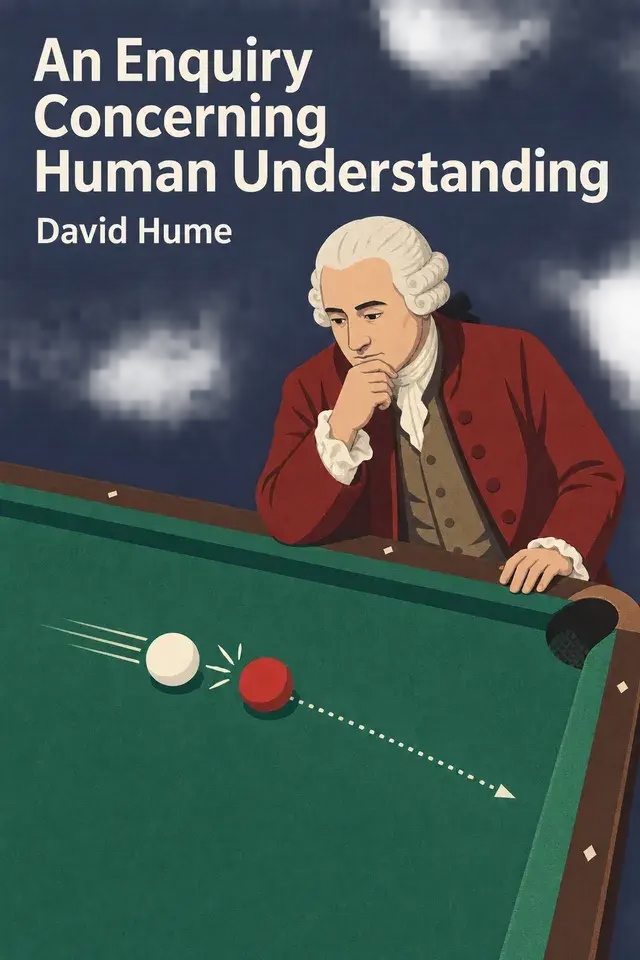
An Enquiry Concerning Human Understanding, by David Hume.
Philosophy, Hume begins, can address human beings in two different ways. One style is humane, accessible, and close to ordinary life. It treats people as agents moved by taste and sentiment. Through vivid examples, contrasts, poetry, and eloquence, it makes virtue attractive and shapes conduct. The other style is abstruse and analytical. It treats human nature as an object of investigation, seeking the principles that govern understanding, feeling, and judgments of approval or blame. It moves from particular cases toward general principles, hoping to discover where inquiry reaches its limits. One style speaks to the heart. The other asks what makes the heart and understanding work.
These styles should not be enemies. Humane philosophy gives inquiry a place in common life, while accurate philosophy gives humane reflection sharper concepts and more reliable reasoning. Hume imagines a balanced human life that joins study, sociability, and practical activity. People are not only thinkers, nor only companions, nor only workers. Philosophy should therefore remain relevant to action and society, even when it investigates difficult questions. Exact knowledge of the mind can also improve writing and judgment. Hume compares inward analysis to anatomy: the examination may feel unpleasant, yet it can help an artist represent living behavior accurately. Accuracy can serve beauty, and sound reasoning can refine delicate sentiment. Neither needs to prove its worth by humiliating the other.
This defense of precision has a sharper purpose. Some metaphysics, Hume argues, tries to penetrate subjects beyond human reach or uses obscurity to shelter superstition. The answer is not to abandon difficult inquiry. It is to examine the mind's powers and capacities, expose hidden assumptions, and determine what can actually be understood. Failure by earlier investigators does not prove that every route is closed; later effort may succeed. But success cannot be promised in advance. The operations of the mind are intimate, yet they become obscure when reflection makes them its object. A preliminary map is therefore valuable. It can separate the faculties we ordinarily distinguish, while leaving open the possibility that deeper principles remain undiscovered.
To begin that map, Hume distinguishes two kinds of perception. Impressions are the more forceful and vivid experiences involved in sensing, feeling, loving, hating, desiring, and willing. Ideas are the less lively perceptions that arise when the mind reflects on or remembers those experiences. Seeing a color, feeling pain, or being moved by passion has a force that a later recollection does not match. Even the liveliest thought is weaker than the dullest sensation. The distinction applies across the senses and the passions, and it also marks the difference between present experience and the mind's quieter operations.
Once this contrast is in place, Hume asks how far thought can create. Imagination looks almost unlimited because it can combine, transpose, enlarge, or diminish what experience supplies. Yet its freedom is rearrangement, not the creation of wholly new materials. The mind can join the familiar ideas of gold and a mountain into a golden mountain. It can combine virtue with the form of a horse to imagine a virtuous horse. A complex or sublime thought can likewise be analyzed into simpler elements copied from earlier feelings or sensations. This is the copy principle: every idea is derived from a prior impression, and a philosophical term should have some experiential material behind it.
The principle becomes an investigative procedure. When a philosopher uses an obscure term, we should ask what impression first supplied its meaning. If the term is said to represent a simple idea, the corresponding impression should be identifiable. If it represents a complex idea, we should separate its parts and trace those parts to experience. When no such source can be found, suspicion is justified: the word may be functioning without a determinate idea. But if someone claims that the principle is not universally true, that critic must first produce an idea allegedly not derived from an impression; Hume must then identify the corresponding impression if he is to maintain the doctrine. The test can dissolve disputes that are only verbal, because a frequently repeated term may feel meaningful even when its content remains faint and confused. Impressions are more vivid and sharply bounded, so they provide a better standard than abstract language alone.
Still, this is a test, not an excuse for automatic dismissal. A person born without a working sense lacks the ideas that sense would normally provide, while restoring the sense supplies a route to them. Someone who has never encountered an object may also lack the corresponding sensation. Limited experience can narrow the understanding of passions such as cruelty or generosity. These cases tell us to inspect the conditions of experience before declaring a term empty. They also remind us that other beings may have senses, and therefore ideas, that humans cannot access. The absence of a familiar human impression does not by itself settle every question. Careful analysis must ask whether the idea is simple or complex, whether its source has been overlooked, and whether the limits belong to the mind or to the vocabulary.
Hume then acknowledges a striking exception. Imagine a person who has encountered every shade of blue except one. If the shades are arranged in order, the missing place can be presented, and the person may be able to imagine the absent shade without having received its direct impression. Hume treats this as a possible case in which a simple idea does not come from a matching impression. He does not hide the difficulty or force the example into the rule. Because it is singular and unusual, he retains the copy principle as a general maxim rather than an exceptionless law. The exception actually clarifies the method's character: it is strong enough to guide inquiry, but flexible enough to acknowledge evidence that resists a universal formulation.
The larger lesson is methodological. Philosophy becomes clearer when it moves from impressive words to the experiences that could give those words content. That movement can expose false metaphysics, sharpen legitimate questions, and show where inquiry must remain modest. It does not promise that every mental principle has already been found. It gives us a disciplined way to investigate: identify the perception involved, analyze its parts, test the conditions under which it arose, and distinguish a genuine limit from a mere confusion of language. Hume's study of human understanding begins there, at the point where experience supplies both the materials of thought and the measure of philosophy's reach.
Chapter 2 of 11 · 8 min · Audio & textIn the app
Connections and Kinds of Thought
Once Hume has considered ideas as the mind’s materials, he asks how one idea leads to another. In serious discourse, casual conversation, reverie, and dreams, thoughts do not usually arrive as a random heap.
Chapter 3 of 11 · 7 min · Audio & textIn the app
Why the Future Exceeds Experience
The problem begins when inquiry moves beyond what memory and the senses directly present. We often infer an absent event or object from something present: a watch suggests a former maker, articulate speech in darkness suggests a person, and heat and light can point to the same fire.
Chapter 4 of 11 · 10 min · Audio & textIn the app
Habit Makes Belief Possible
Hume’s positive account begins with custom, or habit. When two kinds of event have been repeatedly conjoined, the mind acquires a propensity to pass from one to the other.
Chapter 5 of 11 · 6 min · Audio & textIn the app
Proportioning Confidence to Uneven Evidence
Custom does not always deliver a single, settled expectation. When experience has shown a cause followed by different effects, the mind carries those alternatives forward together.
Chapter 6 of 11 · 11 min · Audio & textIn the app
Where Necessary Connection Comes From
Hume now applies the impression test to causal power itself. Terms such as power, force, energy, and necessary connection seem indispensable, yet they are among the most obscure metaphysical ideas.
Chapter 7 of 11 · 12 min · Audio & textIn the app
Freedom Within Predictable Human Conduct
Having treated necessity as a question about observed causal order, Hume turns to human conduct. He says the dispute between liberty and necessity has often been verbal, so he begins by fixing the terms.
Chapter 8 of 11 · 9 min · Audio & textIn the app
When Testimony Conflicts With Experience
Whenever we hear a report about an event we did not witness, its authority is not self-generating. We trust testimony because experience has shown a regular match between what people report and what happens.
Chapter 9 of 11 · 11 min · Audio & textIn the app
Miracle Reports Under Comparative Scrutiny
The preceding test now meets its hardest application. Hume asks not simply whether an individual witness can be exposed as a liar.
Chapter 10 of 11 · 8 min · Audio & textIn the app
How Far an Inferred Cause Reaches
The dialogue now shifts from the credibility of reports to the reach of explanatory reasoning. The narrator introduces a skeptical friend whose principles he records while warning that he does not approve every one of them.
Chapter 11 of 11 · 11 min · Audio & textIn the app
Living With the Limits of Reason
At the close of the enquiry, skepticism has to be separated into different attitudes. One is a preliminary caution.
Chapter 1 of 11 · 8 min · Audio & text: Examining the Mind Through Experience
Wiseley supports reading and listening to summaries in the app.
Continue in WiseleyWhat An Enquiry Concerning Human Understanding is about
What justifies our expectations about events we have never observed? Hume examines how experience, habit, and imagination shape belief, then tests their reach in questions of freedom, miracles, and religion. His enquiry offers ways to assess evidence, clarify difficult concepts, and practise skepticism without abandoning ordinary life.
About David Hume
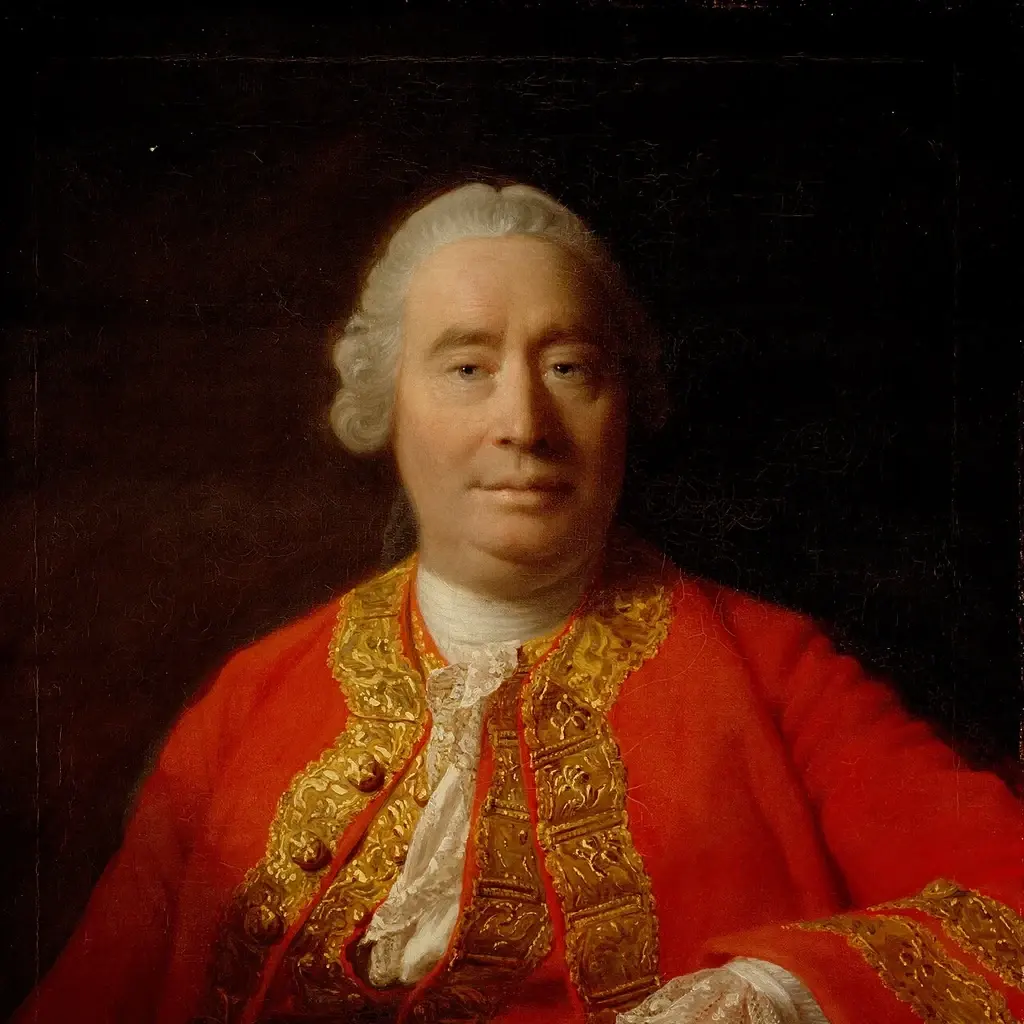
David Hume was a Scottish philosopher, historian, economist and essayist. “An Enquiry Concerning Human Understanding” explores what justifies expectations about events never observed and how experience, habit, and imagination shape belief.
Explore more books by David Hume