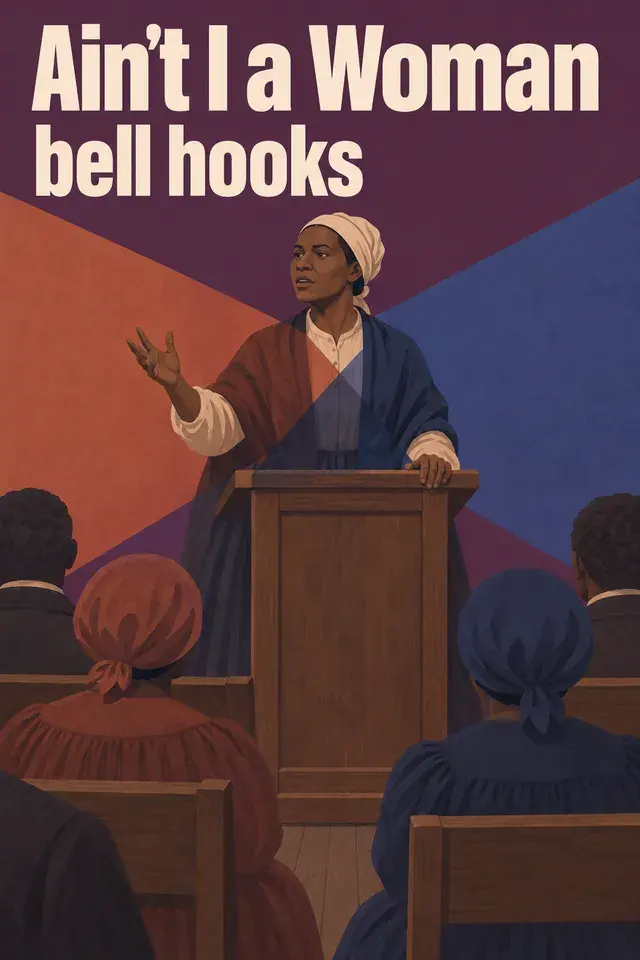
What you'll learn
Key ideas from Ain’t I a Woman
These ideas compress the book's argument without treating the author's view as settled fact. Use them as an orientation before reading the full work or listening in Wiseley.
Black women’s position becomes obscured when racism and sexism are analyzed as separate forces.
Slavery joined racial ownership to Black women’s forced labor, sexual coercion, and reproductive control.
Amazon, mammy, and Sapphire images set conflicting standards that made strength, service, and anger grounds for control.
Black liberation politics could challenge racism while preserving male authority, as hooks’s reading of Douglass’s suffrage argument shows.
Black women’s withdrawal and separate organizing responded to exclusion; sisterhood required continuing work against racism and classism.
Black women’s public advocacy and organizing formed a sustained feminist tradition, despite historical accounts that obscured or misclassified it.
Hooks reclaims feminism as collective liberation from sexist domination, linked to racial and class justice and to human freedom for all.
Inside Ain’t I a Woman
Read the first chapter in full here. The other 6 continue in the Wiseley app.
Chapter 1 of 7 · 8 min · Audio & text
Intersectional Lens, Political Stakes
Ain’t I a Woman, by bell hooks.
bell hooks begins with a problem of understanding: Black women’s position disappears when racism and sexism are examined as separate forces. Accounts of Black people may treat men’s experience as representative, while accounts of women may silently mean white women. In either case, Black women’s lives and political interests fall out of view. hooks argues that neither racial liberation nor feminism can be complete if it asks Black women to set aside part of their experience. The book’s opening framework is to examine race and sex together, and to ask what becomes invisible when either is made secondary.
That erasure affects how Black women understand themselves and what they believe they can ask for. hooks describes socialization that taught many Black women to regard their femaleness as less important, to see racism as the only oppression that mattered, and to accept submission and silence. Some hoped that freedom from racism alone would make them free. These pressures could make sexism seem natural or less urgent, even when it shaped their lives. hooks does not reduce silence to a deliberate tactic of solidarity with Black men or opposition to white feminists. She connects it, too, to resignation: if a woman has been taught that her interests do not deserve defense, speaking may seem to offer little possibility of change.
The conflict around suffrage makes the political stakes visible. In the debate described as “the Negro’s hour,” support for Black men’s votes could coexist with opposition to women’s votes. White women’s advocates, meanwhile, could withdraw from political solidarity with Black activists when they feared that support for Black men might threaten their own chance at the ballot. Black male activists who favored women’s rights still faced pressure to secure their own vote first. Black women were left between a women’s movement marked by racism and a racial movement whose immediate political claim centered men.
Some Black women argued that voting rights had to include both Black men and women. Sojourner Truth warned that giving political rights to Black men alone would leave Black women subject to male rule; it would not make them free. Her challenge exposed a limit in the idea that advancing Black men’s rights would automatically advance Black women’s. hooks notes that Black men gained the vote despite such protest, and that male leaders continued to uphold expectations of women’s subordination. The episode shows how a movement can oppose racial exclusion while still asking women to wait, and how women’s equality can be deferred in the name of a larger cause.
A similar pattern appeared inside Black liberation organizations. In the civil-rights and Black liberation struggles, women worked alongside men, but received less public recognition, while gendered roles could be treated as ordinary. hooks cites Toni Cade’s account of organizations where women answered phones and made coffee as men wrote position papers and set policy. When women objected, their concerns could be redirected into token executive positions or separate caucuses. Conflict could also push women to hold separate workshops, without resolving the question of the group’s political position. The contrast is concrete: women supplied labor that helped the organization function, but men controlled the decisions that defined its aims.
This example suggests questions for evaluating any movement. Who does the routine work, and who speaks for the group? Who sets policy and controls the response when members object? Who benefits from the movement’s definition of freedom? Which oppression is treated as urgent, and whose concerns are asked to wait? A group’s stated commitment to liberation does not answer these questions by itself. Its roles and decisions show whether it makes room for Black women’s interests or reproduces their subordination while opposing another form of injustice.
hooks also preserves the variety in Black women’s responses to these pressures. Some resisted subordinate roles; some accepted or accommodated them. Some supported feminist politics despite criticism, while others remained unaffiliated or formed Black feminist groups. Many faced pressure to choose between movements that each offered an incomplete account of their needs. These responses should not be flattened into a single position or read as proof that Black women were indifferent to equality. The choices took shape within constrained political conditions, and the opening argument asks why those conditions narrowed the available choices in the first place.
The same care is needed when deciding whose experience counts as evidence. Writing that uses “women” to mean white women, or “Black people” to mean Black men, can erase Black women even while discussing oppression. Comparisons between women and Black people can also conceal the fact that Black women belong to both groups and cannot be represented by either comparison alone. hooks’s method is to notice these substitutions and ask whose experience has been made the default. A claim may sound universal while actually describing only one group’s position.
Personal testimony matters, but hooks cautions against treating one person’s story as a complete analysis of Black women’s experience. She recognizes Michele Wallace’s personal account and her criticism of patriarchal impulses among Black male activists, while disputing the claim that the book offers a definitive feminist analysis. In hooks’s view, personal narrative alone gives too little attention to how sexism affects Black women and what feminism might offer them. The qualification is methodological: testimony can reveal an experience, but broader claims require analysis that connects personal accounts to the conditions shaping them.
That method also challenges romantic praise of Black women’s strength. Describing women as able to endure can make oppression appear less harmful, or turn burdens placed on them into a badge of honor. hooks distinguishes coping with oppression from overcoming it. Endurance may help someone survive a condition; it does not show that the condition has changed. The political question is not simply whether Black women have managed to persist, but whether the forces constraining their lives are being challenged.
The opening framework therefore makes a practical demand of both analysis and organizing: keep racism and sexism in view at the same time, and examine who has voice, authority, and protection within a movement. Black women’s freedom cannot be measured by racial progress that leaves sexism intact, or by a feminism that leaves racism unchallenged. The chapters that follow trace how this double bind was built and reproduced; here, hooks establishes why it must first be seen clearly.
Chapter 2 of 7 · 8 min · Audio & textIn the app
Slavery’s Gendered Machinery
Hooks asks us to understand enslaved Black women’s lives through the combined operation of racial ownership and gendered power. Their experience cannot be reduced to the work they shared with men, or to what enslavement took from men.
Chapter 3 of 7 · 11 min · Audio & textIn the app
Devaluation After Emancipation
Emancipation ended the legal condition of slavery, but it did not end the devaluation of Black women. In hooks’s account, the racial and sexual order built under slavery carried into public life, work, law, and ideas about respectable relationships.
Chapter 4 of 7 · 8 min · Audio & textIn the app
Patriarchy Within Liberation
A movement can resist racism and still reproduce male authority. In Ain’t I a Woman, bell hooks asks readers to notice when the struggle for racial liberation seeks greater power for men while leaving women’s subordination intact.
Chapter 5 of 7 · 11 min · Audio & textIn the app
Feminism’s Racial Boundaries and Organizing Responses
bell hooks examines a recurring contradiction in reform movements: an organization can speak in the name of universal rights while protecting the racial and class arrangements that give some women more power than others. The record of suffrage campaigns, women’s clubs, employment efforts, and feminist writing shows that exclusion was not only a matter of personal prejudice.
Chapter 6 of 7 · 10 min · Audio & textIn the app
Black Women’s Feminist Traditions
Black women did not wait for a later movement to think about women’s rights or organize for change. Yet histories have often overlooked their advocacy, or classified their work as racial reform rather than feminist action. bell hooks challenges the assumption that white women began all feminist resistance and that Black women had little interest in equality.
Chapter 7 of 7 · 9 min · Audio & textIn the app
From Equality to Liberation
hooks’s conclusion shifts the question from who gains entry into existing institutions to what equality is meant to change. A woman may gain social standing and still live within a system organized by male authority, racism, and class power.
Chapter 1 of 7 · 8 min · Audio & text: Intersectional Lens, Political Stakes
Wiseley supports reading and listening to summaries in the app.
Continue in WiseleyAbout bell hooks
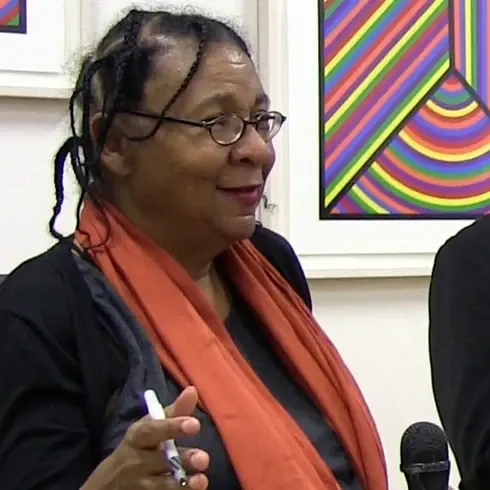
bell hooks was an American author and activist. “Ain’t I a Woman” explores how racism and sexism jointly shaped Black women’s lives from slavery to the modern feminist movement.
Explore more books by bell hooks