What you'll learn
Key ideas from AI 2041
These ideas compress the book's argument without treating the author's view as settled fact. Use them as an orientation before reading the full work or listening in Wiseley.
Proxy features can reproduce caste inequality without an explicit caste variable.
Trust requires layered provenance, detection, biometric checks, and accountable interpretation because adversaries can attack inputs or training data.
Fluent output can coexist with fabricated facts, weak causal reasoning, bias, and unreliable knowledge, especially when impressive examples hide failed attempts.
AI can adapt instruction and routine assessment, while teachers guide emotional growth, collaboration, creativity, values, and resilience.
Staged rollout requires choices about interim risk, human fallback, liability, and whether deployment can proceed before complete certainty.
Autonomous weapons lower the cost of violence while weakening human authorization, attribution, deterrence, and accountability.
A durable workforce social contract must fund transition and preserve entry-level paths because resistant occupations may not absorb everyone.
Pleasure can satisfy immediate needs, while flourishing also involves relationships, growth, purpose, authenticity, and self-actualization.
Inside AI 2041
Read the first chapter in full here. The other 11 continue in the Wiseley app.
Chapter 1 of 12 · 12 min · Audio & text
What Optimization Leaves Out
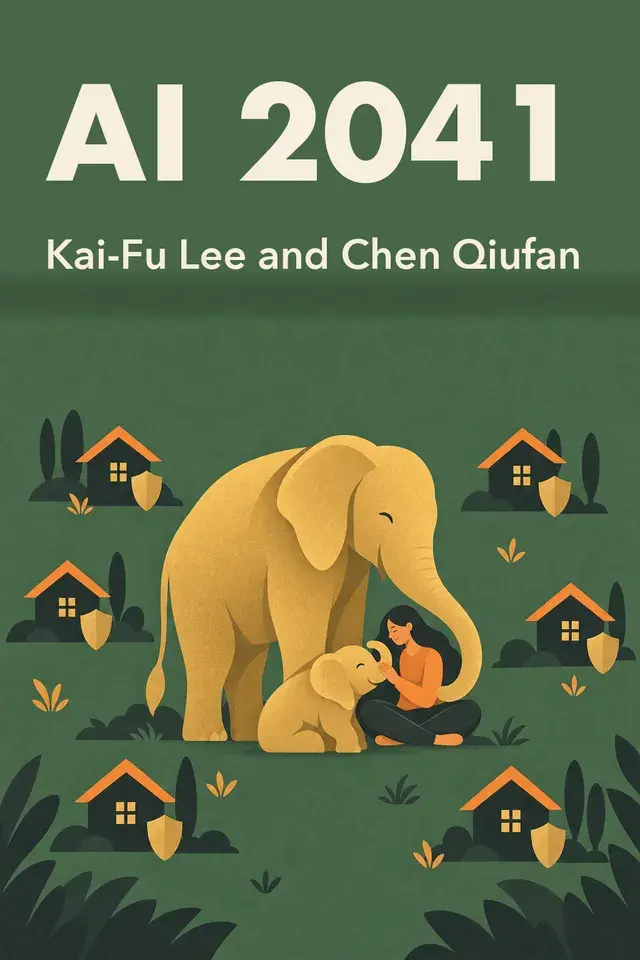
AI 2041, by Kai-Fu Lee and Chen Qiufan.
AI 2041 uses two forms to examine one possible future: technological forecasting and fiction. Kai-Fu Lee estimates how existing technologies might mature, while Chen Qiufan turns those possibilities into stories about people living with them. The stories are fictional, and the 2041 horizon is a forecast, not a promised destination. Lee presents scenarios based on technologies he expects, in his judgment, to mature within roughly twenty years, while admitting that some estimates may be too high or too low. Each story is followed by analysis. The opening story, “The Golden Elephant,” places a Mumbai family inside a deep-learning insurance ecosystem. Its question becomes a foundation for the book: what happens when a system optimizes a target that leaves important human values outside the calculation?
To answer that question, begin with what deep learning does. It is a multilayer neural-network architecture, with an input layer, an output layer, and potentially thousands of layers between them. In supervised training, the system receives many examples paired with correct answers. People do not specify every rule. Instead, the network changes millions or billions of parameters, adjustable numerical settings that shape its responses, until its outputs match the labels as often as possible. The measurable target it tries to maximize is its objective function.
Consider cat recognition. If a network receives millions of labeled photographs, it can learn to separate cats from non-cats without being given a complete human description of feline features. It discovers statistical patterns that distinguish the two groups. After training, it can examine an unfamiliar image and infer whether it contains a cat. This use of a trained model on new input is inference. The model is functioning as a very large mathematical equation. It can generalize on the task without possessing human understanding of cats. That difference between performance and understanding is crucial.
The same recipe can train an insurer on applicants’ medical claims and family information. Whether a serious claim occurred supplies the label, allowing the system to predict approval and premiums for new applicants. It does not need a person to classify every applicant explicitly as a health risk. But this power is conditional. The book attributes deep learning’s recent success to the convergence of abundant data and much greater computing power. The system still needs relevant data, a concrete objective, and a manageable domain. With too little data, it cannot find meaningful correlations. With a goal that is too broad, optimization has too little direction. The authors describe AI as strong at large-scale matching and customization, but weaker than humans at abstraction, common sense, insight, and creativity.
These conditions explain why commercial platforms benefit so strongly. Their users constantly generate data, while clicks, purchases, searches, and time spent can serve as automatic labels connected to revenue or engagement. More activity creates more data. More data can improve recommendations and targeting, which can produce more activity and revenue. This is a data-to-revenue feedback loop. Finance and insurance are also favorable settings because their domain-specific records connect predictions to concrete business outcomes.
Ganesh Insurance, or GI, turns that pattern into a household system. Its connected applications offer insurance, investments, shopping, local deals, and lifestyle recommendations. Family members link data to receive personalized services, while social-media information and minors’ data require additional authorization. GI claims confidentiality and anonymization, but Nayana experiences the arrangement as pressure. Attractive discounts and useful recommendations make refusal difficult, especially when her parents can make decisions for her as a minor. The issue is not only whether the company follows its formal permissions. It is also whether people can meaningfully control the data and inferences shaping their lives.
The benefits are real. GI reminds the grandparents about medicine and appointments. It helps Sanjay stop smoking and drive more safely. The family restricts Rohan’s sweets because his behavior affects their shared premium. Insurance incentives can align with healthier behavior, and the insurer can benefit from customers living longer and making fewer claims. Yet the household becomes constantly aware that each action may raise or lower its costs. The system converts behavior into a stream of measurable risks and rewards.
The same logic reaches Nayana’s relationship with Sahej. GI’s applications infer romantic concerns from her browsing and shopping, although Nayana can only guess how the system reached that conclusion. She suspects that irrelevant recommendations and distractions appear when she focuses on Sahej. A call to him raises the family premium by 0.73 rupees. Sahej predicts that if she approaches Dharavi, GI will flood her with illness alerts and warnings not to drink the water. Sahej—not GI—then tells Nayana that the path is not for people like her. He explains that his family depends on GI too: illness at home and a vulnerable-group premium make insurance affordable. The system is useful to both families, but its risk model treats their relationship as a financial liability.
The story does not establish that GI consciously hates Sahej or deliberately understands caste. Nayana’s belief that the golden elephant wants to separate them is initially her interpretation. The deeper problem is more mechanical. GI is optimizing a narrow insurance objective, such as reducing premiums and claims. It has no built-in measure for love, autonomy, social trust, or the value of crossing inherited boundaries. A prediction can therefore be accurate within the model and still be harmful in human terms. As Nayana and Sahej leave, her smartstream vibrates with increasingly frequent alerts, but the narrative does not specify their contents. Nayana’s mother urges her not to let either people or AI define her future, and Nayana chooses to walk with Sahej anyway.
Caste makes the problem sharper. The narrative describes a hierarchy that shaped work, education, marriage, and life prospects. Constitutional prohibition and affirmative action can reduce discrimination and improve integration, but historical patterns remain in records and behavior. An AI system does not need an explicit caste variable to reproduce those patterns. Surnames, skin color, location, family history, occupation, housing, and other behaviors can act as proxies. A network trained on unequal outcomes may discover that these features correlate with risk, then use them in ways that recreate exclusion.
That is why the system can discriminate without holding a hateful belief or receiving a label such as “Dalit.” It simply optimizes from data that contain the social shadow of caste. A warning about Dharavi may look like a neutral health prediction while also reinforcing a boundary between people. The example generalizes beyond insurance. In hospitals, hiring, lending, or criminal justice, inferred sensitive traits can affect decisions even when protected characteristics were never directly collected. Data-driven systems may reduce some forms of individual prejudice, but incomplete coverage and inherited inequality can still produce systematic harm.
The authors’ response is not to reject personalization. It is to improve what the system is asked to optimize and how its effects are governed. Business goals could be combined with fairness, or engagement could be replaced by a richer idea such as “time well spent.” Concepts such as fairness, happiness, and meaningful use of time require further research before they can become reliable objectives. Stuart Russell’s proposal, as presented here, keeps humans involved in defining those objectives so that optimization remains directed toward human benefit.
The safeguards must also examine outcomes. Companies should disclose when AI is being used and for what purpose. Engineers can adopt ethical principles. Models can be tested across demographic groups during training, and legally required audits can inspect decisions after deployment. Human oversight remains important when a prediction affects access, dignity, safety, or relationships. Richer objectives may reduce short-term profits, so regulation, responsible-AI commitments, third-party dashboards, and ownership structures aligned with users may be needed to create incentives for them.
Finally, deep-learning decisions can be difficult to explain because they depend on huge numbers of features and parameters. Researchers are therefore pursuing summarized logic and more interpretable algorithms, but the book does not claim that explanation has been solved. The central distinction remains: optimizing a measurable outcome is not the same as achieving a desirable human consequence. AI can personalize services, reveal useful patterns, and improve health behavior. It can also magnify the values and inequalities hidden in its data. The future remains open because people can inspect objectives, test consequences, and redirect systems before efficiency is mistaken for wisdom.
Chapter 2 of 12 · 10 min · Audio & textIn the app
Seeing Is No Longer Believing
Computer vision begins where a camera ends. A camera records pixels; a vision system tries to interpret them.
Chapter 3 of 12 · 8 min · Audio & textIn the app
Language Without Human Understanding
Natural language processing asks a deceptively hard question: how can a machine turn human language into useful action? Early systems tried to answer with vocabularies, conjugation tables, and explicit rules.
Chapter 4 of 12 · 8 min · Audio & textIn the app
Learning Beyond the Leaderboard
At Fountainhead Academy, identical twins Golden and Silver show what personalized education can reveal—and what it can get wrong. Their appearance and genomic data are nearly identical, but their temperaments differ.
Chapter 5 of 12 · 10 min · Audio & textIn the app
Healthcare Beyond Better Predictions
AI can make healthcare more predictive, but prediction becomes useful only when a system connects reliable evidence to actual care. The authors’ forecast begins with digitization.
Chapter 6 of 12 · 10 min · Audio & textIn the app
When Simulations Feel Personal
Immersive AI changes the question from whether a machine can make a believable image to whether it can make a situation feel lived. The book calls this presence: a parallel reality experienced as natural enough to feel real.
Chapter 7 of 12 · 10 min · Audio & textIn the app
Autonomy Meets the Physical World
Physical autonomy begins where software meets friction. A robot must perceive its surroundings, locate itself on a map, plan an action, control its body, read the result, and adapt when conditions change.
Chapter 8 of 12 · 14 min · Audio & textIn the app
Power That Outruns Its Safeguards
Power becomes dangerous in this chapter when a technology's ability to multiply action outruns the institutions meant to contain it. The authors place quantum computing beside autonomous weapons because both are dual-use.
Chapter 9 of 12 · 13 min · Audio & textIn the app
Rebuilding Work and Human Worth
AI 2041 treats automation as an economic process that starts before a worker is formally replaced. Digitization turns work into inputs, outputs, messages, meetings, and decisions that can be recorded, searched, compared, and modeled.
Chapter 10 of 12 · 9 min · Audio & textIn the app
Can Happiness Be an Objective
Happiness here is divided into two projects. Hedonic happiness means immediate pleasure, comfort, or relief.
Chapter 11 of 12 · 8 min · Audio & textIn the app
Who Should Hold Our Data
Across the book’s earlier cases, personal AI depends on a tension that is easy to state and difficult to resolve. Data is scattered among devices, applications, institutions, and services.
Chapter 12 of 12 · 13 min · Audio & textIn the app
Abundance Still Requires Human Choices
AI 2041 closes by asking what happens when machines produce far more with less human labor. The authors call this possible condition plenitude: a gradual expansion in which necessities and many comforts become cheap or freely available.
Chapter 1 of 12 · 12 min · Audio & text: What Optimization Leaves Out
Wiseley supports reading and listening to summaries in the app.
Continue in WiseleyAbout Kai-Fu Lee & Chen Qiufan

Kai-Fu Lee
Kai-Fu Lee is a Taiwanese computer scientist and investor. “AI Superpowers” explores the development of artificial intelligence in China and the United States and its social consequences.
Explore more books by Kai-Fu Lee
Chen Qiufan
Chen Qiufan is a Chinese science fiction author. “AI 2041” explores how AI might reshape learning, healthcare, work, and relationships by 2041, pairing fictional scenarios with technical analysis.
Explore more books by Chen Qiufan