What you'll learn
Key ideas from Adult Daughters of Narcissistic Mothers
These ideas compress the book's argument without treating the author's view as settled fact. Use them as an orientation before reading the full work or listening in Wiseley.
A family becomes developmentally reversed when a child monitors a mother’s needs instead of receiving steady care and room for age-appropriate independence.
Gaslighting becomes damaging when repeated invalidation teaches a daughter to doubt perception, memory, judgment, and worth.
Acceptance allows painful inner experiences while action remains guided by personal values, without approving a mother’s conduct or prescribing contact.
The chapter’s sequence is to notice a thought, check for available action, act when possible, and redirect attention when further thinking adds nothing.
Ambiguous loss gives language to grief for a mother-daughter relationship and care that were never reliably available, without requiring forgiveness or reconciliation.
SLOW creates a pause to identify, accept, validate, and compassionately choose a response without approving every impulse.
The chapter defines boundaries as expressions of needs, values, safety, and separateness across time, bodily, emotional, spiritual, sexual, financial, and material domains.
Post-traumatic growth can coexist with grief and recurring symptoms; meaningful practice can continue one action at a time.
Inside Adult Daughters of Narcissistic Mothers
Read the first chapter in full here. The other 8 continue in the Wiseley app.
Chapter 1 of 9 · 8 min · Audio & text
When a Mother's Needs Dominate
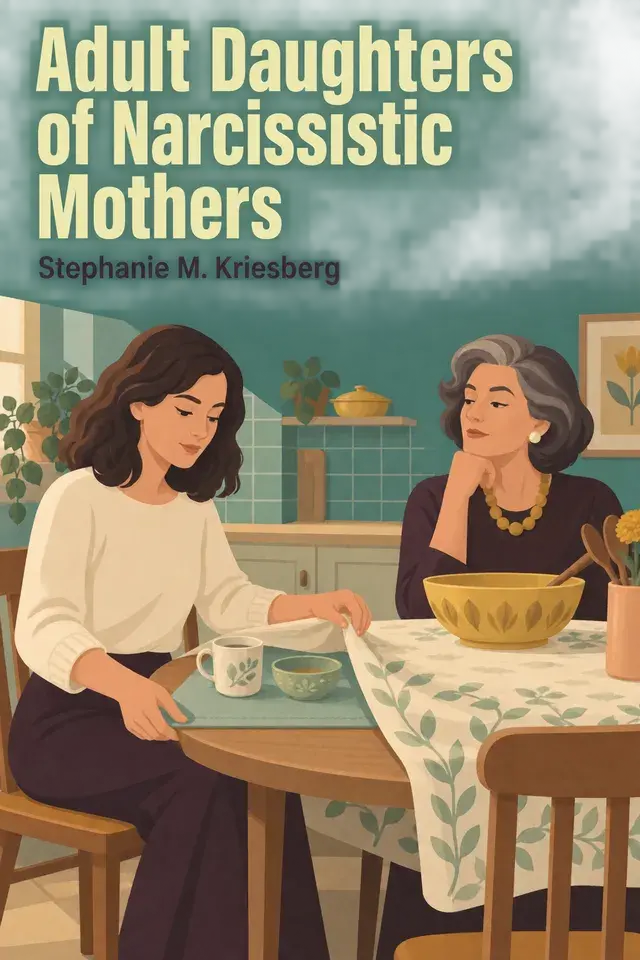
Adult Daughters of Narcissistic Mothers, by Stephanie M. Kriesberg.
At the center of this chapter is a reversal of ordinary parent-child responsibility. In balanced parenting, adults meet children’s needs as best they can. They combine warmth with authority, listen to a child’s views, set fair limits, support age-appropriate independence, and take responsibility for their own emotions. They repair after mistakes and accept the child beyond performance. A child can have needs, preferences, and disappointments without becoming responsible for the parent’s self-esteem.
When a mother’s feelings, image, or demands repeatedly organize family life, the direction of care turns upside down. The daughter’s needs can seem inconvenient or threatening. Instead of asking what she feels, wants, or needs, she learns to watch the mother: Is she pleased, hurt, angry, or about to withdraw? This monitoring may look like obedience or unusual competence, but it directs attention outward. She becomes skilled at reading the room while losing contact with herself.
The author uses narcissism as a spectrum, not as a label for every difficult mother. A person may show a few traits, many persistent traits, or the most extreme and inflexible pattern, narcissistic personality disorder. In the book’s account, the mother is organized around her own needs, image, feelings, or demands, with empathy that is inconsistent or limited. The author proposes that fragile self-esteem may sit beneath self-importance, special treatment, or a need for care. When expectations are not met, the response may be anger and attack, or depression and neediness. This is an explanatory framework, not certainty about an individual mother. Direct research on the effects of narcissistic parents on children is also limited. Josefina and Ilana are composite cases, used to illustrate recurring patterns rather than identifiable people.
The contrast is not between a mother who has no needs and one who has needs. It is between flexibility and a relationship organized around the mother. Attention becomes conditional when a daughter is valued mainly for achievement, appearance, loyalty, or managing the mother’s feelings. Control appears when independence is treated as disobedience. Dependence appears when the mother expects emotional, domestic, or practical care from the daughter. These patterns can overlap. Warmth may be genuine at times and still coexist with harmful, conditional patterns.
Josefina illustrates the grandiose presentation. A grandiose mother may appear confident, focus on image or status, seek admiration, and react angrily when someone imposes a limit. Josefina’s mother dismissed her struggle with cultural identity and rejected her request for a school with more Latina students, insisting that she knew better. Afterward, she gave Josefina the cold shoulder. At graduation, she displayed public pride, but Josefina perceived stiffness as private embarrassment. The point is not to prove what the mother felt internally. It is to show how public approval mixed with private rejection can make independence feel risky. Josefina became a capable immigration lawyer, yet outside work she second-guessed decisions and chose partners who were successful but unkind. Josefina names this internalized maternal standard the Stuck Voice, a name for the criticism that keeps questioning her choices.
Ilana represents the vulnerable presentation. This mother may seem unhappy, anxious, dependent, or unsure rather than dominant. Yet neediness can also keep attention centered on her. Ilana learned to listen for Sharon’s moods, prepare meals, earn perfect grades, and give up activities so she could manage the household. When Sharon became ill before a school trip, Ilana considered giving up the trip. Her mother’s gratitude and discouraging remarks reinforced the belief that Sharon depended on her. As an adult, Ilana remained responsible for work, housework, parenting, and grocery shopping for her physically capable mother. She looked calm and organized while feeling alone and out of control. Overfunctioning seemed like the only way to feel secure, lovable, and keep the world from falling apart.
Grandiose and vulnerable styles can mix or shift. One mother may demand admiration in one moment and caretaking in another. The visible behavior changes, but the developmental effect can be similar: the daughter’s attention is recruited into regulating the mother. If approval depends on performance, she may learn to perform rather than ask who she is. If she is repeatedly needed as caretaker, she may confuse usefulness with love and experience rest or separation as selfish. If her feelings are consistently subordinated, she may struggle to identify them. These habits could protect connection or reduce conflict in childhood, yet later interfere with autonomy and self-trust. A daughter may overwork, second-guess ordinary decisions, or choose what will be approved rather than what fits her.
A brief reflective inventory can make this framework personal without turning it into a test. A daughter might notice whether she monitors moods, tries to win appreciation, doubts her judgment, takes on too many responsibilities, suppresses feelings, feels guilty after creating distance, or assumes other people’s needs matter more. She might also notice perfectionism, mistrust, or isolation. Some people feel numb or distanced rather than clearly emotional. The purpose is to identify learned habits and their costs, not to diagnose a mother, diagnose oneself, or force a conclusion from a checklist. Resonance is a reason to reflect, not proof of a category.
The central distinction is between care that flows from parent to child and a family organized around the parent’s unmet needs. The author offers insecurity and developmental history as possible explanations, but they do not make the daughter responsible for the mother’s behavior. What matters developmentally is what the pattern taught her to do with her own life. Recognizing the reversal gives her language for separating her voice from the role assigned to her. It does not promise that recognition will change the mother or remove pain. It shows how a mother’s needs came to dominate, and why those learned survival habits may still shape identity, responsibility, and trust in oneself.
Chapter 2 of 9 · 8 min · Audio & textIn the app
How Reality Becomes Hard to Trust
Repeated invalidation does not merely make disagreement unpleasant. It can turn a daughter inward against herself.
Chapter 3 of 9 · 9 min · Audio & textIn the app
Choosing Direction Without Controlling Feelings
Recovery in this chapter begins with a distinction that is easy to miss: you do not have to control an inner experience before choosing what to do. Thoughts, feelings, memories, bodily sensations, and urges can arise without permission.
Chapter 4 of 9 · 9 min · Audio & textIn the app
Unhooking From Repetitive Negative Thinking
Some thoughts point toward the future, others replay the past, and others judge the present. When they repeat, they can resemble careful problem solving.
Chapter 5 of 9 · 9 min · Audio & textIn the app
Meeting Shame and Mourning What Was Missing
Shame and grief require more than labeling a thought. A daughter may recognize a thought as a mental event while her body reacts to an old verdict.
Chapter 6 of 9 · 11 min · Audio & textIn the app
Learning to Respond to Your Emotions
Emotional regulation is not a skill children simply discover alone. They learn it in relationships, first by watching caregivers and being helped by them.
Chapter 7 of 9 · 8 min · Audio & textIn the app
Building Confidence Through Evidence and Practice
Confidence is not simply the absence of doubt. In this chapter, it has two connected meanings: a felt sense of self-assurance and the belief that you can attempt a difficult task, learn from what happens, and keep going when needed.
Chapter 8 of 9 · 10 min · Audio & textIn the app
Setting Limits and Speaking Clearly
Boundaries turn inner work into visible choices. They are internal rules about what you will and will not do, along with standards for how others may treat you.
Chapter 9 of 9 · 10 min · Audio & textIn the app
Creating Relationships Beyond Inherited Roles
Recovery extends beyond deciding how to respond to a mother. It asks what happened among siblings and what those lessons taught a daughter about trust elsewhere.
Chapter 1 of 9 · 8 min · Audio & text: When a Mother's Needs Dominate
Wiseley supports reading and listening to summaries in the app.
Continue in WiseleyAbout Stephanie M. Kriesberg
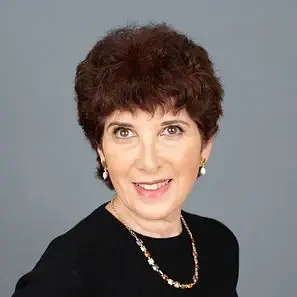
Stephanie M. Kriesberg is the author of “Adult Daughters of Narcissistic Mothers”. The book explores how adult daughters of narcissistic mothers can develop trust in their own feelings, needs, and choices.
Explore more books by Stephanie M. Kriesberg