What you'll learn
Key ideas from A River in Darkness
These ideas compress the book's argument without treating the author's view as settled fact. Use them as an orientation before reading the full work or listening in Wiseley.
Promises of secure work and children’s education had force because poverty and discrimination narrowed prospects in Japan.
The League’s pre-voyage notice promised that travelers could obtain what they needed, but Chongjin and Dong Chong-ri showed stark scarcity.
Ishikawa’s school record and political service could not overcome a hostile classification that shaped education and job assignment.
Work-linked ration rules left Ishikawa stealing radishes to feed his family; foraged food could be spoiled or poisonous and cause severe stomachaches.
The escape plan depended on avoiding document checks and learning when border patrols might leave an opening.
Rain and a suspected change of guards opened a chance to cross, but the torrent nearly killed Ishikawa before a local man rescued him.
Practical help in Japan gave Ishikawa shelter and documentation, but did not reunite him with his family.
Inside A River in Darkness
Read the first chapter in full here. The other 10 continue in the Wiseley app.
Chapter 1 of 11 · 6 min · Audio & text
The River and the Choice
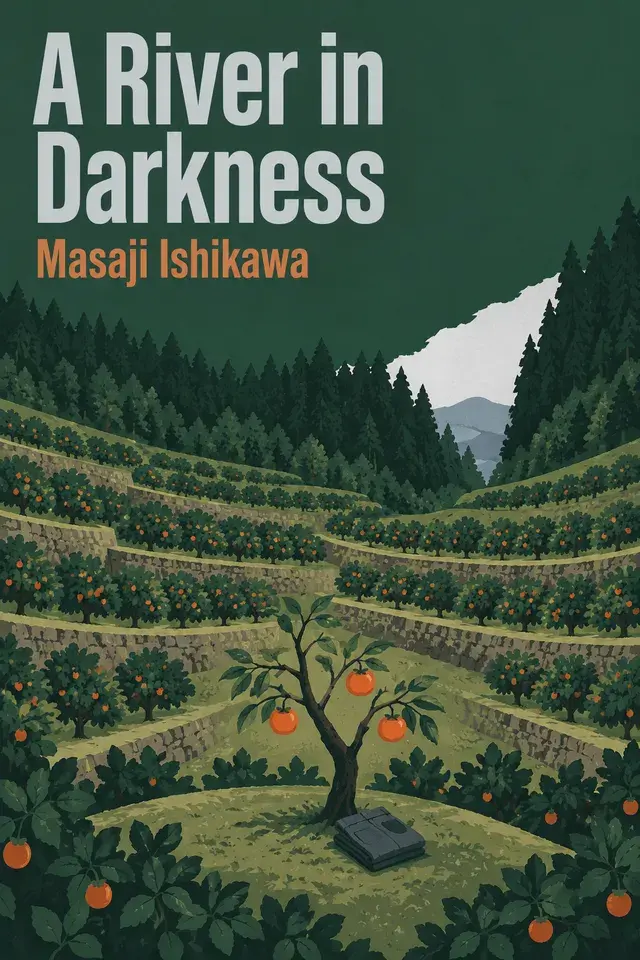
A River in Darkness, by Masaji Ishikawa.
The memoir opens with Ishikawa at the Yalu River, facing China across water swollen by heavy rain. He calls the river impassable, and guards along the bank make capture another danger. His recollection of that night is incomplete; he says he cannot remember everything and has put some memories away. What he does remember is the choice before him. He believes staying means dying of starvation, while escape offers a chance to survive and help his family. He has left his wife and children behind, and thinks of them as the reason to keep going. He had promised that, if he escaped, he would find a way to bring them to him. He cannot know whether he will survive, but his hope is bound to his children.
From that perilous moment, Ishikawa turns back to his childhood in Japan. Born in Kawasaki to a Korean father and a Japanese mother, he felt Japanese as a boy, yet understood his mixed background as a source of tension. He describes himself as caught between two worlds. His memories of rural Mizonokuchi are not only painful, though. Looking back, he calls that poor childhood the happiest period of his life. He remembers playing in canals and attending local festivals, alongside large hopes: helping poor families, bringing peace, and even becoming Japan’s prime minister. Those ordinary joys and ambitions give his early years a warmth that later family suffering would sharply change.
His father’s history complicated the family’s sense of home. Ishikawa says his father was taken from a South Korean village to Japan at fourteen for factory work. Ishikawa did not know him until elementary school, when his mother took him to visit a man in prison and explained who he was. On his mother’s side, he remembers a close-knit family and was told that his grandfather had been a good and gentle man who supported his children’s education. But relatives also voiced anti-Korean stereotypes. Ishikawa felt uneasy hearing them, yet partly believed them because his own Korean father’s violence seemed to confirm what they said. He later recognized how fear and family suffering had shaped that response.
Poverty repeatedly unsettled the children’s home life. The family sent them to live with relatives, then moved suddenly to Nakano. Ishikawa initially welcomed the change: sharing meals and routines felt like a chance to live together as a family. That hope did not last. His father drank and began beating his mother again. The children hid nearby, while Ishikawa tried and failed to protect her. When a neighbor intervened, the father beat him severely. Afterward, no one came to the house, and Ishikawa became afraid to sleep, troubled by nightmares.
When Ishikawa was twelve or thirteen, his father held a knife to his mother’s neck and pushed her over the edge of a steep quarry. Ishikawa jumped down after her and found her bloodied. He helped her reach a doctor. His mother told him she had to leave because his father would kill her. She asked him to be strong and promised to work, save money, and return for the children. He felt helpless and alone as she went.
After she left, his father’s Korean mistress moved into the home and mistreated his younger sisters. Ishikawa stopped attending school for a time to search for his mother around Tokyo. After at least six months, he found her working in a restaurant. She gave him jewelry to pawn if the children needed money and asked him not to reveal where she was. He returned to school and visited her almost every afternoon after classes; his sisters accompanied him only sometimes, on weekends or public holidays. He held on to the hope that she would rescue them.
Much later, Ishikawa tried to understand the forces behind his father’s behavior. He thought his father had lost standing as the postwar world changed and physical force became less useful. He also believed his father resented his mother’s education and property, and took his anger out on her. Ishikawa presents this as a retrospective explanation, not a pardon; he says he could not forgive the abuse. About a year after his mother left, League figures confronted his father and warned that they would end their association if he did not change. A few days later, League members brought his mother home, and she agreed to return. They kept checking on the household. Ishikawa says his father never beat her again.
At his father’s direction, Ishikawa entered a Korean junior high school, though he did not speak Korean. Much of the teaching was incomprehensible to him. At first, the prejudice he had heard from Japanese relatives made him keep his distance from Korean classmates. But he gradually found them rough and also warm and kind. His experience challenged the picture of Koreans as monsters that he had absorbed at home. It gave him a chance to know people through daily contact, even when language made school difficult.
One classmate, Kan Te-son, known as Lion, invited him home. Lion’s mother welcomed Ishikawa and fed him generously. He remembers the visit as a striking experience of affection from people outside his family, and Lion’s house became a place where he could relax. The warmth he found there stood in sharp contrast to the violence at home; he never forgot the family’s kindness. The opening river scene carries that childhood history with it: a father’s determination to survive for his children, shaped by years in which safety and belonging had often been fragile.
Chapter 2 of 11 · 6 min · Audio & textIn the app
The Promise of Repatriation
For Ishikawa’s family, the promise of North Korea met a problem they knew well: life in Japan offered little security. He argues that poverty and discrimination left many Koreans unemployed, underpaid, or struggling to build a future.
Chapter 3 of 11 · 7 min · Audio & textIn the app
Arrival Under Suspicion
Before the voyage, a public notice from the League of Koreans in Japan had promised that anyone going to North Korea would be able to obtain everything they needed. When the ship carrying Ishikawa’s family reached Chongjin, they saw a welcome that sat uneasily beside the conditions around them.
Chapter 4 of 11 · 7 min · Audio & textIn the app
A Future Assigned at Birth
For a long time, Ishikawa treated school as one lever he could still move. He studied hard, improved his Korean, and took on school responsibilities.
Chapter 5 of 11 · 6 min · Audio & textIn the app
Kindness Inside a Fearful System
In spring 1968, soldiers arrived in the Ishikawa family’s village and declared that it would become their garrison. The village head told the family that the soldiers were under Kim Chan-bon’s direct command, but offered no further explanation.
Chapter 6 of 11 · 8 min · Audio & textIn the app
Work, Marriage, and Bereavement
Ishikawa’s account moves from political creed into the assignments and obligations that filled ordinary life. He describes a ten-part creed centered on Kim Il-sung: party unity around the leader, obedience to him, acceptance of his ideology and instructions, and continuation of his revolutionary achievements across generations.
Chapter 7 of 11 · 10 min · Audio & textIn the app
Despair and Improvised Survival
After a stretch of five years when he says nothing happened to him, Ishikawa felt that misfortune had returned. Masako, his sister, became pregnant by a village laborer.
Chapter 8 of 11 · 10 min · Audio & textIn the app
Scarcity Scatters a Family
By June 1982, hunger had reached the most private part of Ishikawa’s family life. His wife, Te-sul, was in the final month of pregnancy after months of eating weeds and wild plants.
Chapter 9 of 11 · 10 min · Audio & textIn the app
Famine Makes Escape Thinkable
Food had been scarce for years, but Ishikawa says conditions worsened from 1991. Severe cold damaged an already fragile supply.
Chapter 10 of 11 · 7 min · Audio & textIn the app
Crossing, Shelter, and Diplomatic Escape
By the time Ishikawa reached the Yalu, he had watched the guards for days and grown too weak to stand for long. On the third night, rain darkened the riverbank.
Chapter 11 of 11 · 7 min · Audio & textIn the app
Return Without Reunion
In Japan, Ishikawa was no longer facing the same immediate hunger, and at first he saw his return as a chance to build a life and help his family. He imagined bringing them out of North Korea so they could live together.
Chapter 1 of 11 · 6 min · Audio & text: The River and the Choice
Wiseley supports reading and listening to summaries in the app.
Continue in Wiseley