What you'll learn
Key ideas from A Monk's Guide to Happiness
These ideas compress the book's argument without treating the author's view as settled fact. Use them as an orientation before reading the full work or listening in Wiseley.
The book distinguishes fleeting stimulation-based pleasure from enduring happiness as present inner freedom.
Awareness is wider than passing thoughts and emotions, so painful states do not define the whole mind.
Mindfulness is recovered awareness that notices distraction and returns attention to an anchor without self-judgment.
Durable meditation joins manageable formal sessions with repeated mindful moments in ordinary activities.
Seeing craving as a relief loop creates space between impulse and action, so wanting can become observable rather than compulsory.
Contentment and gratitude support sharing, responsible resource use, and ambition that is not organized around lack.
Compassion adds an unconditional intention to relieve suffering and turns care into resilient, helpful action.
Acceptance of painful circumstances releases resistance while leaving room for medicine, practical change, and resilient action.
Inside A Monk's Guide to Happiness
Read the first chapter in full here. The other 8 continue in the Wiseley app.
Chapter 1 of 9 · 4 min · Audio & text
Happiness Beyond the Hit
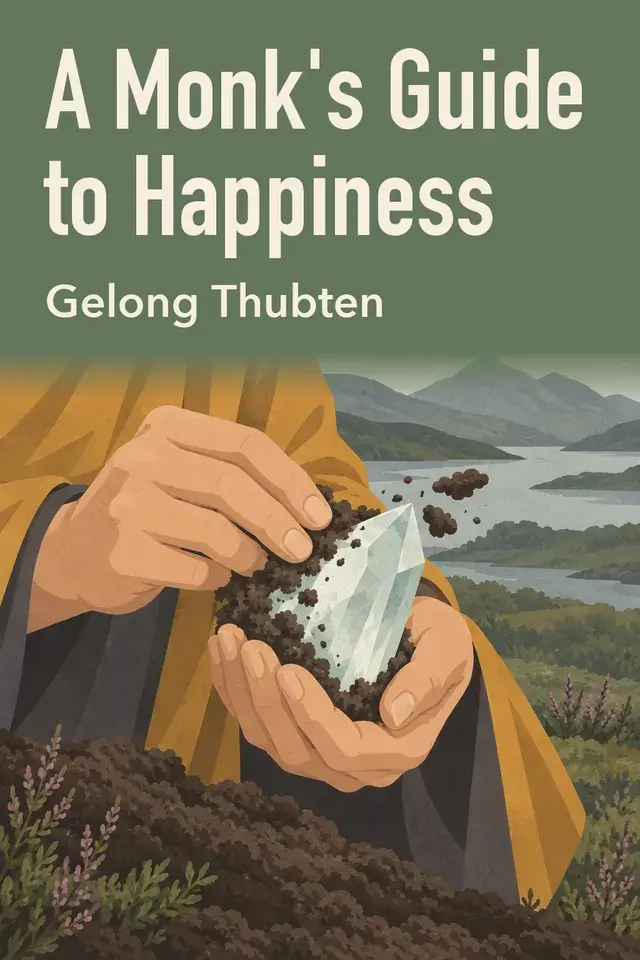
A Monk's Guide to Happiness, by Gelong Thubten.
After a four-year retreat in Scotland, Gelong Thubten returned to ordinary life with a sharper question about happiness. During the retreat, he lived in isolation, meditated for twelve to fourteen hours a day, spoke very little, and kept a five-month vow of silence. He says it was sometimes the unhappiest period of his life, but its intensity forced him to examine the mind. When he returned, smartphones, moving advertisements, constant news, and screen-focused pedestrians made modern attention look faster and more fragmented. He came to see meditation not as a luxury, but as an urgent response to a culture increasingly dependent on instant stimulation.
The book’s central distinction begins here. Many people call a brief surge of pleasure happiness, but Thubten describes it as a hit. Food, caffeine, entertainment, consumer goods, social-media approval, and simultaneous streams of input can produce an immediate lift. Yet the feeling fades, and the mind reaches for another experience. Constant novelty can make the present seem dull before it has been fully lived. Even a snack or a caffeinated drink may provide a short boost without resolving the underlying dissatisfaction. The book attributes this cycle partly to dopamine: anticipation rises before a desired reward, then falls once the reward arrives. As a result, the mind keeps leaning into the next promise, whether that promise is wealth, a perfect relationship, or a desired body.
Thubten offers a different definition of happiness. It is not a reward that circumstances deliver when everything is arranged correctly. It is an experience of completeness and presence, free from compulsive desire, fear, and striving. Searching for happiness as a future achievement creates hunger, expectation, and uncertainty, because fulfillment remains somewhere ahead. By contrast, genuine happiness involves no longer needing the next moment to complete the present one. The same situation can affect people differently, which suggests that thoughts and reactions help shape both happiness and suffering. The author does not deny the force of circumstances: extreme hardship can make happiness seem remote, and survival may come first. His point is that external conditions do not fully determine the mind’s freedom.
This is the book’s basic case for meditation. Happiness is presented as a learnable mental capacity, and meditation is one way to develop it. The practice is not supposed to clear the mind, produce a blank state, or eliminate thoughts and emotions. A busy mind is not disqualified from meditation. Instead, meditation changes the relationship with mental activity, making it possible to meet thoughts and feelings without being wholly directed by them. Nor is it merely escapism, stress control, or a private form of self-improvement. Thubten presents it as a way of reconnecting with a deeper human capacity for freedom and unconditional compassion.
Mindfulness extends that meditative awareness into ordinary situations. The aim is not to wait for perfect circumstances before feeling whole, but to recognize that the sought-after freedom is not contained in the next purchase, achievement, sensation, or reassuring event. The chapter’s foundation is therefore simple: fleeting pleasure depends on stimulation and fades with it, while enduring happiness is an inner freedom that can be uncovered and trained in the present.
Chapter 2 of 9 · 4 min · Audio & textIn the app
Freedom Behind the Mind
Inner freedom can disappear without any external chain. A person may have choices and still be directed by moods, memories, future worries, and drifting attention.
Chapter 3 of 9 · 4 min · Audio & textIn the app
Training Attention, Not Silence
Meditation starts with a correction to a common expectation. Many people expect it to switch off the mind, but the author calls that mistaken.
Chapter 4 of 9 · 5 min · Audio & textIn the app
From Sessions to Daily Life
Formal meditation becomes sustainable when it is treated as a path, not a series of occasional experiences. The author compares repeated sessions with physical training: each session reinforces tendencies, while everyday reactions both express old habits and create new ones.
Chapter 5 of 9 · 4 min · Audio & textIn the app
Beyond the Well-Being Trap
Once meditation begins to help, a new problem can appear: it becomes something to grasp. Gelong Thubten calls this the well-being trap.
Chapter 6 of 9 · 4 min · Audio & textIn the app
Happiness Through Connection
Having examined happiness as shaped by the mind, Thubten widens the frame to shared life. No person is self-sufficient: survival and identity depend on other people and the natural world.
Chapter 7 of 9 · 5 min · Audio & textIn the app
From Empathy to Compassion
Compassion gives meditation an outward direction. The author connects this shift to a four-year retreat, where severe anxiety, depression, and panic made practice difficult.
Chapter 8 of 9 · 4 min · Audio & textIn the app
Forgiveness as Resilient Freedom
Forgiveness, in Gelong Thubten’s account, is not a verdict that harm was acceptable. It ends the inner process that keeps harm alive.
Chapter 9 of 9 · 6 min · Audio & textIn the app
Keeping the Practice Alive
Even after meditation has become meaningful, it can fade from daily life. Thubten names three central obstacles: lack of confidence, procrastination, and busyness.
Chapter 1 of 9 · 4 min · Audio & text: Happiness Beyond the Hit
Wiseley supports reading and listening to summaries in the app.
Continue in WiseleyAbout Gelong Thubten
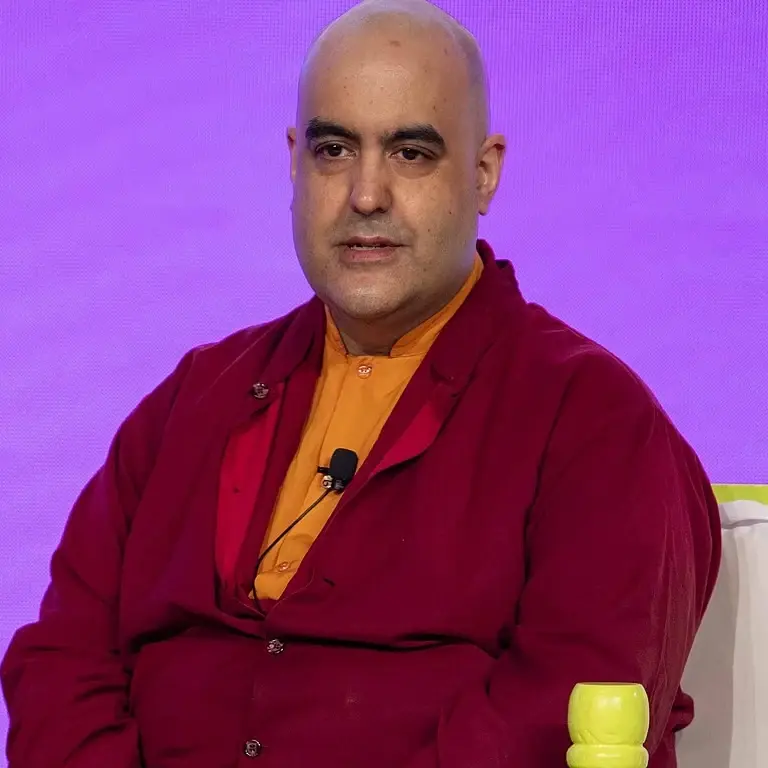
Gelong Thubten is a Buddhist monk, meditation teacher, and author. “A Monk's Guide to Happiness” explores whether lasting happiness can survive stress, desire, uncertainty, and difficult relationships.
Explore more books by Gelong Thubten