What you'll learn
Key ideas from A Little History of Philosophy
These ideas compress the book's argument without treating the author's view as settled fact. Use them as an orientation before reading the full work or listening in Wiseley.
Socratic questioning tests general claims against difficult cases and exposes confidence unsupported by understanding.
Epicurus treats philosophy as therapy through modest desires, friendship, kindness, and the ability to draw comfort from remembered pleasures.
Political authority can secure peace while also creating risks of tyranny and serious losses of freedom.
The cogito establishes a thinking self’s existence, but it does not by itself establish a body or the wider world.
Kant grounds moral worth in duty and tests maxims by whether everyone could follow them.
Natural selection links inherited variation and local environmental fit to differences in survival, reproduction, and species change.
Popper’s falsifiable hypotheses gain support by surviving attempted refutation, but those tests cannot prove them true.
Rawls’s veil tests social rules by asking what people would choose without knowing their place or advantages.
Inside A Little History of Philosophy
Read the first chapter in full here. The other 18 continue in the Wiseley app.
Chapter 1 of 19 · 6 min · Audio & text
Questioning, Reality, and a Good Life
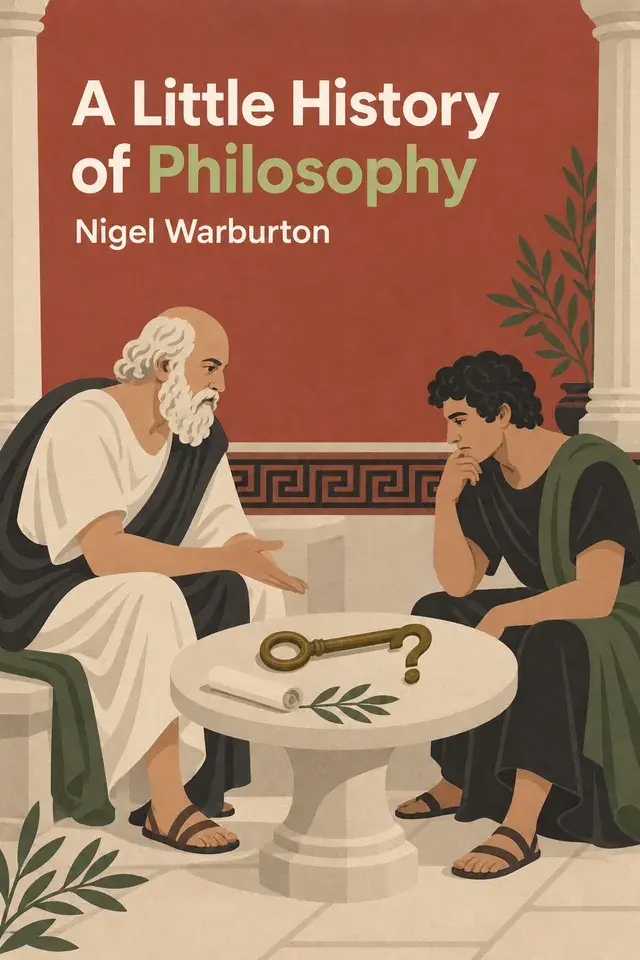
A Little History of Philosophy, by Nigel Warburton.
Philosophy begins when confident beliefs are treated as claims to examine, rather than conclusions secured by confidence alone. The book presents Socrates as the figure with whom philosophy in this tradition decisively takes off. In the marketplace, he asked deceptively simple questions and pressed people's answers until gaps or contradictions appeared. The point was not to win an argument. It was to show that a belief can guide a life even when its holder has not examined what it means.
Consider Euthydemus and the claim that deceit is always immoral. Socrates tests this rule with a case: if Euthydemus took a knife from a friend who was suicidal, the act would be deceitful. Socrates asks whether this deceitful act might be moral rather than immoral. The counterexample does not show that every lie is good. It shows that a broad rule needs more thought than its confident wording suggests. Questioning turns a general answer into a problem: what matters in this situation, and why?
Socrates treated recognizing the limits of one's knowledge as a kind of wisdom. According to the story, the oracle at Delphi declared that no one was wiser than he was. He investigated by questioning people reputed to be skilled, and found that expertise did not always bring understanding of more fundamental questions. He concluded that he was wiser, if at all, because he did not mistake confidence for knowledge. He valued continued questioning and debate; an unexamined life, he said, was not fit for human beings.
The historical Socrates left no writings. Plato's dialogues are a main source for his conversations, but they do not settle which arguments belong to Socrates and which may be Plato's own. Socrates was charged with neglecting the Athenian gods, introducing new gods, and corrupting young men. The book says it is difficult to establish how accurate those charges were. He chose not to abandon questioning for quiet survival, and was executed.
Plato's own arguments suggest that appearances can conceal a deeper reality. A drawn circle is always imperfect, yet we can understand the idea of a perfect circle. Plato explains this by proposing a perfect, intelligible Form that is not simply another object we can see. He applies the same idea to goodness: understanding it requires more than collecting examples of good things. Reason, he argues, can grasp what the senses alone cannot.
The cave makes this contrast vivid. Imagine prisoners chained so they can see only shadows cast on a wall. Taking those shadows for the whole world, they mistake appearances for reality. One prisoner escapes, gradually sees the fire and then the world outside, and returns with an account the others do not believe. For Plato, the escapee represents a philosopher who has learned to look beyond what first seems obvious. The story also points to a risk in Plato's politics. If philosophers alone can grasp reality and goodness, Plato argues, they should rule. But his ideal republic assigns people fixed roles and maintains control through lies and force. The claim to superior knowledge can become a reason to deny others a voice.
Aristotle shifts attention from abstract Forms to particular things in the world, such as real cats, as a way to understand what cats are. He also asks what it means for a human life to go well. His answer, eudaimonia, is better understood as flourishing or success than as a pleasant feeling. It is an assessment of a whole life. Pleasure may contribute, but a moment of enjoyment cannot by itself establish that a life has gone well. Flourishing can also depend on luck and events beyond a person's knowledge or control.
Aristotle connects flourishing with the distinctively human ability to reason. A good life uses thought to decide how to act, and good character develops through habits that shape emotions and behavior. Virtue is a mean between excess and deficiency, but it is not a fixed midpoint that fits every situation. The brave soldier illustrates the point: bravery lies between cowardice and foolhardiness. The brave person feels fear, yet responds appropriately to danger. This account asks what a situation calls for, rather than treating a single rule as sufficient for every choice.
Taken together, these thinkers establish examination as a way to approach questions about reality and how to live. Even Aristotle's later authority could be accepted without testing, despite his own reliance on investigation. Philosophical progress depends on keeping claims open to reasoned challenge, whoever first put them forward.
Chapter 2 of 19 · 5 min · Audio & textIn the app
Philosophy as Practical Therapy
Philosophy can respond to distress by asking how to live when certainty or control is out of reach. Pyrrho, Epicurus, and the Stoics propose different exercises: loosening belief and desire, choosing manageable wants, and governing one’s response to events.
Chapter 3 of 19 · 5 min · Audio & textIn the app
Evil, Fortune, and Divine Time
Augustine asks how a world full of suffering can be governed by a God who is all-good, all-knowing, and all-powerful. He distinguishes natural evil, such as earthquakes and disease, from moral evil, such as murder and torture.
Chapter 4 of 19 · 4 min · Audio & textIn the app
Testing Arguments for God
A proof for God has to do more than give a concept a name or tell a story about causes. It must show that its premises establish the existence claimed in its conclusion.
Chapter 5 of 19 · 5 min · Audio & textIn the app
Power, Promises, and Political Peace
Machiavelli and Hobbes both begin with danger, but ask different questions. In The Prince, Machiavelli asks what a new ruler must do to hold power amid rival states and unreliable allies.
Chapter 6 of 19 · 5 min · Audio & textIn the app
Doubt, Certainty, and the Wager
René Descartes’s search for certainty began with a disturbing question about waking. He once thought he had woken from a dream, then realized he was still dreaming.
Chapter 7 of 19 · 5 min · Audio & textIn the app
Nature, Identity, and Perception
What exists, what makes you the same person over time, and how much can your senses tell you about the world? Spinoza, Locke, and Berkeley give sharply different answers.
Chapter 8 of 19 · 4 min · Audio & textIn the app
Suffering and Religious Evidence
Can the suffering people encounter be reconciled with the claim that the world is arranged for the best? Voltaire puts that confidence on trial in Candide.
Chapter 9 of 19 · 5 min · Audio & textIn the app
Freedom, Society, and Human Knowledge
Rousseau’s political problem is how people can live under laws without surrendering freedom. The Social Contract opens with the claim that people are born free, yet live in chains.
Chapter 10 of 19 · 6 min · Audio & textIn the app
Duty, Happiness, and Historical Change
Kant’s account of knowledge leads into a different problem: what makes an action right? Here the answer diverges sharply across three philosophers.
Chapter 11 of 19 · 5 min · Audio & textIn the app
Desire, Pleasure, and Liberty
If happiness is the aim, a simple tally of pleasant experiences leaves two questions: what kind of experience counts, and what happens when wanting itself hurts? Schopenhauer sees desire as a source of recurring suffering.
Chapter 12 of 19 · 5 min · Audio & textIn the app
Evolution and the Leap of Faith
Darwin's theory changed how many people understood humanity. If human beings developed through natural processes alongside other animals, they could not be treated as wholly separate from the rest of life.
Chapter 13 of 19 · 5 min · Audio & textIn the app
Class, Consequences, and Truth
Marx looked at the harsh conditions faced by industrial workers: long hours, low wages, unsafe machinery, and little security. Owners controlled factories, buildings, and machinery.
Chapter 14 of 19 · 5 min · Audio & textIn the app
Values and the Unconscious
Nietzsche’s phrase “God is dead” does not mean that a deity once lived and then died. It means that belief in God has ceased to be reasonable.
Chapter 15 of 19 · 5 min · Audio & textIn the app
Logic, Language, and Meaning
Bertrand Russell thought philosophy could make progress by asking what a sentence says beneath its everyday grammatical surface. Words can make it seem as if we have named a thing, while the underlying claim has a different logical shape.
Chapter 16 of 19 · 5 min · Audio & textIn the app
Existence, Choice, and Absurdity
Existentialism begins with a question about how to live when no purpose has been set for us in advance. Sartre contrasts people with designed objects.
Chapter 17 of 19 · 7 min · Audio & textIn the app
Language, Judgment, and Science
Late Wittgenstein treats many philosophical puzzles as signs that we have misunderstood how language works. Words do not all get meaning by naming objects.
Chapter 18 of 19 · 6 min · Audio & textIn the app
Moral Cases and Fair Society
Thought experiments are imagined cases that isolate a moral question. Their purpose is not to describe ordinary life, but to make the principles behind our judgments easier to see.
Chapter 19 of 19 · 6 min · Audio & textIn the app
Machine Minds and Moral Reach
How can we tell whether a machine thinks? Alan Turing proposed judging by what a machine can do in conversation, rather than by inspecting how it is built.
Chapter 1 of 19 · 6 min · Audio & text: Questioning, Reality, and a Good Life
Wiseley supports reading and listening to summaries in the app.
Continue in Wiseley