What you'll learn
Key ideas from A Little History of Economics
These ideas compress the book's argument without treating the author's view as settled fact. Use them as an orientation before reading the full work or listening in Wiseley.
Scarcity makes every economic choice carry an opportunity cost, while positive and normative economics separate description from judgments about outcomes.
Comparative advantage describes mutual gains through relative opportunity costs, even when one country is more productive in both goods.
Externalities and public goods separate private incentives from social value, motivating taxes, subsidies, and public provision.
Schumpeter links credit-funded innovation, imitation, and monopoly rewards that can fade as rivals copy innovations to creative destruction beyond existing-market competition.
Keynesian analysis explains depression as a collapse of effective demand that can leave workers and factories idle despite remaining productive capacity.
Sen evaluates development by the capabilities people possess, not income or goods alone.
Reinvested returns compound wealth; when returns exceed economic growth, fortunes can pull ahead and concentration can deepen.
Climate change is a double externality because emission costs cross national borders and affect future generations.
Inside A Little History of Economics
Read the first chapter in full here. The other 15 continue in the Wiseley app.
Chapter 1 of 16 · 7 min · Audio & text
Scarcity, Morality, and National Wealth
A Little History of Economics, by Niall Kishtainy.
Economics begins with scarcity: human wants can remain unlimited while land, labour, materials, time, and money are limited. Every choice therefore excludes alternatives. Suppose a city uses its available site, workers, and materials for a hospital. It cannot use those same resources to build a train station. The station is the hospital’s opportunity cost. Looking only at the hospital’s monetary price misses what else those resources could have produced. In poorer societies, choices may put food against medicine. Richer societies face more consumer choices, yet still experience unemployment, business failure, and hardship.
Economics asks how societies organize production, consumption, and distribution. Households, workers, firms, banks, and governments all affect where resources go and who receives the results. A statement about what causes food prices to rise is a descriptive claim, or positive economics. It does not, by itself, say whether the outcome is fair. A judgment that food waste or inequality is unacceptable belongs to normative economics. The book’s ideal is to join accurate observation with moral concern: cool heads and warm hearts. History helps because every society confronts scarcity, but the questions and answers change with its institutions, technologies, and power relations.
Agriculture created an early turning point. Farming and animal domestication allowed more people to live from a given area and settle in villages. When farmers produced more than they needed, the surplus could support priests, kings, soldiers, and other specialists. Writing and taxation helped officials collect crops, organize distribution, fund irrigation, and build monuments. Economic complexity therefore depended not only on production, but also on decisions about control and allocation.
Ancient thinkers disagreed about the institutions that should govern this surplus. Plato feared that private property among rulers and soldiers would produce envy, competition, class conflict, and rule by the rich. His ideal city assigned people fixed roles and left little room for markets. Aristotle considered that vision impractical. Private ownership, he argued, could encourage care and make contributions clearer, even if ownership also required moral restraint.
Aristotle used shoes and olives to show why exchange becomes necessary. A shoemaker may need olives, while an olive grower needs shoes, so specialization connects people who produce different goods. Barter becomes difficult when each person must find someone with exactly the right reciprocal need. Money solves that problem by serving as a medium of exchange, a measure of value, and a way to carry purchasing power between transactions. Aristotle distinguished ordinary exchange for household needs from commerce pursued for profit. He viewed household wealth as limited by use, but endless accumulation through sales or moneylending as potentially corrupting.
Medieval Christian thought added a strong moral and religious framework. Work and possessions were treated as necessary in a fallen world, yet wealth, luxury, envy, and attachment to property could endanger spiritual life. After Rome’s decline, trade became more local, and feudal relationships tied land, protection, loyalty, and service together. Aquinas accepted private property and profit when they supported livelihoods and good purposes, but insisted that surplus wealth should aid the poor. His idea of a just price rejected the highest price obtainable through deception or the power to exploit a buyer.
Interest was initially condemned as usury. Medieval thinkers regarded money as barren: it could mediate exchange, but should not reproduce itself through a loan. Charging repayment plus interest therefore looked like taking payment twice. As towns, trade, banking, and insurance expanded, economic necessity softened this view. Compensation for profits forgone by lending became more acceptable, and the merchant’s social status improved. The change shows how moral judgments can shift when commercial arrangements change.
The growing alliance between merchants and monarchs appeared dramatically in Drake’s voyage. His return with Spanish treasure and Elizabeth’s decision to knight him symbolized how commerce, military power, piracy, and royal authority could reinforce one another. Mercantilism emerged from this nation-building world. Its writers often equated national wealth with stocks of gold and silver, because rulers needed hard money to pay armies and build fortifications. Yet the Midas story exposes the mistake: gold cannot feed or clothe anyone. Real wealth lies in useful goods and productive capacity.
Mercantilists therefore sought to increase exports, restrict imports, protect domestic producers, and charter companies that pooled investment for dangerous overseas ventures. These policies could expand national power, but they also reflected particular interests. Import restrictions might raise merchants’ profits while making food, clothing, or other necessities more expensive for ordinary people. A country’s treasure was not automatically the welfare of its population.
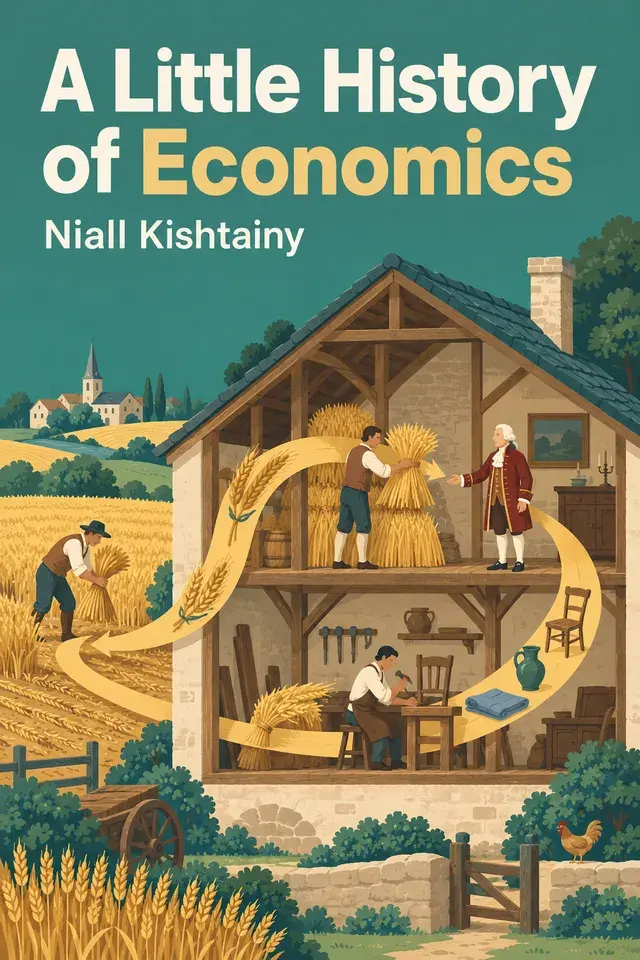
Physiocracy offered a different model. Quesnay argued that France’s heavy burdens on peasants and privileges for urban producers damaged agriculture. He treated farming as the sole source of a genuine surplus, or net product. In his circular flow, farmers generated the surplus, landowners received it as rent and spent it on goods from craftsmen, and craftsmen bought food from farmers. A larger surplus expanded these flows; a smaller one contracted them. Quesnay’s model was an important move toward representing the economy through mechanisms and relationships rather than mainly through theology or custom. Its central error was restricting new value to agriculture just before manufacturing began transforming production. Quesnay also criticized economic privileges while retaining assumptions about hierarchy and absolute monarchy. Economics thus begins with choices under scarcity, but its theories of wealth always carry moral and political assumptions.
Chapter 2 of 16 · 7 min · Audio & textIn the app
Specialization, Trade, and Competing Interests
Adam Smith starts with a puzzle: how can people coordinate their work when no one assigns every task? His baker offers an answer.
Chapter 3 of 16 · 7 min · Audio & textIn the app
Poverty, Population, and Class Conflict
Industrial capitalism made the gains of markets impossible to judge only by cheaper goods or expanding production. The Industrial Revolution made some people rich, while many others endured deep poverty, crowded cities, child labour, disease, and harsh workhouses.
Chapter 4 of 16 · 8 min · Audio & textIn the app
Prices, Efficiency, and Social Costs
Prices can coordinate an economy, but only under conditions that are easy to miss. The key analytical move is to ask what the next unit or the next bit of spending adds.
Chapter 5 of 16 · 6 min · Audio & textIn the app
Market Power and Creative Destruction
Competition is not limited to tiny firms selling identical goods. Perfect competition assumes many small sellers and an indistinguishable product; monopoly assumes one seller.
Chapter 6 of 16 · 6 min · Audio & textIn the app
Planning, Freedom, and Government Incentives
Choosing between markets and government begins with a practical question: how can a large society coordinate countless decisions when no one sees the whole picture? A Soviet factory offered a revealing scene.
Chapter 7 of 16 · 6 min · Audio & textIn the app
Why Economies Run Below Capacity
The Great Depression exposed a gap between an economy’s productive power and its actual employment. America had built factories and infrastructure capable of producing abundance, yet millions of workers were unemployed and poverty spread.
Chapter 8 of 16 · 9 min · Audio & textIn the app
Development Without a Universal Formula
After political independence, the development question was not simply how to trade more. It was how a poor country could move labour, capital, and knowledge into activities that raised productivity.
Chapter 9 of 16 · 8 min · Audio & textIn the app
Strategic Choices and Designed Markets
Game theory begins where a decision cannot be judged in isolation. If one country buys missiles, the other’s security calculation changes; if a firm cuts its price, its rival must respond.
Chapter 10 of 16 · 8 min · Audio & textIn the app
Inflation, Expectations, and Credible Promises
The postwar Keynesian framework made stabilization look like a trade-off. Through the Phillips curve, policymakers imagined that more spending could reduce unemployment while accepting somewhat higher inflation.
Chapter 11 of 16 · 8 min · Audio & textIn the app
Information Gaps and Financial Panics
One influential claim says that competitive markets use available information so quickly that predictable opportunities disappear. The problem begins when people act rationally while holding different information.
Chapter 12 of 16 · 7 min · Audio & textIn the app
Capabilities, Care, and Economic Visibility
An economy can produce more goods and still leave people unable to live safely, participate fully, or avoid preventable suffering. Amartya Sen therefore changes the central question.
Chapter 13 of 16 · 6 min · Audio & textIn the app
Choice Beyond the Rational Individual
Earlier economic theories often modeled the decision-maker as someone with stable preferences who weighs costs and benefits. Gary Becker extended this method far beyond ordinary markets, treating economics as a portable tool for understanding crime, discrimination, household life, and education.
Chapter 14 of 16 · 6 min · Audio & textIn the app
How Stability Breeds Financial Fragility
The financial crisis exposed a danger hidden inside apparent stability. Economists had celebrated the Great Moderation of steady growth and low inflation.
Chapter 15 of 16 · 6 min · Audio & textIn the app
Why Income and Wealth Concentrate
Imagine an income parade in which each person’s height matches their income relative to the average. People with negative incomes would move underground.
Chapter 16 of 16 · 5 min · Audio & textIn the app
Climate Policy and Economic Judgment
Economics is most useful when it makes a difficult problem precise without pretending that precision settles every political question. Climate change is a revealing test.
Chapter 1 of 16 · 7 min · Audio & text: Scarcity, Morality, and National Wealth
Wiseley supports reading and listening to summaries in the app.
Continue in WiseleyWhat A Little History of Economics is about
How do societies create wealth, and who benefits from it? Niall Kishtainy traces competing economic ideas through industrialization, poverty, government policy, and financial crises. This summary explains their mechanisms and limits, helping listeners distinguish market efficiency from fairness and assess arguments about prosperity and public choices.
About Niall Kishtainy

Niall Kishtainy is the author of “A Little History of Economics”. The book explores how societies create wealth and who benefits from it, traced through competing economic ideas.
Explore more books by Niall Kishtainy