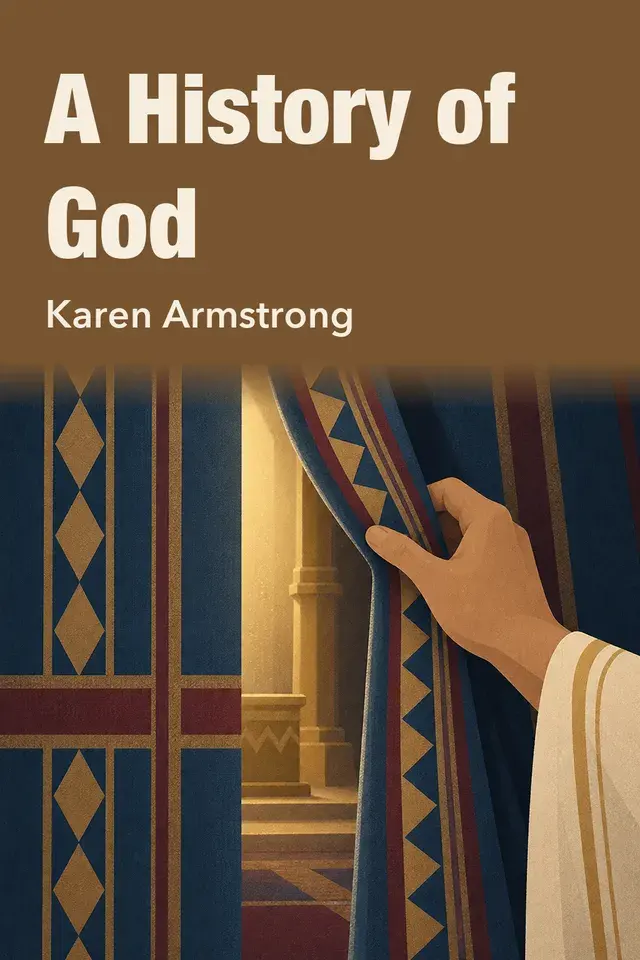
What you'll learn
Key ideas from A History of God
These ideas compress the book's argument without treating the author's view as settled fact. Use them as an orientation before reading the full work or listening in Wiseley.
Armstrong separates ineffable divine reality from the historically changing representations through which communities interpret transcendence.
Exile and Temple loss made divine presence portable through prophetic hope, Priestly order, Torah interpretation, and communal practice.
Meccan wealth and tribal fragmentation made revelation a program of surrender, gratitude, and social responsibility.
Mystical traditions train attention through disciplined practice, supervision, and culturally shaped symbols rather than treating visions as automatic evidence.
An objectively demonstrable God became vulnerable when natural explanations displaced the functions assigned to divine agency.
Feuerbach, Marx, Darwin, Freud, and Nietzsche offer distinct critiques of projection, social power, creation, psyche, and inherited value.
Colonial domination made Muslim reform a struggle over power, institutions, science, and the historical credibility of God.
Armstrong judges religious meaning by whether its symbols and practices foster compassion rather than absolutize human projects.
Inside A History of God
Read the first chapter in full here. The other 13 continue in the Wiseley app.
Chapter 1 of 14 · 9 min · Audio & text
How Sacred Worlds Become History
A History of God, by Karen Armstrong.
Armstrong begins with a distinction that governs the history: divine reality is not identical with the changing human representations made of it. Her subject is what Jews, Christians, and Muslims have meant by God, not an ineffable reality beyond time and change. A God-concept takes shape within a language, a community, and a particular period. It may conflict with earlier meanings, then be revised or abandoned when it no longer helps people interpret their lives. This does not make symbols meaningless. Myth, ritual, revelation, and theology are ways of relating human life to transcendence without possessing it. Religious history is not a straight advance toward one final definition, but a changing record of representations, practices, and historical allegiances.
Armstrong describes traditional societies as experiencing sacred power as awe, dread, calm, presence, or impersonal force. Myths, carvings, and images connected that mystery with ordinary life; they were not necessarily literal explanations of nature. Ritual made the connection practical. Cities and temples copied divine patterns, and reenacting them let people participate in the power believed to sustain the world. Sacred time returned participants to a primordial order so it could be renewed. Religion was therefore not only a set of ideas, but a way of entering a meaningful world.
The Babylonian New Year festival shows this logic. During its eleven sacred days, the king was enthroned, but stability was thought durable only insofar as it participated in the gods’ government over primordial chaos. A scapegoat cancelled the old year, a carnival king represented chaos, and a mock battle reenacted the divine victory over destruction. These rites returned the community to sacred time and renewed order. The Enuma Elish was recited as a symbolic account of creation, not a witnessed report. Earlier divine emanations differentiate the sky, rivers, and earth. Marduk later defeats Tiamat and divides her corpse to form the arch of the sky and the world of humans. Creation means ordering eternal sacred raw material, not making everything from nothing. Humanity, formed from divine blood mixed with dust, shares a limited portion of divine nature. Ritual therefore lets fragile human creativity participate in the power that holds chaos at bay.
Israelite religion emerged from such worlds, but its surviving accounts shift attention from primordial cosmic struggle toward ordinary historical time. Abraham has no contemporary record, and the people later called Israel seem to have been a confederation, not a single homogeneous population. The Pentateuch was assembled from older traditions centuries after the narrated events; divergent creation, flood, and divine-name accounts remain. In source-critical labels, J presents continuity between the patriarchal God and Yahweh, while P says Yahweh’s name was newly disclosed to Moses and identifies Abraham’s deity as El Shaddai. The point is not to settle source criticism, but to avoid projecting later monotheism backward into the patriarchal period.
Abraham carries the example of changing divine encounter. In J, Yahweh’s first decisive revelation is not a cosmogony but an imperative: leave Haran for Canaan, become a nation, and trust the promise. Abraham’s faith means reliance on a divine pledge, not correct theology. Yet his deity may have been the Canaanite High God El, suggested by titles such as El Shaddai and El Elyon. El appears as approachable and capable of human form. In the Mamre story, Abraham welcomes three strangers and naturally discovers that one is Yahweh and two are angels. E removes this direct anthropomorphism by making God speak through an angel. The accounts preserve a changing encounter: the divine can be an intimate guest within an inherited sacred world, or a more distant presence mediated through revelation and historical demand.
Exodus pushes this change further. At the burning bush, Yahweh identifies with the God of Abraham, Isaac, and Jacob, yet demands holy distance and refuses a straightforward disclosure of his name. Armstrong reads “I Am Who I Am” as deliberate vagueness, not the later philosophical idea of self-subsistent Being. Yahweh offers no fixed nature or predictable guarantee; he promises participation in Israel’s history. The Exodus story uses plagues, the death of Egyptian firstborns, the parting of the sea, and the drowning of Pharaoh’s army to liberate Israel. Armstrong treats it not mainly as realistic history; it may preserve memory of a revolt by oppressed peasants against Egyptian domination. Read literally, however, this God is brutal, partisan, murderous, and tribal. The narrative can offer hope to the oppressed while also supplying images of vengeance, election, tribalism, and fundamentalism. At Sinai, purification, prohibition, thunder, fire, smoke, and restricted access dramatize divine remoteness. The covenant demands exclusive loyalty in exchange for protection. This is exclusive worship, not necessarily denial that other gods exist; Israel’s attraction to Baal, Asherah, and Anat shows the older religious world remained present. Historical allegiance means choosing the god through whom a people understands its past and faces its future.
Other Axial traditions connect transcendence to different forms of transformation. An Upanishadic parable dissolves salt in water: the salt can no longer be seen, yet remains present throughout the water and can be tasted. Being is likewise imperceptible but present throughout the universe and as Atman, the Self within each person. Brahman is not an external deity added to the world, nor simply the world as an object, but the hidden power sustaining it. Yoga discloses this dimension through disciplined inward transformation rather than public historical command. Buddhism takes another route. The Buddha did not deny the gods, but placed liberation beyond their assistance. Nirvana cannot be captured by speculation; its practical test is the Dharma, a life of compassion, careful speech, right conduct, and release from craving. Transcendence is verified through transformation, not by proving a supernatural being.
Greek philosophy recast older mythic patterns as contemplation. Plato described eternal Forms, with the Good highest, and imagined education as movement from shadows toward intellectual light. The archetypal pattern became an inward ascent in which desire and reason could be transformed into contemplation. Aristotle placed ultimate reality in the Unmoved Mover, pure thought contemplating itself and drawing beings through attraction rather than guiding history. Their approaches were intellectually powerful but socially limited. Across these traditions, transcendence could be encountered as inward realization, ethical practice, or contemplation; Israel’s distinctive allegiance centered on a God encountered in commands and events.
Chapter 2 of 14 · 11 min · Audio & textIn the app
Catastrophe Creates a Universal God
Israel’s movement toward a universal God did not begin with an abstract proof. It grew through political defeat and the prophets’ insistence that catastrophe exposed moral failure.
Chapter 3 of 14 · 9 min · Audio & textIn the app
From Jewish Messiah to Christian God
Christian belief in Jesus’ divinity did not begin as a finished doctrine. It emerged as a Jewish messianic movement expanded into the Gentile world, while devotion, rival interpretations, and institutions changed the meaning of divine mediation.
Chapter 4 of 14 · 10 min · Audio & textIn the app
Trinity and the Limits of Language
Creation ex nihilo made Christ’s status decisive. It means that God called the universe from absolute nothing, rather than through emanation, the idea that the world flows from divine fullness.
Chapter 5 of 14 · 8 min · Audio & textIn the app
Divine Unity Becomes Social Order
Armstrong locates Islam’s emergence in a Mecca that had become wealthy but unstable. Within two generations, Quraysh merchants moved from nomadic insecurity to commercial prosperity.
Chapter 6 of 14 · 9 min · Audio & textIn the app
Reason Searches for Ultimate Reality
Greek science and philosophy entered Abbasid culture through translation, changing more than what scholars knew. They introduced a mentality that sought universal laws behind nature and human life.
Chapter 7 of 14 · 9 min · Audio & textIn the app
Practicing What Concepts Cannot Capture
Concepts can name God, but they cannot by themselves transform the person who uses them. Armstrong presents mysticism as a disciplined response to that limit.
Chapter 8 of 14 · 9 min · Audio & textIn the app
Imagination Makes Suffering Meaningful
Mystical experience can transform attention, but it does not by itself explain how people live with grief, exile, and moral responsibility. This chapter turns to imagination: the power to give invisible realities a humanly graspable form.
Chapter 9 of 14 · 10 min · Audio & textIn the app
Reform Between Trust and Fear
Armstrong treats the Reformation as a cluster of responses to insecurity, institutional strain, and a growing demand for direct religious life. It was not simply a revolt against corrupt clergy, nor a single, deliberate Protestant program.
Chapter 10 of 14 · 8 min · Audio & textIn the app
When God Becomes an Explanation
Armstrong opens with a transformation broader than a dispute between scientists and churches. From the late sixteenth century, technicalisation joined industrial and agricultural change, capital accumulation, specialised knowledge, new political arrangements, and empirical investigation.
Chapter 11 of 14 · 9 min · Audio & textIn the app
Renewal and the Risks of Certainty
While Enlightenment rationalism challenged traditional proofs, religion did not simply disappear. Some reformers developed a parallel inward revival, seeking a divine presence ordinary people could encounter directly.
Chapter 12 of 14 · 8 min · Audio & textIn the app
What Dies When God Dies
By the beginning of the nineteenth century, atheism had become an explicit intellectual possibility. Scientific and technological advances encouraged people to imagine themselves as autonomous, less dependent on God.
Chapter 13 of 14 · 9 min · Audio & textIn the app
Faith Under Domination and Catastrophe
Modern religious crisis was not only a crisis of scientific explanation. For Muslims under European domination, it was also a crisis of power and history.
Chapter 14 of 14 · 7 min · Audio & textIn the app
The Future of Religious Meaning
Armstrong brings the history to a world threatened by nuclear weapons, ecological disaster, famine, and drought. These crises make the future hard to imagine and raise the question of whether God can survive.
Chapter 1 of 14 · 9 min · Audio & text: How Sacred Worlds Become History
Wiseley supports reading and listening to summaries in the app.
Continue in WiseleyAbout Karen Armstrong
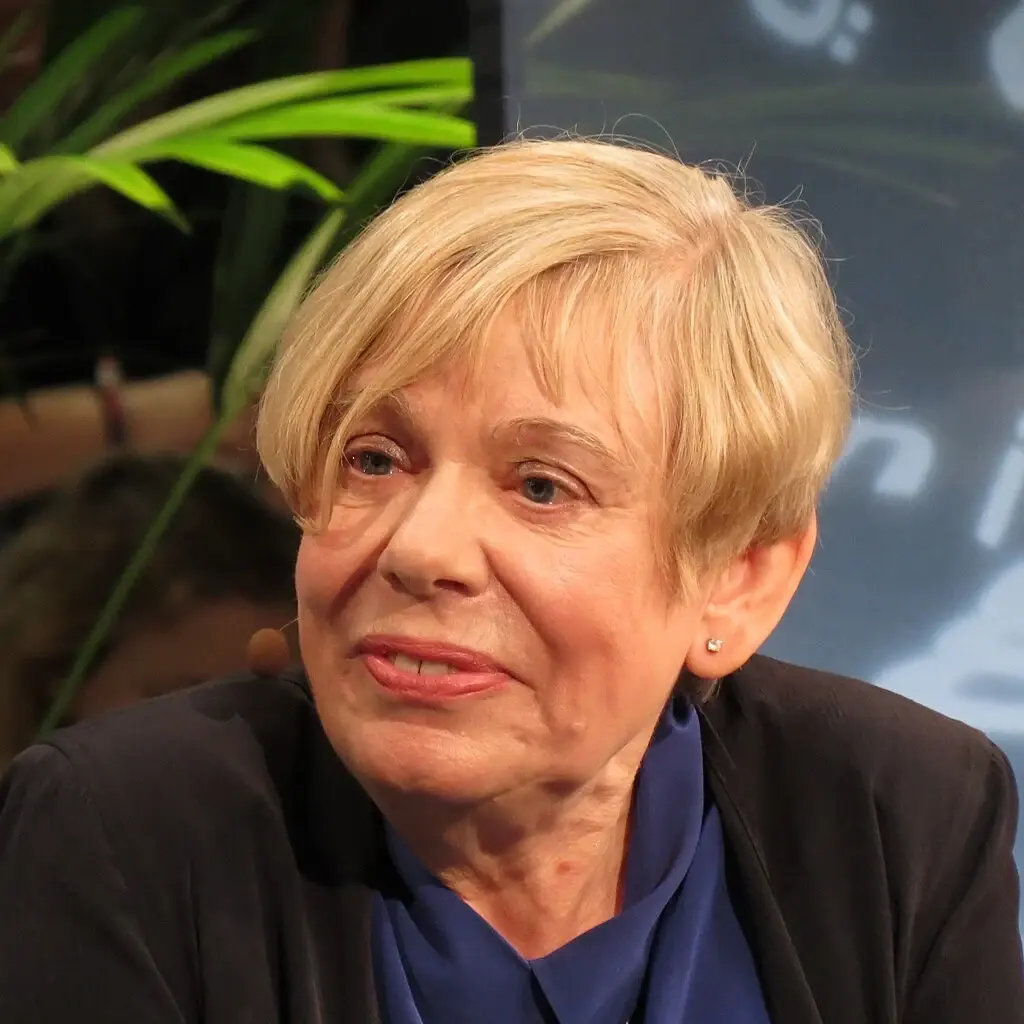
Karen Armstrong is a British author and scholar of comparative religion. “A History of God” explores how Jews, Christians, and Muslims have imagined God and why those ideas changed.
Explore more books by Karen Armstrong