What you'll learn
Key ideas from 168 Hours
These ideas compress the book's argument without treating the author's view as settled fact. Use them as an orientation before reading the full work or listening in Wiseley.
A detailed log records concrete activities across 168 consecutive hours and groups them into broad categories for comparison.
A generous List of 100 Dreams surfaces possibilities; inexpensive trials help distinguish lasting interest from imagined appeal.
Career time gains direction when meaningful outcomes, rather than hours or visible activity, determine what counts as progress.
Annual outcomes become schedulable through monthly and weekly actions, realistic duration estimates, and room for disruption.
Shared reading and small routines create ordinary opportunities for family connection.
A household chore audit weighs time, dislike, cash cost, and the valued activity those hours displace.
Weekend plans can protect chosen activities while leaving room for reading, quiet, and spontaneity.
Protected priority blocks work best when the surrounding schedule can change with work, family, energy, and habits.
Inside 168 Hours
Read the first chapter in full here. The other 10 continue in the Wiseley app.
Chapter 1 of 11 · 9 min · Audio & text
A Week, Not a Day
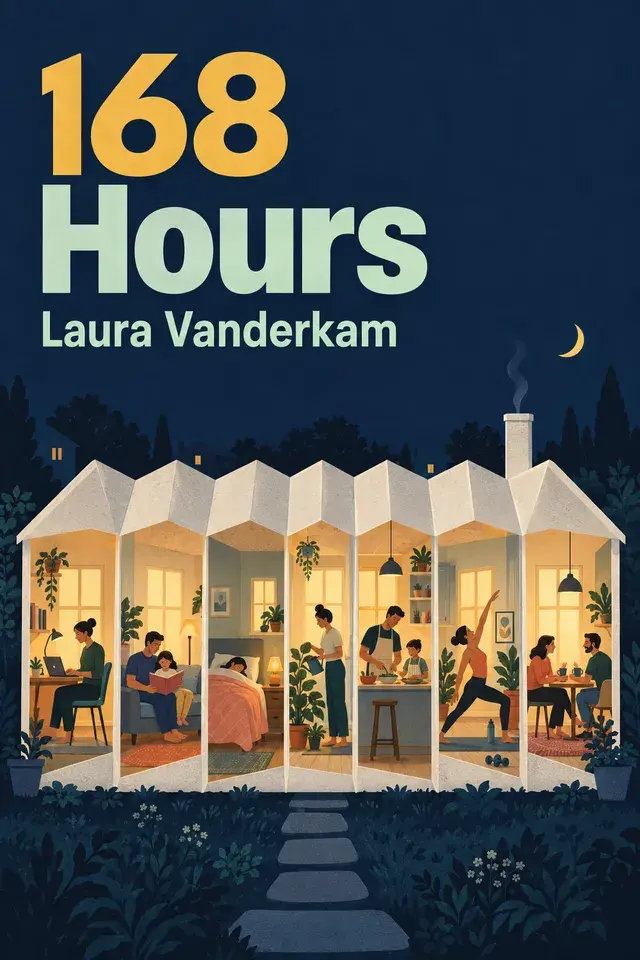
168 Hours, by Laura Vanderkam.
A single day can make life look more crowded than it is. One Tuesday may be swallowed by work, errands, or a difficult commute, while the activities that matter happen on other days. Laura Vanderkam proposes looking at a full week: 168 hours, the same fixed span everyone gets. Across that stretch, recurring commitments and less frequent activities can be seen together. A weekly view offers a clearer picture than judging a whole life by its busiest day.
The number is simple, but the shift in perspective matters. People often describe time in broad impressions: work fills the week, there is never enough time to sleep, or household tasks take over. Those feelings are real, but they are not precise records. The author argues that impressions can make demands seem larger and available time smaller than they are. Writing down what actually happens gives a person something more useful to examine than a general sense of being busy.
Work is particularly easy to overestimate. Long days and late nights stand out in memory, while early departures, breaks, appointments, and shorter days are easier to forget. Brief checks of email or messages can also feel like constant work, even when their total time is small. In studies Vanderkam cites, people who described themselves as working very long weeks often logged fewer hours than they estimated. When estimates for work, housework, caregiving, and exercise are added together, reported totals can even exceed 168 hours. That cannot be a literal account of one week; it shows how separately remembered demands can swell in the telling.
Household work can be misjudged for a similar reason. Routine chores and administration may feel as though they occupy the day, especially when they are unpleasant or repetitive. The author cites comparisons in which people estimated substantially more time on housework than they recorded in diaries. That does not mean the chores are imaginary or unimportant. It means that the feeling of a task taking over and the number of hours it occupies are different kinds of evidence.
Estimates may also shrink time spent sleeping or at leisure. In one comparison Vanderkam discusses, working mothers reported about six hours of sleep on weekdays, while time diaries put the weekly average near eight hours per night. The measurements came from different methods, so the contrast is not an exact measure of every person’s sleep. It does illustrate how little sleep people may think they get. Leisure estimates can be similarly puzzling: a frequently cited figure of 16.5 hours a week sits awkwardly beside reports of more than 16.5 hours of television. Some measures count when a television is on; diaries may count it only when watching is the main activity. The mismatch suggests that quick estimates and formal records may be counting different things.
Time-use diaries are more demanding than asking someone to guess. They ask people to record or reconstruct specific activities over a day or week, then sort the entries into categories so patterns can be compared. Vanderkam presents this detailed approach as more reliable than broad retrospective estimates, but not as perfect. Categories can be debatable: a call, commute, or email check might be counted differently by different people. Overlapping activities are difficult to divide neatly, and a logged week may be unusual. The figures cited in the book also come from studies with different definitions and populations, so they should not be treated as a universal description of every household.
For a personal record, the author’s central procedure is to follow 168 consecutive hours as completely as possible. Use a notebook, spreadsheet, or worksheet, and enter activities regularly rather than trusting memory at the end of the week. She suggests recording frequently, even at intervals as short as six minutes. The point is to catch ordinary details as well as memorable events: getting ready, looking for misplaced things, checking messages, attending meetings, taking breaks, commuting, exercising, caring for family, and watching television. A log becomes more useful when it names the activity instead of hiding many different tasks under a broad label such as work or home.
After recording, group the entries into broad categories such as sleep, paid work, personal care, household tasks, care, leisure, communication, and civic activity. The categories help show how much of the week each area occupies. Some choices will remain uncertain, and a record does not have to add up to exactly 168 hours to be informative. If the week seems far from ordinary, Vanderkam allows for keeping another record. Yet perfectly typical weeks are hard to find; disruptions and variation are part of real life. The aim is a candid picture, not a flawless accounting system.
Theresa Daytner’s week shows why the whole span can change the picture. She ran a growing construction business with a twelve-person payroll while raising six children, including twins. Her responsibilities brought pressure, and she sometimes worked nights and weekends. She also slept at least seven hours, supported and coached her children in sports, helped plan her daughter’s wedding, and made room for recreation and relaxation. Between school drop-offs, a ten-minute gap could become time to read with her sons. The example presents someone treating time as precious and arranging many commitments across the week.
That account is not evidence that the same arrangement is easy or available to everyone. Daytner’s business growth was mentally draining, and she had mortgaged her home to fund childcare when she started the company. Her experience illustrates one person’s way of allocating time under particular conditions, not a standard against which other lives should be judged. Vanderkam also recognizes that her own circumstances are unusually privileged. The suggestion that people may have more time than they think applies most clearly where there is relative material and civic abundance; it is not a claim that everyone has equal control over their hours, or a reason to feel guilty about constraints.
The author’s own ordinary good Tuesday offers a quieter contrast. Much of the day went to writing, alongside breakfast and a stroller walk with her young son, exercise while reading, an afternoon outing, volunteer leadership, and conversation with her husband. She calls it good because a large share of the day served things she cared about, not because it was spectacular or free of demands. One day does not reveal every recurring commitment, but it can show how a week’s activities become a lived experience.
The two examples differ sharply in scale and circumstance. Together, they point to the value of counting the whole week before deciding what it means. A log cannot remove obligations or guarantee room for every desired activity. It can show which hours are spoken for, which estimates were off, and where the account is still unclear. That factual view is the first step toward considering whether the week could be shaped to include more of what matters.
Chapter 2 of 11 · 7 min · Audio & textIn the app
Discover What Deserves Your Hours
A time record is most useful when it is set beside the life someone wants. The point is not only to see how many hours fall under work or leisure, but to ask whether the week reflects what matters.
Chapter 3 of 11 · 8 min · Audio & textIn the app
Find Work That Fits
After getting clearer about the activities that matter and the abilities a person values, the next question is how paid work fits that picture. Work takes up many waking hours, so its substance and conditions can shape satisfaction across the week.
Chapter 4 of 11 · 9 min · Audio & textIn the app
Shape the Work You Have
Once you have a sense of what kinds of work suit you, the next question is whether the role you have can be reshaped. A job description is someone else’s original arrangement of tasks.
Chapter 5 of 11 · 10 min · Audio & textIn the app
Turn Hours into Results
A full calendar can create the impression of a productive career, but hours alone do not show whether important work is getting done. Laura Vanderkam argues that work time serves a career best when it advances meaningful professional outcomes.
Chapter 6 of 11 · 10 min · Audio & textIn the app
Build Skill and Opportunity
Planning work around meaningful results is one part of a career. Advancement also depends on the ability you are building, how others recognize its value, and whether you are ready when an opening appears.
Chapter 7 of 11 · 9 min · Audio & textIn the app
How Family Time Changed
Family life is often described as a contest between work and children. The history Vanderkam presents complicates that picture.
Chapter 8 of 11 · 9 min · Audio & textIn the app
Protect Attention at Home
Family time has to be planned with other people’s hours in view. A parent’s work schedule, a child’s school or care, and a partner’s obligations all shape when a family can be together.
Chapter 9 of 11 · 10 min · Audio & textIn the app
Reclaim Hours from Housework
Housework can look like one unavoidable block, but it is made up of separate tasks that take time, may cost money to delegate, and can crowd out other valued activities. Vanderkam asks readers to weigh all three costs: the hours spent, the dislike or satisfaction the task brings, and the value of what those hours could otherwise hold.
Chapter 10 of 11 · 10 min · Audio & textIn the app
Make Leisure Deliberate
Weekends show why leisure needs its own kind of planning. With weekday routines loosened, open hours can fill with errands, children’s activities, scattered work, and television.
Chapter 11 of 11 · 10 min · Audio & textIn the app
Redesign and Revisit the Week
A time makeover is not a search for a perfect schedule that will finally solve everything. It is a repeatable comparison: the life you want on one side, the week you can actually shape on the other.
Chapter 1 of 11 · 9 min · Audio & text: A Week, Not a Day
Wiseley supports reading and listening to summaries in the app.
Continue in WiseleyWhat 168 Hours is about
How can a finite 168-hour week hold satisfying work, family, health, relationships and leisure? Laura Vanderkam argues that a candid weekly time log and clearer priorities expose choices obscured by perceived time scarcity. The book offers ways to shape work, protect family and personal time, and trade household effort against money, while recognizing unequal constraints and the need for rest.
About Laura Vanderkam

Laura Vanderkam is an American author. “168 Hours” explores how a finite 168-hour week can hold satisfying work, family, health, and leisure.
Explore more books by Laura Vanderkam