What you'll learn
Key ideas from 100 Ways to Change Your Life
These ideas compress the book's argument without treating the author's view as settled fact. Use them as an orientation before reading the full work or listening in Wiseley.
The chapter establishes wellness as a tool for a meaningful life, judged by whether it reduces avoidable suffering rather than by universal rules.
WOOP combines a desired outcome with an honest internal obstacle and a concrete plan, because positive visualization alone can reduce effort.
Defaults, three priorities, energy mapping, and feasible time limits protect attention from routine depletion.
Self-trust grows from small promises kept consistently, not from oversized goals that repeatedly fail.
Friendship formation depends on chosen qualities, direct initiation, recurring contact, playful participation, and willingness to resize mismatched relationships.
Plant diversity supplies varied fibers for different microbes, while thirty weekly plants functions as a practical target rather than a guaranteed threshold.
Anxiety is approached through intentional inputs, unfinished tasks, proportionate action, and flexible meditation rather than one universal cure.
Mortality reflection clarifies which values and relationships deserve action before urgency makes the choice for us.
Inside 100 Ways to Change Your Life
Read the first chapter in full here. The other 13 continue in the Wiseley app.
Chapter 1 of 14 · 7 min · Audio & text
Make Change Serve Your Life
100 Ways to Change Your Life, by Liz Moody.
Before this book asks you to change anything, it asks what change is for. Moody’s organizing idea is that wellness should serve a life you find meaningful. It should help you handle hard periods, pursue goals, nourish your body, and stay connected. It is not a permanent state to perform. When a practice makes life smaller—when menu anxiety keeps you from social meals, exercise becomes a ritual of self-insult, or rigid routines create stress—it has stopped serving its purpose. The test is not whether a practice is effortless. Some effort is worthwhile, and some discomfort can lead to feeling better. The test is whether it reduces avoidable suffering overall. Persistent dread, harsh self-talk, unnecessary restriction, and isolation are signals to reconsider the method.
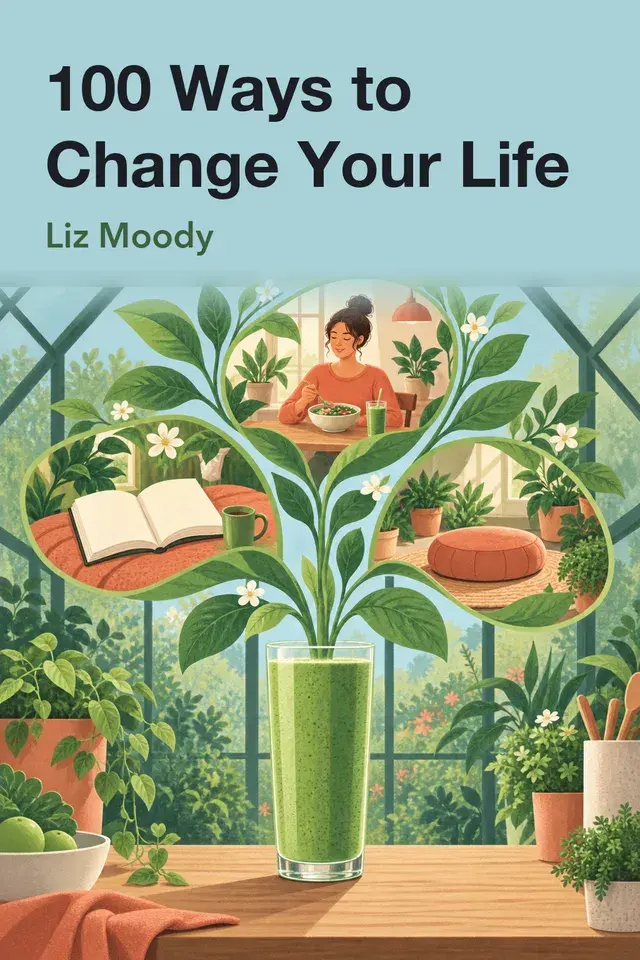
Moody’s own recovery provides the opening illustration, without serving as a universal prescription. During a period when anxiety had narrowed her life, she chose a daily green smoothie because it offered nourishment and structure without requiring her to leave home. It did not instantly heal her. Repeating it made getting out of bed more possible. Then she added eating at the kitchen table, five minutes of meditation, reading, and short walks. The sequence mattered: one manageable action created enough capacity for the next. She presents this progression from being largely housebound toward greater mobility, work, relationships, and travel as her route, not proof that smoothies, meditation, or walking treat everyone in the same way. The lesson is incremental recovery shaped around an actual need.
That distinction explains the book’s design. People want universal wellness rules, but interventions vary in usefulness. A practice may help many people, a smaller group, or an individual under particular conditions. Research can point toward credible options, while personal biology, priorities, resources, access, and relationships affect whether an option fits. So the chapters are arranged around outcomes rather than a single ideal diet, workout, or lifestyle. A reader can enter through the need that matters now, return later, or browse for an idea that feels relevant. For readers who want a sequence, Moody suggests trying no more than three tips per week. The slower pace reduces overwhelm and makes it easier to tell what is helping.
The framework is an N-of-1 experiment: the participant is one person. First define the outcome before making a change. “Feel healthier” is too vague to evaluate; a useful outcome might be fewer anxiety symptoms, steadier energy, better sleep, or lower blood pressure. Next record a baseline—the pattern before the intervention—using whatever is practical. A symptom diary may be enough. A wearable, blood-pressure monitor, or home test is optional, not a requirement. Then change one variable at a time, such as adding one practice or one supplement, so the result is interpretable. Observe what happens during the trial and compare it with the baseline. Did the chosen outcome move in the hoped-for direction? Did the change create costs, new symptoms, dread, or social restriction? Does the benefit seem large and consistent enough to keep? A positive result is personal evidence, not a general law. A result that fails to change the outcome tells you the practice did not help under those conditions; it does not prove that nobody could benefit. The point is disciplined curiosity: test, notice, and adjust instead of obeying advice blindly.
The anecdote about teas made from wild greens sourced from Ikaria shows both the value and the limit of this method. Sara Gottfried describes adding the teas and changing nothing else, then observing a modest five-to-ten-point reduction in her blood pressure. That observation can justify asking whether the change helped her. It cannot establish that teas made from wild greens lower blood pressure for everyone. A single person’s measurement can reflect ordinary variation or explanations that were not isolated. The story therefore illustrates a personal signal, not general proof.
The Blue Zone example supplies the population-level caution. Research may observe long life alongside a region’s food, community, soil, genes, and microbiome. When those factors travel together, it is hard to identify which one caused the outcome, or whether the combination mattered. The association may suggest options worth testing, but it cannot be lifted intact into every person’s life. Population evidence and individual experiments answer different questions: one asks what tends to occur across groups; the other asks what changes for me under my circumstances.
This approach keeps the book from becoming another demand for perfect compliance. A practice earns its place when it supports the person’s values and observable aims. If it produces some beneficial effort but also persistent dread, restriction, or disconnection, its total effect deserves review. Readers can modify the activity, replace it with a route to a similar benefit, or let it go. The book’s abundance becomes useful only when selection is allowed.
That is this chapter’s contribution to everything that follows. It supplies a way to choose among the book’s ideas and a way to learn from trying them. The goal is not to complete a wellness checklist. It is to make changes that expand a meaningful life while reducing suffering that need not be there.
Chapter 2 of 14 · 8 min · Audio & textIn the app
Turn Values Into Repeatable Actions
An intention is more likely to last when it matters to the person carrying it and offers a benefit that can be felt soon. The useful question is not only how will I perform this habit, but why is it worth doing for me?
Chapter 3 of 14 · 8 min · Audio & textIn the app
Work With Your Body's Rhythms
Behavior change happens in a body that wakes, tires, digests, and responds to light, movement, and reward. This chapter argues that energy-supporting routines last more easily when they respect biological timing and attach movement to existing cues.
Chapter 4 of 14 · 9 min · Audio & textIn the app
Protect Attention and Create Momentum
Productivity is not the same as busyness. A day can be full of cleaning, email, and small errands while meaningful work remains untouched.
Chapter 5 of 14 · 8 min · Audio & textIn the app
Build Confidence Through Real Attempts
Confidence can seem like something you must possess before you ask for more money, pursue a new role, or share ambitious work. Moody frames it as something built through a personally chosen goal, support from other people, and evidence gathered through attempts.
Chapter 6 of 14 · 8 min · Audio & textIn the app
Practice Self Respect in Daily Life
Self-respect begins in the relationship you have with yourself, not in how impressive your improvements look from the outside. The chapter makes self-love credible through self-trust: if you repeatedly promise to wake early, meditate, write, or nourish your body and then do not, later affirmations can feel empty.
Chapter 7 of 14 · 10 min · Audio & textIn the app
Cultivate Joy and Lasting Friendship
Joy, in Moody’s account, is not a prize that arrives once life is organized. It is an attention practice.
Chapter 8 of 14 · 8 min · Audio & textIn the app
Make Partnership a Shared Practice
Romantic scripts often promise that love begins with a consuming spark and leads to a fairy-tale ending. The book questions both assumptions.
Chapter 9 of 14 · 10 min · Audio & textIn the app
Feed Diversity Rather Than Restriction
Moody’s nutrition argument begins with addition: build meals around what can nourish the body instead of making health a list of forbidden foods. The metabolic checklist asks us to maximize micronutrients and antioxidants, fiber, omega-three fats, and probiotics, while minimizing refined grains and sugars.
Chapter 10 of 14 · 9 min · Audio & textIn the app
Improve Health Through Overlooked Basics
The earlier nutrition discussion emphasizes adding variety rather than relying on restriction. This chapter asks a related question: how much nourishment does each bite provide?
Chapter 11 of 14 · 9 min · Audio & textIn the app
Reduce Anxiety Through Multiple Routes
Anxiety is not a single problem with one lever. The book distinguishes acute, intermittent stress from prolonged stress.
Chapter 12 of 14 · 8 min · Audio & textIn the app
Restore Capacity and Make Clearer Decisions
Restoration in this chapter is a condition for judgment, not merely a reward after productivity. When work and home share a space, emails, unresolved problems, and lingering stress can keep the workday active.
Chapter 13 of 14 · 8 min · Audio & textIn the app
Build Resilience Without Denying Difficulty
Resilience, in Moody’s account, does not mean turning suffering into a success story or pretending difficulty is enjoyable. It means meeting real problems with enough foundation, perspective, and support to respond honestly.
Chapter 14 of 14 · 7 min · Audio & textIn the app
Choose a Life With Fewer Regrets
Most days, the question is how to improve a routine. This chapter asks a larger question: what deserves a finite life?
Chapter 1 of 14 · 7 min · Audio & text: Make Change Serve Your Life
Wiseley supports reading and listening to summaries in the app.
Continue in WiseleyWhat 100 Ways to Change Your Life is about
How can small changes make daily life healthier, calmer, and more meaningful? Liz Moody connects habits, physical health, emotional resilience, work, and relationships through practical experiments. The summary explains how to choose changes that fit your circumstances, turn intentions into routines, and assess whether those routines actually improve your life.
About Liz Moody

Liz Moody is the author of “100 Ways to Change Your Life”. The book explores how small changes can make daily life healthier, calmer, and more meaningful.
Explore more books by Liz Moody