What you'll learn
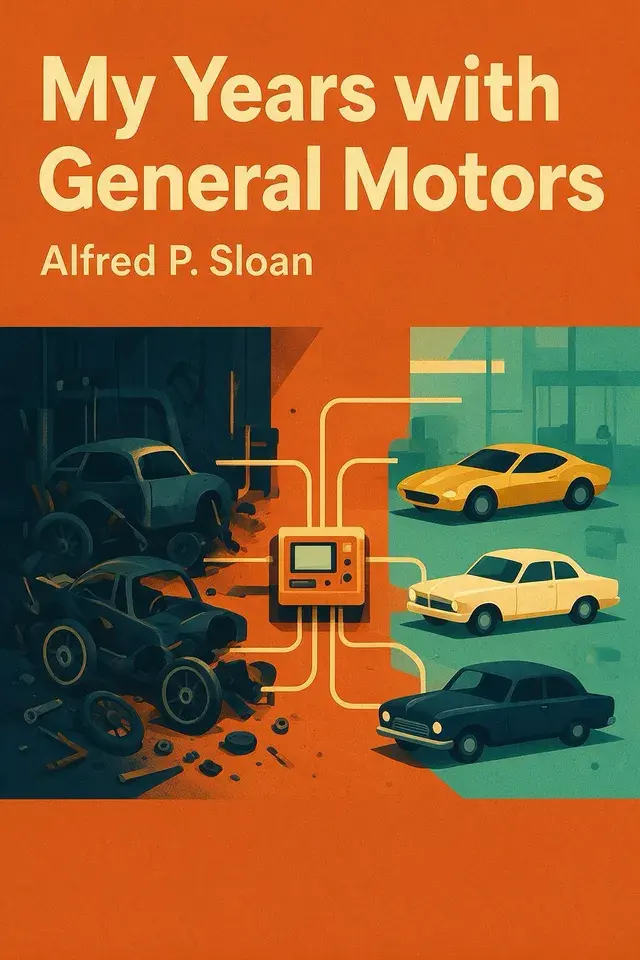
Key ideas from My Years with General Motors
These ideas compress the book's argument without treating the author's view as settled fact. Use them as an orientation before reading the full work or listening in Wiseley.
GM’s organization paired divisional responsibility with central policy, financial judgment, and shared information.
Return on investment and standard volume gave headquarters comparable measures without turning financial analysis into an automatic substitute for judgment.
War, reconversion, postwar shortages, and later recessions tested the system’s ability to adapt without abandoning investment.
Research became useful through failed experiments, prototypes, standards, tooling, pilot production, and feedback.
Harley Earl’s clay-based, integrated designs and the Art and Color Section made styling a coordinated corporate capability.
GM treated local dealers as economically independent partners whose selling, service, trade-ins, and market knowledge made factory output distributable.
Managerial capacity and political uncertainty limited overseas expansion as much as market opportunity did.
Organization supplies criteria, but responsible individuals remain necessary for judgment, succession, and continuing creation.
How My Years with General Motors builds its case
Follow how the book develops its argument. Each note is a brief orientation, not a replacement for the chapter.
The Opportunity and the Crisis
Alfred P. Sloan tells this history from a personal, selective standpoint. He spent decades as a General Motors executive, director, and committee participant, but does not present the book as an official corporate statement. He combines memory with records and associates’ recollections, while acknowledging the limits of any individual’s view. This is his explanation of how an industrial opportunity became a managerial emergency. The opportunity was the automobile itself. Sloan came of age as the American industry…
Two Concepts for One Corporation
After the 1920 crisis, General Motors faced two linked questions: how could a corporation built from many businesses preserve initiative without confusion, and what kind of automobile business was it trying to be? Sloan’s answer joined a management concept to a product concept.
The Cost of Forcing Innovation
General Motors’ new management doctrine met its first serious test when a promising invention collided with production responsibility. The copper-cooled engine placed research engineers, corporate officers, and operating divisions on different sides of one decision.
Controls Meet a Changing Market
After the nineteen twenty crisis, General Motors faced more than a shortage of cash. Divisions could retain operating responsibility only if headquarters could see what they were doing.
Policy, Growth, and Resilience
GM’s management system proved itself in changing conditions. By 1929, the company was no longer the formless aggregation of 1920.
Engineering Progress, Organized
GM’s account of automobile progress begins with a practical correction: a better vehicle is not the product of one isolated invention. Reliability came first.
Styling Becomes Corporate Strategy
Styling became strategic at General Motors when engineering matured and annual model changes made appearance a recurring reason to buy. For the industry’s first decades, engineers largely controlled design, often without equal regard for manufacturing, maintenance, cost, or visual harmony.
Dealers, Credit, and the Market
GM’s factories could produce cars, but production alone did not put them into lasting use. The final link was a network of locally embedded dealers and a credit institution able to finance inventories and customers.
Global Growth Under Constraint
GM's international growth did not follow automatically from domestic success. Sloan presents it as conditional: whether an American car could sell abroad, whether to export or produce near customers, whether to acquire or build, and whether GM had enough managers to oversee the result.
Diversifying Through Technical Bets
General Motors did not diversify according to a master plan. Sloan describes ventures connected broadly with motors and durable goods, but says their motives differed and luck mattered.
War, Conversion, and Capacity
Sloan treats national defense as a permanent responsibility of modern corporations, but not as one continuous business. GM’s experience fell into four largely unrelated periods: limited World War I work, total conversion in World War II, partial mobilization in Korea, and a later period when defense depended more on research than mass production.
Labor, Incentives, and Alignment
By the time Alfred P. Sloan wrote, General Motors had gone more than seventeen years without an extended strike over national issues.
Management as Continuing Creation
At the end of Sloan’s account, the question is what kind of organization can keep working while circumstances change. Sloan calls management a continuing act of creation.